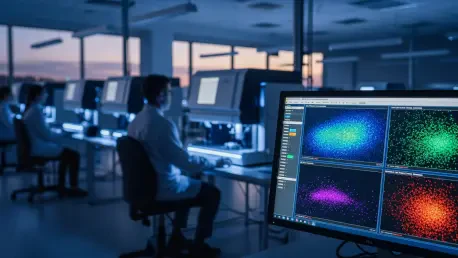

Ivan Kairatov’s journey through the intricate world of biophysics and optical physics has positioned him as a pivotal figure in the evolution of biopharmaceutical research and development. With a rich history spanning academic leadership as a core facility director and deep involvement in high-content screening (HCS) innovation, he possesses a rare perspective on how technology translates into therapeutic discovery. Kairatov’s expertise is not merely theoretical; it is grounded in the practicalities of managing complex biological systems and extracting actionable intelligence from the massive datasets generated by modern microscopy. In an industry increasingly leaning toward automation and digital intelligence, he serves as a bridge between the physical realities of light and lenses and the virtual power of machine learning, helping the scientific community navigate the transition from traditional 2D assays to human-relevant 3D models.
The discussion centers on the foundational role of high-quality imaging data in training robust artificial intelligence models, particularly for the critical task of cellular segmentation. We delve into the physical and computational hurdles of scaling 3D organoid models, the essential nature of high-numerical-aperture optics in resolving biological structures, and the ways in which automation and guided workflows are democratizing advanced screening for researchers at all experience levels. Furthermore, we explore how deep learning and techniques like cell painting allow for the detection of subtle phenotypic shifts, such as changes in mitochondrial morphology or endoplasmic reticulum architecture, that provide an early warning system for drug toxicity and efficacy.
High-quality imaging data is often described as the bedrock of any successful AI-driven workflow, but why is this foundation specifically crucial during the initial stages of cellular segmentation?
The reality of artificial intelligence in the biopharma space is governed by a simple, almost visceral rule: the integrity of your output is a direct reflection of the purity of your input. When we talk about high-content screening, we are essentially asking a machine to see what a human eye might miss, but for that machine to function, it needs a clean, crisp canvas. Segmentation is the absolute starting point of this process, where the AI must delineate the precise boundaries of a cell’s nucleus, its Golgi apparatus, or the outer edges of the plasma membrane. If the initial image is plagued by a poor signal-to-noise ratio or blurry cellular features, the AI begins its journey with a distorted map, leading to cascading errors in every subsequent analysis. By ensuring high-quality, AI-ready data from the outset, we are providing the model with the resolution it needs to distinguish between two closely packed cells rather than seeing them as a single, amorphous blob. This becomes life-or-death in applications like toxicity testing, where we are hunting for minute, subtle phenotypic changes that signal a compound’s potential harm. Without that clarity, the entire downstream biological interpretation is built on a house of cards, whereas high-quality imagery allows the AI to perform at its peak, identifying structures with a level of reliability that matches the rigor of our scientific goals.
As the industry shifts toward more human-relevant models, what are the primary physical and logistical hurdles researchers face when trying to image 3D organoids at a high-throughput scale?
While the transition from flat, 2D monolayers to complex 3D organoids is essential for capturing the nuances of human biology, it introduces a massive spike in technical difficulty that can be quite overwhelming. Physically, 3D systems are thick and dense, which causes light to scatter and creates significant refractive index mismatches between the sample and the optical system, leading to images that look “milky” or out of focus as you move deeper into the tissue. Logistically, the sheer data volume is staggering; instead of a single snapshot of a well, a researcher might need to capture hundreds of optical sections through a single structure to get the full picture. When you multiply those hundreds of slices across a 384-well microplate, you aren’t just dealing with images anymore—you are managing an absolute deluge of data that requires immense computational power to process. Beyond the storage, the analysis itself becomes an order of magnitude harder, as segmenting individual cells inside a dense, light-scattering spheroid requires a level of image quality that traditional brightfield or simple widefield systems simply cannot provide. Despite these “growing pains,” the drive toward 3D is fueled by the knowledge that these models offer a far more accurate window into drug penetration and disease biology than anything we’ve used in the past.
In the context of complex 3D tissue imaging, how do specific advancements in optics, such as water immersion and confocal disks, directly influence the success rate of AI training and classification?
Optics are the “eyes” of the AI, and if those eyes are blurry, the brain of the machine cannot learn effectively. Using high-numerical-aperture objectives is a game-changer because it allows us to resolve fine details that would otherwise merge into a single pixel, and this precision is vital when an AI is trying to classify different cellular states. Water immersion objectives are particularly important in this context because they align the refractive index of the lens with the aqueous environment of the biological sample, drastically reducing the distortion that typically occurs when light moves through different media. We have seen significant improvements when comparing different confocal setups; for instance, using a 50 µm pinhole deep tissue disk on a high-content screening system provides a much sharper, cleaner slice of a sample than a standard 60 µm pinhole. This reduction in out-of-focus light means that the AI-driven segmentation models, like SINAP, receive much clearer edges to work with, which prevents them from making the mistake of merging distinct organelles or missing rare objects entirely. When the optics provide this level of high-fidelity information, the subsequent classification of things like mitochondria or nuclei becomes significantly more accurate, leading to results that researchers can actually trust for their downstream biological conclusions.
With the increasing demand for high-volume data, how does the integration of automated workflows and “robot-friendly” designs move the needle for reproducibility in pharmaceutical development?
Automation is the silent engine of modern discovery, providing the consistency and speed that human hands, however skilled, simply cannot maintain over thousands of samples. In a busy laboratory, a robot-friendly design allows for increased “walk-away time,” meaning the system can move plates between instruments and collect data 24 hours a day with minimal human intervention. This is not just about throughput; it is fundamentally about the reliability of the science, as automation removes the variability that inevitably creeps in when different researchers set up experiments manually. By utilizing standardized protocols that are baked into the software, a pharmaceutical company can ensure that an assay run in a facility in Europe is identical to one run in North America, which is a critical requirement for regulatory approval and large-scale drug development. Furthermore, when you automate the entire workflow—from plate loading to image acquisition and final analysis—you create a closed loop that reduces the risk of human error and ensures that every single data point is captured under the exact same conditions. This level of repeatability is what allows us to move from small-scale pilot studies to the massive screening efforts required to find the next breakthrough therapeutic.
Given the various stages of image analysis, why is deep-learning-based segmentation considered the most transformative area for HCS performance compared to classification or quality control?
If you think of image analysis as a pyramid, segmentation is the massive block at the very bottom; if it shifts or cracks, everything above it—classification, quantification, and quality control—will eventually collapse. Historically, we relied on threshold-based methods that required a human to manually “guess” where a cell boundary was, which was incredibly subjective and prone to failure in complex samples. Deep learning has transformed this by allowing the software to “learn” what a nucleus or a Golgi apparatus looks like across thousands of different examples, making it far more robust when dealing with the “noisy” or heterogeneous backgrounds common in 3D imaging. Once we have a perfect segmentation mask, the task of classifying those objects into “healthy” or “diseased” categories becomes much easier because the machine is working with a highly accurate representation of the biology. In many ways, segmentation was the traditional bottleneck that slowed down the entire discovery pipeline, so by using AI to solve this problem, we have unlocked the ability to process thousands of images in a fraction of the time. Improving this foundational step has a cascading benefit: it leads to better classification accuracy and more rigorous quality control, which ultimately speeds up the transition from a laboratory experiment to a meaningful biological insight.
For core facilities that manage a wide variety of users and projects, how do guided workflows and intuitive software help maximize imaging capacity without requiring additional specialized staff?
The most precious resource in any core laboratory isn’t the multimillion-dollar microscope; it’s the time of the expert staff who have to train a revolving door of new users. Many researchers who walk into a core facility are biological experts but may have very little experience with the intricacies of optical physics or complex software configurations. Guided workflows solve this by acting as a “GPS” for the imaging process, taking a novice through a step-by-step setup that ensures they aren’t making critical mistakes with their acquisition parameters or analysis protocols. This “democratization” of technology means that a first-year graduate student can achieve results that are comparable to a seasoned microscopist, which allows the core facility staff to focus on high-level experimental design rather than troubleshooting basic software errors. By shortening the learning curve, we effectively multiply the facility’s output, as more users can operate the equipment independently and move from sample preparation to actionable data much faster. This scalability is essential for modern research institutions that need to support a vast range of projects—from basic cell biology to complex drug screening—without needing to hire a small army of technicians to oversee every single plate run.
Machine learning is often praised for its ability to find “hidden” patterns. Can you elaborate on how techniques like cell painting and multi-parameter analysis reveal biological shifts that would be invisible to traditional assays?
Traditional assays often look for a single, obvious signal—is the cell alive or dead?—but biological reality is far more nuanced, and this is where machine learning truly shines. Through techniques like cell painting, we can stain multiple organelles simultaneously and use algorithms to evaluate an enormous breadth of data, often pulling as many as 246 different measurements per cell. These measurements include everything from subtle changes in the texture of the cytoplasm to the spatial organization of the mitochondria or the specific “stretched” morphology of the nucleus. A human observer might look at a control and a treated cell and see no obvious difference, but a machine learning model can process these hundreds of features in parallel to identify a distinct “phenotypic fingerprint” for a specific compound. We can then use tools like UMAP to visualize these complex relationships, allowing us to see how different drugs cluster together based on their biological impact. This capability is particularly powerful in early-stage toxicology, where we might detect an adverse effect on the endoplasmic reticulum long before the cell actually dies, providing us with a “canary in the coal mine” that can save millions of dollars in failed clinical trials.
What is your forecast for the role of AI and high-content screening in the next decade of drug discovery?
Looking ahead, I see a future where the line between the physical experiment and the digital model becomes almost entirely blurred, with AI moving from a “tool for analysis” to an “active participant” in experimental design. We are heading toward a paradigm where high-content screening systems will be smart enough to perform real-time quality control, automatically adjusting acquisition parameters or even deciding which “rare” objects to center and zoom in on for high-magnification imaging without any human input. I expect that 3D organoid models will become the standard rather than the exception, supported by AI that can effortlessly navigate the massive data loads and light-scattering challenges that currently slow us down. We will also see a much deeper integration of phenotypic profiling, where the “246 measurements” we take today will grow into thousands, allowing us to predict drug responses with a level of precision that feels like science fiction. Ultimately, the next decade will be defined by our ability to leverage these AI-driven insights to create truly “human-relevant” drug discovery pipelines, moving away from animal models and toward personalized medicine that is built on a foundation of high-fidelity, high-content data.