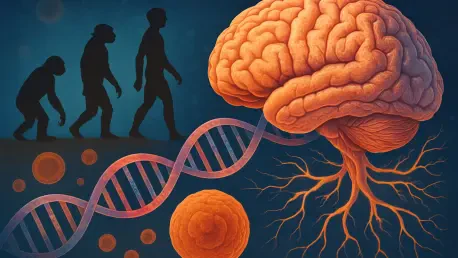

The journey from a single fertilized egg to a functioning human brain is one of nature’s most staggering architectural feats, involving the precise coordination of approximately 170 billion cells. For decades, the prevailing wisdom suggested that cells navigate this complex construction site primarily by “sniffing” out chemical trails to find their designated stations. However, recent breakthroughs are challenging this view, suggesting that the secret to the brain’s organizational map is actually written in its family history. By shifting the focus from external signals to internal lineage, researchers are uncovering a surprisingly simple rule that allows brain structures to scale across different species, from the tiny zebrafish to the vastly more complex mammalian brain.
This conversation explores the shift toward a lineage-based model of development, where cellular ancestry acts as a built-in GPS for growing tissues. We delve into how cells solve the dual problem of location and identity without relying on long-distance communication, the methodology behind comparing developmental patterns in different vertebrates, and the broader implications this research holds for the future of artificial intelligence and oncology. By viewing the brain not just as a collection of neurons but as a multi-generational population, we can begin to understand how evolutionary intelligence is baked into the very process of growth.
Cells must determine both their physical location and their functional identity to prevent developmental errors. Since chemical signals lose effectiveness over long distances, how do cells utilize their ancestry to navigate these spatial challenges, and what specific mechanisms ensure they don’t transform into the wrong tissue type?
The fundamental challenge for any developing cell is that it essentially operates in a vacuum, only able to “see” itself and its immediate neighbors. When you consider that a fully formed brain contains 170 billion cells, the idea that a single chemical gradient could guide a cell to a precise location several millimeters away becomes physically impossible because those signals simply fade into the noise. Instead of looking for a distant lighthouse, cells rely on their “family tree” to provide a local sense of place. As a progenitor cell divides, its descendants tend to stay physically close to their point of origin, creating a natural geographic cluster of related cells. This lineage-based mechanism ensures that identity is inherited rather than just assigned by the environment; a cell “knows” who it is because of who its parents were, which significantly reduces the risk of a neuron accidentally trying to become a skin cell or landing in the wrong cortical layer.
Large-scale structures often emerge because descendants tend to settle near their progenitors, much like human migration patterns. How does this proximity-based organization reduce the biological “cost” of long-range communication, and what are the step-by-step phases of building a computational model that captures this growth?
If every cell had to constantly “talk” to every other cell across the brain to figure out its position, the metabolic and temporal cost would be unsustainable for a growing embryo. By following a proximity-based rule—where descendants settle near their parents—the brain builds massive, organized structures using only short-range interactions, much like how human neighborhoods form distinct cultural identities without a central planner. To capture this in a model, we first had to establish the theoretical computations that would allow such a decentralized system to remain stable as it scales. The second phase involved testing these mathematical assumptions against real-world gene expression data from developing mouse brains to see if physical clusters actually shared genetic ancestry. Finally, we looked for universality by applying the model to different species, ensuring that the rules of growth weren’t just a quirk of one animal but a fundamental biological law.
Patterns of gene expression in organisms as different as mice and zebrafish suggest a universal, scalable rule for brain assembly. What were the most significant metrics used to compare these species, and how does a lineage-based model account for the massive difference in cell counts between various vertebrates?
When comparing a mouse brain to that of a zebrafish, the most striking metric is not the difference in their final form, but the consistency of their genetic “positional information” relative to their size. We analyzed individual and group gene expression patterns to see how cells organized themselves into functional regions despite the mouse brain being significantly more voluminous. A lineage-based model is inherently scalable because it doesn’t depend on an absolute distance or a specific concentration of chemicals; it depends on the number of cell divisions. Whether you are building a small brain or a massive one, the “family tree” logic remains the same: as long as the ratio of division to migration stays consistent, the resulting map will be proportional. This explains why the basic architecture of a vertebrate brain remains recognizable across evolution, even as the total cell count explodes.
Chemical signaling and lineage-based mechanisms likely work in tandem rather than in isolation. In what specific scenarios does one system take precedence over the other, and how might this dual-process theory change the way researchers approach the study of malformed brain structures or developmental delays?
It is helpful to think of lineage as the broad “zip code” and chemical signaling as the specific “street address.” In the early stages of development, lineage is the dominant force, setting up the large-scale partitions of the brain and ensuring that the right types of progenitors are in the right general zones. However, as the brain matures and cells need to make very specific local connections—such as a neuron reaching out to a specific neighbor—chemical signals take over to provide that fine-tuned guidance. If we see a developmental delay or a malformation, this dual-process theory suggests we need to look at whether the “map” was drawn wrong by the lineage or if the “navigation” failed due to chemical interference. By identifying which system is at fault, clinicians could eventually develop more targeted interventions that address the root cause of the structural error rather than just the symptoms.
Self-replicating systems that pass information through generations offer a potential blueprint for evolving technology. How could these biological rules be integrated into the architecture of next-generation artificial intelligence, and what are the primary trade-offs when trying to mimic organic growth in a digital environment?
Current artificial intelligence is largely static; it is trained on a set of data and then “frozen” in that state, but biological intelligence is grown through a process of continuous, generational refinement. We could integrate these rules into AI by developing models that don’t just process information but actually “reproduce” and evolve their own internal architectures over time, passing down structural knowledge to the next iteration of the code. The trade-off here is the loss of direct control and predictability; organic growth is messy and relies on a certain level of randomness that digital environments usually try to eliminate. However, the reward would be an AI that is far more resilient and adaptable, capable of self-organizing and repairing its own logic in ways that a human programmer might never have envisioned.
Beyond healthy brain development, lineage-based theories may provide insight into the rapid expansion of abnormal tissues. What practical steps could clinicians take to apply these findings to tumor research, and how might understanding a cell’s “family tree” help in predicting the trajectory of a disease?
A tumor is, in many ways, a developmental process gone wrong, and it follows many of the same rules of lineage and proximity that a growing brain does. Clinicians could potentially use “lineage tracing” as a diagnostic tool, mapping the “family tree” of a biopsy to see how the cancer is spreading and which specific progenitor cells are driving the growth. By understanding the ancestral history of a tumor, we can predict its trajectory more accurately; if a specific lineage is known for rapid migration, we can anticipate where secondary growths might appear before they are even visible on a scan. This moves us away from treating cancer as a uniform mass and toward treating it as a dynamic, evolving population where the history of each cell dictates its future behavior.
What is your forecast for the future of brain development research?
The next decade will likely see a departure from the “blueprint” view of the brain—where we try to map every single connection—and a move toward an “algorithmic” view, where we seek the simple rules that allow the brain to build itself. I expect we will find that much of our cognitive complexity isn’t hard-coded into our DNA but emerges naturally from the way cells interact and divide over time. This will lead to a new era of “evolutionary medicine,” where we can treat neurological disorders by subtly tweaking the growth rules rather than trying to fix a finished, broken circuit. Ultimately, understanding how 170 billion cells organize themselves from a single starting point will not only solve mysteries of the mind but will redefine what we consider to be the very limits of biological and artificial intelligence.