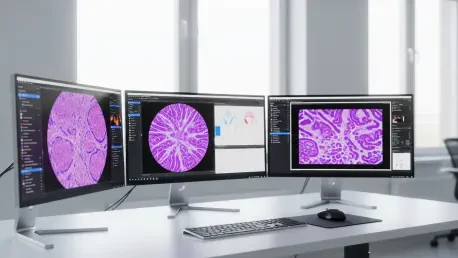

The shift from glass slides to high-resolution pixels represents the most profound change in tissue analysis since the invention of the compound microscope. This transition is no longer a futuristic concept but a daily reality for modern pathology departments across the nation. Laboratories are finding that the move to a digital environment involves much more than swapping a lens for a monitor; it requires a complete reimagining of the diagnostic lifecycle. As the technology matures, the focus has shifted from initial adoption toward long-term sustainability and the seamless integration of artificial intelligence into the clinical workflow.
Transitioning a pathology department to a digital workflow is not merely a hardware upgrade; it is an enterprise-wide IT transformation that fundamentally alters how life-saving diagnoses are made. While digital tools were once reserved for niche research or remote consultations, they are rapidly becoming the primary diagnostic platform for high-volume clinical practices. Laboratories that view this shift as a simple purchase and install event often find themselves facing unexpected bottlenecks in data management and financial overhead. Success in this field requires moving away from a traditional equipment mindset toward a comprehensive lifecycle framework that anticipates the needs of the lab years down the road.
Beyond the Microscope: The Evolution of Primary Digital Diagnostics
The evolution of primary digital diagnostics has moved past the experimental phase, establishing a new standard for precision medicine. In the current landscape, the ability to share digital slides instantly across geographic boundaries has eliminated the logistical delays inherent in physical slide transport. This democratization of expertise allows general pathologists in rural settings to collaborate with sub-specialists in urban centers without the risk of losing or damaging precious tissue samples. Consequently, the speed of diagnosis has improved significantly, allowing for more rapid initiation of treatment protocols for oncology patients.
However, this evolution demands a more sophisticated understanding of data as a clinical asset. Moving toward a fully digital environment means that the pathology report is no longer a static document but a gateway to a massive dataset. This data-centric approach enables longitudinal studies and the creation of vast archives that can be queried to find similar cases, but it also places a heavy burden on IT infrastructure. Laboratories must now function as data centers, ensuring that the transition from analog to digital does not compromise the security or the integrity of the diagnostic record.
Why a Lifecycle Approach is Essential for Clinical Survival
The leap from analog glass slides to digital imaging addresses critical modern challenges, including the need for faster sub-specialty consultations and the rising demand for precision medicine. However, the sheer volume of data generated by whole-slide imaging presents a significant hurdle for legacy hospital infrastructures. Without a strategic roadmap, institutions risk implementing siloed systems that cannot communicate with existing Laboratory Information Systems or Electronic Health Records. Establishing a sustainable program is no longer just about diagnostic accuracy; it is about ensuring that the digital environment is interoperable, cybersecure, and capable of supporting future growth.
Adopting a lifecycle approach protects the laboratory from technological obsolescence and financial instability. This method treats the digital pathology system as a living entity that requires regular updates, hardware refreshes, and continuous training. Instead of a one-time capital expense, sustainability is found in a predictable operational budget that accounts for the constant evolution of software and the increasing storage requirements of high-resolution images. By planning for the entire life of the system, laboratories can avoid the “forklift upgrades” that often derail digital initiatives when a specific piece of equipment reaches the end of its functional life.
The Technical and Operational Pillars of Digital Transformation
A sustainable digital pathology program rests on three foundational pillars: high-throughput scanning hardware, robust storage networking, and integrated Image Management Systems. The scanner serves as the front end, but the real work occurs in the background where massive data files require tiered storage solutions and high-speed bandwidth to prevent diagnostic delays. Beyond the hardware, the workflow itself must be redesigned from the pre-analytic phase. Because digital scanners are less forgiving of slide imperfections than the human eye, histology labs must adopt higher standards for tissue processing and slide preparation to ensure image clarity.
Furthermore, the integration of these pillars determines the efficiency of the pathologist’s digital cockpit. If the image management system is not perfectly synchronized with the Laboratory Information System, the workflow becomes disjointed, leading to manual data entry errors and physician burnout. Operational success depends on creating a seamless loop where patient data and high-resolution images are presented simultaneously. This synchronization ensures that pathologists can focus on complex diagnostic tasks rather than navigating clunky interfaces or waiting for large image files to load over an inadequate network.
Validation vs. Authorization: Insights from Current Research
Current research highlights a critical distinction that many labs overlook: the difference between manufacturer-driven FDA clearance and institutional laboratory validation. While a manufacturer must prove a device is safe and effective, the local laboratory remains responsible under Clinical Laboratory Improvement Amendments guidelines to perform internal studies. Expert consensus suggests that a sustainable program must treat quality management as a living document. This means that as software updates are pushed or new scanners are added to the fleet, the laboratory must have a rigorous, ongoing validation process to ensure digital interpretations remain accurate.
This internal validation process serves as a safeguard against the subtle variations that can occur when moving between different hardware vendors or software versions. Research by Yao and Li emphasized that laboratories that maintained a strict internal validation protocol reported higher levels of pathologist confidence and fewer diagnostic discrepancies. By establishing these protocols early, institutions created a culture of quality that extended beyond regulatory compliance. This proactive stance ensured that the digital transition strengthened the clinical foundation of the practice rather than introducing new variables that could jeopardize patient safety.
Institutional Strategies for AI Readiness and Financial Viability
The most successful laboratories implemented a multi-step framework that prioritized data integrity and strategic governance to ensure long-term viability. They standardized histology protocols to minimize staining variations, which ensured the data fed into artificial intelligence models remained consistent and reliable. These organizations avoided siloed applications by delivering AI-generated insights directly within the primary viewing software, effectively preventing workflow disruptions. By establishing multidisciplinary committees that included pathologists, IT specialists, and financial administrators, these institutions managed vendor relationships and planned for necessary hardware lifecycles with precision.
Financial health was maintained through comprehensive cost capture and the strategic use of evolving reimbursement models. Successful administrators accounted for hidden operational expenses such as software licensing, increased server cooling costs, and dedicated technical support. They utilized Category III CPT codes to track digital pathology usage, providing the data required to support future permanent reimbursement and proving a solid return on investment through faster turnaround times. Ultimately, these strategies transformed digital pathology from a costly experiment into a durable, data-driven diagnostic environment that empowered clinicians and improved patient outcomes across the healthcare system.