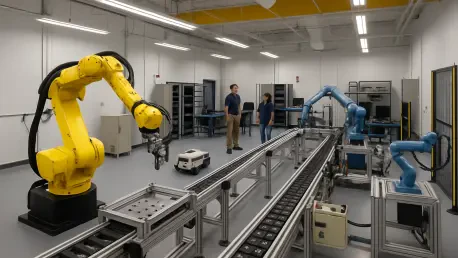

The gap between academic engineering theory and the gritty reality of industrial operations narrows significantly when students are forced to troubleshoot physical hardware under the pressure of real-world constraints. Embry-Riddle Aeronautical University addressed this disparity by establishing a new Automation Lab at its Prescott Campus, providing a dedicated space where mechanical engineering students engage with the complex machinery that drives modern production lines. Funded by a substantial contribution from the James Family Trust, the facility prioritizes hands-on experience with Programmable Logic Controllers, which are the specialized computing units responsible for managing everything from assembly lines to sophisticated flight systems. By moving away from purely digital simulations and pre-packaged educational kits, the university ensures that its graduates are prepared for the high-stakes environment of global manufacturing. This initiative represents a strategic shift toward a pedagogical model that emphasizes the physical assembly and logical programming of autonomous systems.
Bridging the Divide Between Logic and Hardware
The transition from conceptual design to functional industrial machinery requires a level of precision that software-based models often fail to replicate in a sterile classroom environment. Under the guidance of Dr. Mehran Andalibi, the lab encourages a philosophy where students build their projects from the ground up, selecting individual components and integrating them into a cohesive mechanical structure. This build-it-yourself approach exposes students to the nuanced frustrations of hardware integration, such as sensor calibration errors and mechanical tolerances that can derail an otherwise perfect piece of code. For instance, when constructing an automated vending system, students must account for the exact torque and rotation of motors to ensure reliable delivery, a task that demands deep mechanical insight. By navigating these difficulties, learners develop a robust understanding of how electronic commands translate into physical motion, which is a critical skill for any engineer entering the professional workforce.
Utilizing industrial-grade Programmable Logic Controllers instead of simplified consumer microcontrollers provides students with a distinct advantage when they transition into the aerospace and manufacturing sectors. These controllers are the standard for reliability in harsh environments, and mastering their complex ladder logic and networking protocols prepares students for the rigorous standards of modern industry. The lab environment allows for the testing of these controllers in scenarios that simulate factory floor conditions, where timing and safety are paramount. Rather than relying on curated educational modules that provide predictable outcomes, students are tasked with solving open-ended problems that require them to source their own parts and design their own circuit layouts. This methodology fosters a sense of ownership over the engineering process and compels students to think critically about cost-efficiency and system durability. As a result, the university is producing a new cohort of engineers who are not only technically proficient but also practically resourceful.
Innovative Student Projects and Technical Mastery
Within the walls of the new facility, the diversity of student-led projects highlights the vast potential of automation technology when applied to creative and complex problem-solving scenarios. One standout example involves the development of an AI-driven carnival game that uses high-speed laser tracking to identify and engage moving targets with remarkable accuracy. This project required the integration of advanced computer vision algorithms with rapid-response mechanical actuators, demonstrating how automation can be both entertaining and technically demanding. Similarly, another student team successfully engineered a multi-story elevator model, complete with sophisticated priority queuing and safety protocols that mimic the operational logic of high-rise urban infrastructure. These projects serve as more than just academic exercises; they are proof-of-concept models that require students to manage power distribution, signal interference, and structural integrity. By applying rigorous engineering principles to these imaginative concepts, students gain the confidence to tackle larger industrial systems.
The lab also serves as a critical incubator for senior capstone research, particularly in the realm of advanced robotics and autonomous material handling. Current projects include the development of robotic arms equipped with sophisticated vision systems capable of identifying and sorting objects based on their material properties and geometric shapes. This level of integration represents the pinnacle of current industrial trends, where artificial intelligence and physical robotics converge to create highly efficient, self-governing production environments. Students involved in these projects must master the synchronization of multiple sensors and actuators, ensuring that the robotic systems can operate with minimal human intervention. This exposure to high-level system integration is invaluable, as it mirrors the current shift toward fully autonomous logistics centers and smart factories. By working through the complexities of these sorting systems, students learn to anticipate the failure points inherent in complex automation, preparing them to innovate and improve upon existing technologies in their careers.
Strategic Outcomes and Implementation of Advanced Training
The establishment of the Automation Lab provided a clear roadmap for the integration of practical industrial skills into the traditional engineering curriculum. By focusing on the direct application of hardware and logic controllers, the program effectively eliminated the disconnect between theoretical studies and professional expectations. Leaders at the university recognized that the most effective way to prepare for the complexities of the current industrial landscape was to foster an environment of experimentation and physical construction. Consequently, the transition to a dedicated automation course in the current spring semester was positioned as a necessary evolution for the mechanical engineering department. This move ensured that all graduates possessed the requisite knowledge to manage the automated systems that now define the global economy. The success of the initial student projects demonstrated that when given access to professional-grade tools, aspiring engineers could develop solutions that were both innovative and commercially viable.
Actionable steps for other institutions and industry partners involved the creation of collaborative programs that directly linked lab projects with real-world manufacturing problems. The university sought to establish partnerships that allowed students to work on proprietary industrial challenges, providing a direct pipeline from the classroom to the workforce. This strategy not only enhanced the relevance of the student’s work but also provided local industries with a steady stream of highly skilled talent ready to implement advanced automation solutions. Furthermore, the emphasis on building systems from scratch rather than using pre-made kits became a recommended standard for engineering programs seeking to increase the depth of their technical training. By prioritizing the procurement of versatile industrial components, the lab maintained a cost-effective yet high-impact educational environment. The long-term insights gained from this facility suggested that the future of engineering education lied in the seamless blending of logic, mechanics, and autonomous intelligence.