
The dream of long-duration missions to the Moon and Mars carries with it a harsh physiological reality: the human body, evolved for Earth’s gravity, deteriorates alarmingly in space. Prolonged exposure to microgravity triggers a cascade of deconditioning effects, including severe muscle atrophy, stiffening of the joints, and a significant loss of bone density, which fundamentally compromises an astronaut’s physical capabilities. Simple tasks that are effortless on Earth can become monumentally taxing, posing a substantial risk not only to the health of the crew but also to the success of complex missions far from home. Addressing this profound challenge is paramount for the future of human space exploration. In response, a team at the University of Bristol has engineered a pioneering solution: a soft robotic exosuit designed as a pair of trousers that could help astronauts counteract the debilitating effects of space and effectively find their “space legs” on alien worlds.
A New Generation of Wearable Robotics
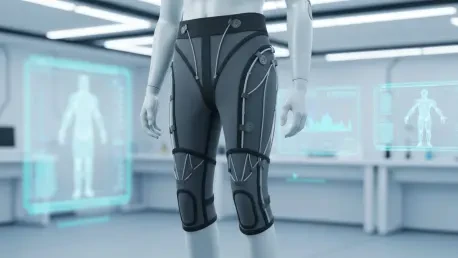
Moving far beyond the cumbersome and rigid exoskeletons often depicted in science fiction, this innovative exosuit is engineered with a human-centric philosophy, designed to function more like a piece of high-performance apparel than a machine. Its lightweight construction is composed predominantly of fabric, allowing it to be worn comfortably and discreetly beneath a conventional spacesuit without impeding movement. The suit’s functionality is powered by a sophisticated network of artificial muscles intricately woven throughout the garment. These actuators are not simple motors but elegant two-layer structures, featuring an outer nylon shell and an inner thermoplastic layer. When inflated, they can provide precisely calibrated forces to either assist or resist the wearer’s motion. To manage the significant tension these muscles generate without adding prohibitive weight or sacrificing flexibility, the design strategically incorporates elements made from high-strength Kevlar at critical anchor points, such as the waistband and knees, ensuring durability and performance in the most demanding environments imaginable.
The true ingenuity of the robotic trousers lies in their sophisticated dual-action capability, which allows the system to serve as both a supportive assistant and a demanding personal trainer. In its assistive mode, the exosuit can actively help an astronaut perform physically strenuous tasks, such as carrying heavy equipment or climbing steep inclines, thereby significantly reducing muscular effort and delaying the onset of fatigue. This function is crucial for enhancing operational efficiency and endurance during extravehicular activities. Conversely, the suit can be switched to a resistive mode, where it intentionally pushes back against the wearer’s movements. By applying meticulously timed and located resistance, the exosuit effectively simulates the constant muscular loading that gravity provides on Earth. This novel application is vital for keeping an astronaut’s muscles actively engaged and working hard enough to prevent atrophy, thus preserving their strength and mass while permitting the natural, fluid biomechanics essential for complex exploration tasks.
From the Lab to a Lunar Landscape
To rigorously validate the exosuit’s design and performance, the research team transitioned the prototype from the controlled confines of the laboratory to a highly realistic field environment. These critical tests were conducted at the Exterres CRATER facility at the University of Adelaide, recognized as the largest simulated lunar environment in the Southern Hemisphere. This facility offers a high-fidelity analog for extraterrestrial conditions, complete with loose, Moon-like terrain that authentically replicates the challenges of navigating an alien surface. The experiment itself marked a significant milestone in wearable robotics, representing the first time a soft robotic exosuit had been field-tested while fully integrated within a pressurized spacesuit. This step was essential to ensure the technology could function seamlessly as part of a complete system, providing a true assessment of its potential contribution to future space missions where reliability and integration are non-negotiable requirements for crew safety and success.
During the extensive trials, participants donned the complete exosuit and spacesuit assembly to perform a series of tasks representative of surface exploration activities, including walking over uneven ground, climbing structures, and carrying simulated geological samples. The data collected from these experiments provided highly encouraging initial findings. The results suggested that the exosuit could significantly reduce muscular fatigue during periods of intense physical activity. Furthermore, and just as critically, it helped the wearers maintain a more natural and stable gait, a key factor in preventing falls and injuries in a low-gravity environment where balance is already compromised. This demonstrated potential to enhance the endurance and operational effectiveness of future lunar and Martian explorers is a critical step forward, promising to extend the reach and productivity of astronauts who will need to work for prolonged periods far from the safety of their lander or habitat.
Applications on Earth and Beyond
While conceived for the extreme environment of space, the core technology powering the robotic trousers has profound implications for terrestrial applications, particularly within the field of healthcare and rehabilitation. The same fundamental approach of providing precisely controlled assistance and resistance to movement could be adapted to support individuals on Earth facing mobility impairments. This includes stroke survivors undergoing physical therapy to regain motor function, as well as older adults who require supplemental support to remain active, independent, and safe in their daily lives. While soft exosuits have already demonstrated considerable promise in clinical studies focused on gait assistance, this project significantly expands that knowledge base by uniquely addressing the complex biomechanical challenges associated with hypogravity, yielding insights that can accelerate the development of more effective and versatile assistive devices for a wide range of patients.
The development of these robotic trousers represented a pivotal moment, signaling a shift toward a new class of versatile, wearable robotics designed for seamless human-machine integration. The project successfully fused meticulous craftsmanship—evidenced by the hand-sewn prototype—with cutting-edge robotic technology, resulting in a solution that was both powerful and profoundly human-centric. For space agencies, this innovation was seen as a critical component of a future human-performance toolkit, which integrated the exosuit alongside established countermeasures like advanced exercise equipment and specialized nutrition programs. This comprehensive approach to astronaut health marked a new strategy for ensuring the long-term well-being of crews on missions of unprecedented duration and distance, fundamentally altering the calculus of what was possible for sustained human presence beyond Earth.