
The field of neurotechnology is currently witnessing a transformative shift as we move away from static, “one-size-fits-all” medical devices toward intelligent, responsive systems. For decades, deep brain stimulation has been a cornerstone in treating the motor symptoms of Parkinson’s disease, but it has long struggled to address the complex, dynamic nature of human locomotion. Ivan Kairatov, a biopharma expert with a distinguished background in research and development, joins us to discuss how a groundbreaking study from Lausanne is utilizing artificial intelligence to bridge this gap. By decoding neural signals in real time, this new approach promises to restore natural movement for patients who have previously found little relief for their walking impairments.
In this discussion, we explore the evolution of deep brain stimulation from its conventional roots to the latest AI-driven innovations that adapt to a patient’s every move. We delve into the mechanics of neural decoders that can differentiate between standing and walking, the profound physical and emotional impact on patients who no longer feel “heavy” or “stuck,” and the collaborative efforts between elite academic institutions and industry leaders. Finally, we look toward the future of these intelligent therapies and how they might eventually be scaled to serve a much broader population of those living with neurological challenges.
Conventional deep brain stimulation often addresses tremors and rigidity while leaving walking impairments largely unchanged. How do the recent breakthroughs in AI-powered systems fundamentally alter this treatment landscape for patients who struggle with mobility?
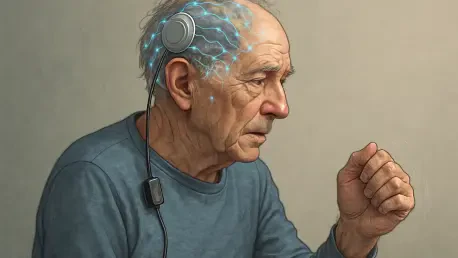
For more than three decades, deep brain stimulation has served as a vital lifeline for over 200,000 patients worldwide, successfully dampening the tremors and rigidity that define Parkinson’s. However, the tragedy of conventional DBS is that it operates on fixed parameters, delivering a constant stream of electricity that doesn’t understand whether a patient is trying to navigate a narrow hallway or simply sit in a chair. This “always-on” approach is particularly ineffective for gait, which is a highly variable and complex motor task. The new research published in Nature Medicine changes the entire paradigm by introducing a system that finally listens to the brain before it acts. By adapting stimulation in real time to the patient’s mobility, we are seeing a significant reduction in the heavy, uncontrollable leg movements that make daily life a struggle. It moves us toward a more natural physiological demand-matching, where the therapy breathes and moves with the person rather than just masking a symptom.
The study mentions the development of neural decoders that can detect different locomotor states. Could you explain the technical process of how these AI algorithms interpret brain activity to make adjustments in a matter of seconds?
The technical sophistication here lies in the ability to sift through the “noise” of the brain to find specific neural biomarkers that signify intent and action. Researchers utilized data from forty patients to train these AI-powered decoders, teaching them to recognize the distinct electrical signatures associated with standing, walking, or even turning. When a patient begins to move, the system identifies these patterns and modulates the electrical stimulation within mere seconds to support that specific activity. It is a closed-loop system that acts with remarkable speed, ensuring the therapy is relevant to the movement as it unfolds in real time. This is a massive departure from traditional methods where a clinician would manually set a frequency during a monthly office visit. Now, the device itself acts as an on-board clinician, making micro-adjustments every moment the patient is active.
Participants like Mr. F have described a sense of relief, noting that their legs no longer feel heavy or move uncontrollably. From a neurotechnological perspective, what is happening internally to create such a dramatic shift in the patient’s physical experience?
When we talk about the “heavy” sensation patients describe, we are often referring to a failure of the motor system to properly initiate and sustain the fluid patterns required for walking. Conventional stimulation can sometimes even exacerbate these issues if the parameters aren’t perfectly aligned with the gait cycle. By using adaptive DBS, we are effectively providing the correct “electrical push” only when the brain’s internal signaling for walking is detected. This prevents the over-stimulation that can lead to uncontrollable movements while ensuring there is enough support to overcome the freezing of gait. For a patient like Mr. F, this means the act of walking no longer feels like a conscious, grueling battle against their own limbs. Instead, the stimulation matches the physiological demand of the task, whether they are navigating obstacles or simply standing up, allowing for a much more fluid and natural sensory experience.
This breakthrough was the result of a collaboration between the .NeuroRestore center, EPFL, CHUV, and Medtronic. How critical is the relationship between academic research and industry giants when it comes to refining these “intelligent” therapies for everyday use?
The path from a laboratory breakthrough to a device that a patient can safely use in their daily life is incredibly steep, and this partnership was essential to climbing it. By collaborating with Medtronic, the researchers were able to gain direct access to clinically established DBS systems, which provided a robust and safe hardware foundation for their innovations. They didn’t have to reinvent the wheel; instead, they were able to refine the existing technology to target gait problems specifically by integrating their AI software. This synergy between the clinical expertise at CHUV and the neurotechnology leadership at EPFL allowed the team to accelerate the translation of this therapy significantly. Without industry involvement, these “intelligent” features might have remained as conceptual software on a lab computer rather than becoming a functional tool for neurosurgeons like Jocelyne Bloch to use in the operating room. It proves that the future of medicine lies in these interdisciplinary hubs where engineering, surgery, and manufacturing meet.
The research team is already looking toward follow-up studies and long-term outcomes. What are the primary challenges in scaling this AI-driven approach to a larger, more diverse patient population over an extended period?
Scaling this technology requires us to move from a controlled study environment into the unpredictable chaos of everyday life for a much larger group of people. While the forty patients involved in the development provided a great starting point, every person with Parkinson’s has a unique neural “fingerprint,” and the AI must be robust enough to handle that diversity without constant manual intervention. We also need to see how these systems perform over months and years, ensuring that the brain doesn’t adapt to the stimulation in a way that diminishes its effectiveness. There is also the logistical challenge of making the calibration of these neural decoders simple enough for any neurologist to perform, rather than requiring a team of elite scientists from Lausanne. The goal of the follow-up studies will be to prove that these real-time adjustments provide a durable, long-term improvement in quality of life across the board. If we can achieve that, we are looking at a future where this becomes the standard of care for the most severe cases of walking impairment.
What is your forecast for the future of adaptive neurostimulation in the broader context of neurological health?
I believe we are entering an era of “biocompatible computing,” where we will see these intelligent, closed-loop systems move far beyond just Parkinson’s disease. Within the next decade, the success we are seeing with gait and mobility will likely be applied to other complex neurological conditions, including epilepsy, chronic pain, and even treatment-resistant depression. We are essentially learning how to speak the brain’s language in real time, which allows us to provide targeted interventions exactly when and where they are needed. As the hardware becomes smaller and the AI becomes more intuitive, these implants will stop being “foreign objects” and start functioning as seamless extensions of the patient’s own nervous system. We are no longer just treating symptoms; we are building digital bridges to restore lost human functions, and the implications for autonomy and dignity in aging populations are truly staggering.