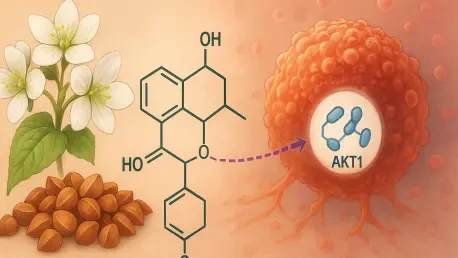

The inherent phototoxicity and potential carcinogenicity of natural fagopyrine require chemical engineers to modify the molecule before it can be considered for human trials. This reality underscores the dual nature of natural compounds: while they offer a rich library of chemical structures capable of interacting with human proteins, they often carry evolutionary defense mechanisms that are incompatible with systemic administration. Researchers at the Plasma Cell Research Center and Hajee Mohammad Danesh Science and Technology University have recently navigated this complexity by identifying fagopyrine, a phytochemical found in common buckwheat, as a high-potential lead scaffold for targeting the AKT1 protein. By synthesizing vast amounts of genomic data with sophisticated computational modeling, the scientific community is beginning to see how these plant-derived molecules can be re-engineered to disrupt the signaling pathways that allow tumors to survive. This shift toward data-driven pharmacology represents a significant leap from traditional screening methods to a more precise, structural approach in oncology.
The Biological Role and Genomic Landscape of AKT1
The identification of AKT1 as a central therapeutic target marks a critical evolution in how oncologists approach the disruption of cancer’s internal machinery. This protein, which acts as a serine-threonine kinase, sits at the junction of several vital signaling pathways that dictate whether a cell lives, grows, or dies. In a well-regulated environment, AKT1 ensures that tissues develop normally and respond appropriately to insulin and growth factors. However, the genetic instability of malignant cells often results in a permanent activation of this protein, effectively keeping the throttle of cellular growth pinned to the floor. By understanding the structural vulnerabilities of the AKT1 protein, researchers are now able to look for specific chemical keys that can jam its activation mechanism. This effort is not merely about finding a toxin that kills cells, but rather about discovering a precise modulator that can restore order to a chaotic biological system.
The Mechanics: Cancer Growth and Signaling
AKT1 functions as a critical control hub within the PI3K/AKT/mTOR signaling network, a pathway frequently described as a central command station for the cell. This specific network regulates fundamental processes including proliferation, survival, and metabolic reprogramming necessary to sustain rapid tumor growth. When this system becomes hyperactive due to genetic mutations or environmental signals, it facilitates the hallmarks of malignancy: uncontrolled cell division and resistance to programmed cell death. Because of its pivotal role, AKT1 has long been a primary target for pharmaceutical intervention. However, creating a molecule that can effectively inhibit AKT1 without causing systemic toxicity has remained an elusive goal. Current research addresses this challenge by first defining the diverse landscape of AKT1 behavior across different cancers before attempting to identify a chemical solution, ensuring that any future drug works within the specific context of the disease.
Genomic Profiling: Mapping Mutations and Microenvironments
Recent genomic mapping has revealed that AKT1 overactivity is driven by a complex interplay of genetic mutations and epigenetic modifications, such as reduced DNA methylation in the promoter region. Studies using data from 33 distinct cancer types indicate that while AKT1 is highly expressed in breast and stomach cancers, its impact on survival varies significantly depending on the tissue type. Beyond the malignant cell, AKT1 has also been found within the tumor microenvironment, present in immune populations like macrophages and fibroblasts. This presence suggests that inhibiting AKT1 could have the dual benefit of killing tumor cells directly and reshaping the immune response. There is a documented correlation between AKT1 levels and biomarkers like tumor mutational burden, implying that a targeted inhibitor might enhance the effectiveness of current immunotherapies. Understanding these nuances allows for the development of treatments tailored to the specific molecular profile of a patient’s tumor.
From Buckwheat to Computational Drug Discovery
The transition from botanical observation to molecular pharmacology began with a comprehensive screening of 97 phytochemicals derived from the common buckwheat plant, Fagopyrum esculentum. Buckwheat has long been studied for its nutritional value, but its chemical complexity offers a treasure trove for drug discovery. Researchers focused on identifying compounds that could physically obstruct the active site of the AKT1 protein. This process involved filtering the initial library down to 52 candidates based on their chemical stability and potential for human absorption. By focusing on natural scaffolds, scientists are looking to leverage millions of years of biological evolution to find molecules that fit perfectly into human protein structures. This computational approach bypasses years of traditional laboratory trial and error, allowing researchers to home in on the most promising candidates with high mathematical precision. It represents a new era where the blueprints for tomorrow’s medicines are found within the genetic and chemical diversity of the natural world.
Molecular Docking: Identifying the Lead Scaffold
Through the use of molecular docking, fagopyrine emerged as the most formidable candidate for AKT1 inhibition, achieving an impressive binding affinity score of −15.45 kcal/mol. This computational technique predicts how a small molecule will orient itself within a protein’s binding pocket, and the results for fagopyrine were significantly stronger than those of other tested compounds like quercetin. The models demonstrated that fagopyrine forms several stable hydrogen bonds and hydrophobic interactions with specific amino acid residues that are essential for AKT1 function. By effectively “plugging” this pocket, the molecule prevents the protein from interacting with its natural substrates, thereby halting the downstream signals that drive cancer progression. This level of structural compatibility is rare and marks fagopyrine as a uniquely qualified scaffold for further medicinal chemistry. The precision of these digital interactions provides a solid foundation for the subsequent stages of drug optimization and laboratory validation.
Dynamic Stability: Simulation and Electronic Analysis
To ensure that the initial docking results were not merely a snapshot of a temporary interaction, scientists utilized 100-nanosecond molecular dynamics simulations to observe the AKT1-fagopyrine complex in a simulated physiological environment. These simulations track the movement of atoms over time, confirming that the bond remains stable even under the constant thermal fluctuations of a living system. Throughout the duration of the test, the complex showed remarkable consistency, with the molecule staying firmly lodged within the target site. Further analysis using Density Functional Theory confirmed that the electronic structure of fagopyrine is inherently stable, characterized by a favorable energy gap between its molecular orbitals. These rigorous computational checks are essential because they provide the high-level evidence needed to justify the move toward physical synthesis and testing. The stability of the complex suggests that once the molecule is refined, it could maintain its therapeutic effect long enough to provide a meaningful clinical benefit.
Addressing Pharmacological Hurdles and Safety
Despite the computational success, translating a plant-derived compound into a viable medicine involves overcoming significant pharmacological barriers. Fagopyrine possesses a high molecular weight and a high degree of lipophilicity, which means it often fails to meet standard “drug-likeness” criteria such as Lipinski’s Rule of Five. These characteristics typically result in poor oral bioavailability, making it difficult for the body to absorb the compound and transport it to the site of a tumor. Furthermore, the molecule’s natural phototoxicity poses a major safety risk, as it can cause severe sensitivity to light and skin inflammation. These hurdles do not disqualify the molecule but rather define the scope of the engineering required to make it a safe therapeutic. The goal is to strip away the problematic chemical groups while keeping the core structure that binds so effectively to the AKT1 protein. This process requires a sophisticated marriage of biology, chemistry, and engineering to transform a toxic plant extract into a precision medical tool.
Pharmacological Realism: Overcoming Absorption Barriers
The high lipophilicity of fagopyrine means that in its raw form, it tends to remain trapped in fatty tissues rather than circulating through the bloodstream to reach the intended target. This lack of solubility is a common challenge in natural product drug discovery, and it requires the use of advanced delivery systems or chemical modifications. Researchers are exploring the use of nanotechnology and lipid-based carriers to encapsulate the molecule, protecting it from degradation and improving its delivery to malignant cells. Additionally, by modifying the peripheral chemical groups of the fagopyrine scaffold, engineers can decrease its molecular weight and improve its ability to cross cellular membranes. These modifications are crucial for ensuring that the drug can be administered in a way that is convenient and effective for patients. Addressing these pharmacokinetic issues is a prerequisite for any compound moving from the computer screen to a clinical setting, ensuring that the theoretical potency of the molecule is matched by its practical performance.
Future Directions: From Scaffold to Precision Therapy
The research community concluded that fagopyrine served as an essential lead scaffold rather than a finalized clinical product. Looking ahead from this 2026 breakthrough, chemical engineers prioritized the synthesis of modified analogs that maintained the high binding affinity for AKT1 while successfully eliminating the structural groups responsible for phototoxicity. This transition from a raw plant extract to a synthetic pharmaceutical lead allowed for more precise control over the molecule’s solubility and oral absorption rates. Subsequent efforts were directed toward validating these results through in vitro assays on human cancer cell lines, which confirmed the actual suppression of downstream signaling pathways. By utilizing the buckwheat-derived compound as a structural blueprint, scientists effectively bridged the gap between traditional botanical observation and modern molecular medicine. This methodology provided a scalable roadmap for repurposing natural products into advanced tools for precision oncology, offering a blueprint for future drug development.