
Ivan Kairatov stands at the intersection of traditional biopharmaceutical research and the frontier of digital health, bringing a unique perspective to the rapidly evolving landscape of medical artificial intelligence. As a seasoned expert in tech-driven innovation, he has spent years examining how computational power can translate into better patient outcomes, particularly in the high-stakes environments of research and clinical development. With recent studies suggesting that advanced large language models are now matching or even surpassing human performance in complex diagnostic tasks, Kairatov’s insights are essential for understanding the shift from theory to bedside application. In this discussion, we explore the nuances of the landmark study conducted by Brodeur and colleagues, the inherent sensory limitations of current AI, the protocols necessary for human-machine collaboration, and the ethical guardrails required to ensure these tools serve all patient populations equitably.
This conversation delves into the performance of the OpenAI o1 series against hundreds of physicians, the specific advantages of AI in handling the chaotic data streams of emergency triage, and the critical need for multisensory integration in future medical technology. We also examine the framework for resolving disagreements between doctors and digital assistants to ensure patient safety remains the ultimate priority.
When clinicians face fragmented, unstructured data during emergency room triage, advanced models often demonstrate a distinct edge. What specific reasoning patterns allow AI to navigate this uncertainty so effectively, and how can these insights be integrated into current physician training programs to improve human decision-making?
The primary advantage we see in models like the OpenAI o1 series is their ability to synthesize vast amounts of “noisy” data without the cognitive fatigue or anchoring bias that often plagues human clinicians in high-pressure environments. In the chaos of an emergency department, where a patient’s history might arrive in disjointed snippets or unstructured electronic health record notes, the model excels by identifying patterns across disparate data points that a tired doctor might overlook. The study by Brodeur and colleagues highlighted that this edge was most pronounced in the early-stage triage phase, where the model used fragmented data to outperform humans in diagnostic and management reasoning. To integrate these insights into medical education, we should move away from rote memorization and toward “augmented reasoning” training, teaching students how to use AI as a high-speed cross-referencing tool. By simulating scenarios where data is intentionally withheld or presented in a jumbled format, we can train physicians to recognize their own heuristic shortcuts while learning to leverage the model’s systematic approach to uncertainty.
Clinical practice relies heavily on visual and auditory cues that text-based AI models currently cannot process. How does this limitation affect the overall safety of AI-driven diagnosis, and what specific sensory capabilities must be prioritized in the next generation of medical technology to bridge this gap?
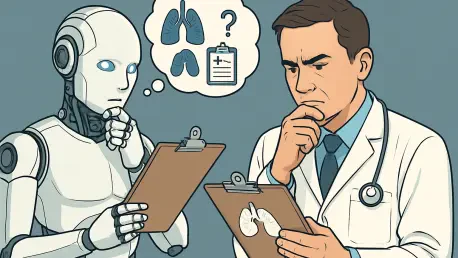
Medicine is inherently a sensory profession—the subtle wheeze in a child’s chest, the specific shade of a patient’s pallor, or the way a person’s gait shifts during an examination are data points that text-only models simply cannot “feel.” Currently, the safety of AI-driven diagnosis is limited because it relies on a human to act as a “translator,” turning physical signs into written descriptions, a process that is ripe for subjective error and information loss. To bridge this gap, the next generation of medical AI must prioritize multimodal integration, specifically computer vision for dermatological and radiological assessment and advanced acoustics for cardiac and pulmonary monitoring. We need systems that can analyze a real-time video feed of a patient’s tremors or interpret the nuance of a cough alongside the laboratory results. Without these sensory inputs, the AI remains a brilliant librarian rather than a true clinical partner, potentially missing critical physical markers that contradict the written record.
Collaborative decision-making between doctors and AI could potentially reduce diagnostic errors and address disparities in healthcare access. What step-by-step protocols should be implemented to manage disagreements between a physician and a model, and how should we define professional accountability when these systems are used?
When a seasoned physician and a high-performing model arrive at different conclusions, we need a rigorous “arbitration protocol” that prioritizes patient safety over either the doctor’s intuition or the machine’s probability score. The first step should be a mandatory “differential expansion,” where the doctor must explicitly address the model’s suggested diagnosis, documenting why it was dismissed or accepted based on physical findings the AI couldn’t see. Secondly, in cases of high-risk management, such as emergency surgical decisions, a disagreement should trigger an automatic second human opinion or a more granular data review to see if the model detected a pattern in the history that the first clinician missed. Accountability must ultimately remain with the human provider, but we need to evolve our legal frameworks to recognize “informed deviation”—where a doctor chooses to ignore a model’s correct suggestion—and “uncritical reliance,” where a doctor follows a model’s error. Defining these boundaries is essential to ensuring that AI serves as a safety net rather than a source of professional complacency.
Accuracy on a defined task is only one metric for clinical readiness, as tools must also be equitable and transparent. What strategies can ensure that AI tools do not perpetuate existing healthcare biases, and what metrics are most vital for monitoring their long-term impact on patient outcomes?
Ensuring equity in AI is not a one-time adjustment but a continuous process of “algorithmic hygiene” that must be baked into the development lifecycle. We must move beyond simple accuracy scores and adopt metrics like “parity of performance” across different demographic groups, ensuring that a model’s diagnostic precision doesn’t drop when evaluating patients from underserved or marginalized communities. Transparency is equally vital; we need “explainable AI” that doesn’t just provide a result but outlines the specific clinical data points it prioritized, allowing human auditors to check for biased correlations. Long-term impact should be measured by patient-centric outcomes, such as a reduction in time-to-treatment or a decrease in readmission rates, rather than just how often the AI gets the diagnosis “right” compared to a human. If a tool is 99% accurate but only for a specific subset of the population, it fails the fundamental test of clinical readiness and should not be deployed in a general hospital setting.
Advanced models are now matching or exceeding human performance in complex tasks like treatment planning and emergency management. In what specific scenarios should AI take the lead in clinical reasoning, and how can we prevent “automation bias” from clouding a physician’s professional judgment?
AI should arguably take the lead in scenarios involving “big data” synthesis, such as complex treatment planning for patients with multiple comorbidities where thousands of potential drug interactions must be cross-referenced simultaneously. It is also incredibly effective in “triage surveillance,” where it can scan the electronic records of an entire waiting room in seconds to flag patients whose vital signs and history suggest a high risk of rapid deterioration. However, to prevent “automation bias”—the tendency for humans to trust a machine’s output even when it is wrong—we must implement “adversarial prompts” or “forced skepticism” during the diagnostic process. This means the system should occasionally ask the physician to justify their agreement with the machine or provide a counter-argument to the machine’s top choice. By maintaining this healthy friction between the human and the model, we ensure the physician stays cognitively engaged and uses their professional judgment as a final, critical filter.
What is your forecast for the role of large language models in clinical medicine?
I believe we are entering an era of “The Augmented Clinician,” where the large language model becomes as ubiquitous and essential as the stethoscope or the pulse oximeter. Within the next five to ten years, I expect LLMs to move from being external consulting tools to being deeply embedded in the “operating system” of healthcare, handling the heavy lifting of documentation, real-time data synthesis, and preliminary triage. We will see a shift where the physician’s role evolves into that of a “Clinical Orchestrator,” focusing on the physical examination, complex ethical nuances, and the human-to-human empathy that no machine can replicate. However, the success of this transition depends entirely on our ability to solve the “black box” problem of AI reasoning and ensure that these systems are built on diverse, real-world data. Ultimately, AI will not replace doctors, but doctors who use AI will inevitably replace those who do not, leading to a healthcare system that is significantly more efficient, less prone to error, and more accessible to patients globally.