
The persistent challenge of integrating heavy, motor-driven machinery into delicate human environments has finally met its match at Arizona State University’s Robotic Actuators and Dynamics Lab. Assistant Professor Jiefeng Sun is spearheading a transition away from the rigid constraints of traditional engineering, focusing instead on the fluid efficiency of biological systems. By utilizing materials that mimic the mechanical properties of human muscle and animal trunks, the research team is redefining what it means for a robot to be mobile and functional. Traditional systems often fail due to their excessive weight and reliance on tethered power sources, creating barriers for deployment in remote or high-stakes scenarios. This move toward soft actuators represents a fundamental paradigm shift, prioritizing compliance and safety over the brute force of metal gears. As these bio-inspired technologies mature, they offer a blueprint for machines that are not just tools, but adaptable partners capable of navigating the unpredictable complexities of the physical world.
Breakthroughs in Actuator Design and Mobility
A significant leap in this field was achieved through the creation of Helical Anisotropically Reinforced Polymer (HARP) actuators, a project led by researcher Eric Weissman. These artificial muscles are distinct in their geometry, resembling hollow, ridged spirals that draw inspiration from the structural efficiency of pasta shapes like cavatappi. By employing pneumatic inflation, these tubes can contract or expand with remarkable precision. The true technical breakthrough lies in the concept of decoupled anisotropy, which allows the actuators to exert significant force while remaining incredibly lightweight. These devices can lift up to 100 times their own weight, a ratio that far exceeds that of most traditional hydraulic or electric motors. This level of performance enables the construction of robots that are significantly more agile, allowing them to perform heavy-duty tasks without the typical bulk associated with industrial machinery.
Beyond raw strength, the efficiency of HARP actuators addresses the long-standing issue of power dependency in mobile robotics. Because these artificial muscles require relatively low air pressure to function, they allow robots to move effectively without being tethered to massive external air compressors. This independence is crucial for real-world applications where mobility is non-negotiable, such as navigating disaster zones or agricultural fields. The reduction in energy overhead means that smaller, onboard power sources can sustain prolonged operations, marking a departure from the “connected” nature of previous generations. This development bridges the gap between laboratory prototypes and field-ready systems, proving that soft robotics can be both powerful and autonomous. By eliminating the need for heavy external support equipment, the ASU team has paved the way for a more versatile and portable class of robotic entities capable of operating in diverse landscapes.
Bio-Mimetic Dexterity and Environmental Adaptability
The practical application of soft actuator technology is perhaps most visible in the development of the bionic elephant arm, a project spearheaded by doctoral student Jiahe Wang. This device replicates the multi-functional dexterity of an elephant’s trunk, utilizing a series of soft segments that provide inherent compliance. Unlike conventional robotic arms that rely on rigid joints and are easily obstructed by physical barriers, this soft variant can gracefully weave over, under, and around obstacles. This flexibility is essential for tasks that require high sensitivity, such as navigating the dense, tangled canopies of a fruit orchard or a crowded factory floor. The ability to manipulate objects without the risk of crushing them or damaging the surrounding environment opens new doors for automation in sectors that previously required a human touch. This bio-mimetic approach ensures that robots can engage with their surroundings in a more organic and less intrusive manner.
Safety remains a primary driver for the adoption of soft robotics, as the elimination of rigid components significantly reduces the risk of “pinching hazards” and other mechanical accidents. Soft materials are naturally more forgiving during human interaction, making them ideal for collaborative workspaces where people and machines must operate in close proximity. Furthermore, these bio-inspired systems exhibit remarkable durability in harsh conditions that would typically degrade traditional electronics and metal structures. They can survive contact with abrasive surfaces and continue to function even when exposed to extreme temperatures, such as those found near deep-sea thermal vents. This resilience stems from the lack of complex, exposed gearboxes and the use of robust polymers that can withstand significant environmental stress. Consequently, the transition to soft robotics is not merely about achieving better movement, but about creating machines that are fundamentally more resilient and safer for the world they inhabit.
Hybrid Systems and Wearable Technology
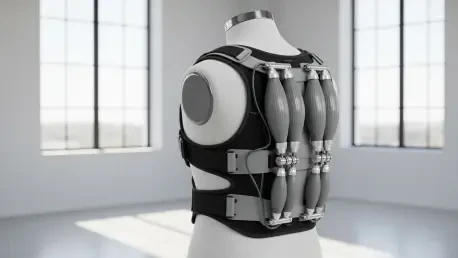
Extending the utility of soft robotics to the human body, researcher Rohan Khatavkar has developed hybrid Back Support Devices (BSD) that redefine wearable technology. These systems address the inherent compromise found in current exoskeletons, which are typically either heavy and motorized or lightweight but non-adjustable. By integrating elastic actuators with pneumatic artificial muscles in a parallel configuration, the ASU team has created a tunable system that adapts to the wearer’s needs. This hybrid approach allows the device to provide maximum support during heavy lifting while remaining unobtrusive during lighter tasks. The result is a wearable solution that offers the strength of an active exoskeleton without the associated bulk or restrictive weight. For workers in logistics or healthcare, this technology provides a critical safeguard against musculoskeletal injuries, proving that soft robotic principles can be directly applied to enhance human physical capabilities and long-term health.
The overarching strategy within the ASU lab involves creating a unified technological framework that can be scaled across various industries rather than focusing on isolated inventions. By leveraging nature as a universal design standard, the researchers are developing versatile systems that promise lower-cost applications for mass adoption. This shift toward a holistic design philosophy ensures that the innovations are commercially viable and easily integrated into existing industrial workflows. Support from major industry players and significant hardware grants has accelerated the movement of these concepts from theoretical models to functional prototypes. As these frameworks become more standardized, they will enable the rapid deployment of bio-inspired robots in everything from home care for the elderly to deep-sea exploration. The ability to customize these “muscles” for specific tasks while maintaining a consistent technological base is what makes this research a cornerstone for the future of automated assistance and industrial safety.
Strategic Implementation and Future Implications
The integration of these soft robotic advancements into high-stakes environments offers a transformative solution for disaster relief and specialized agriculture. In search-and-rescue operations, the capacity for soft robots to compress and navigate through unstable debris is a literal lifesaver, as they can locate survivors without triggering further collapses of ruined structures. Similarly, in the agricultural sector, soft robotic arms are becoming indispensable for delicate manual tasks like pollination and harvesting. Unlike drones or heavy machinery that can damage sensitive crops through physical contact or turbulent air, these soft systems provide a gentle touch that preserves the integrity of the produce. This precision, combined with the ability to operate in cramped or hazardous spaces like chemical plants, demonstrates the broad utility of bio-inspired design. These robots are not just substitutes for human labor; they are specialized tools designed to perform in environments where traditional machines and humans alike would struggle.
The advancements led by the ASU team established a clear trajectory for the next phase of robotic development, where machines moved beyond the limitations of rigid metal and became truly compliant with their surroundings. These researchers successfully demonstrated that by prioritizing lightweight, flexible materials, it was possible to overcome the traditional barriers of weight and power dependency that hindered automation for decades. Organizations looking to adopt these technologies should have focused on integrating soft actuators into existing safety protocols to maximize the benefits of human-robot collaboration. Looking forward, the next step involved the mass production of these bio-inspired components to drive down costs for the healthcare and logistics sectors. By securing patents and industry partnerships, the laboratory ensured that these designs provided a sustainable foundation for future explorations into deep-sea and space environments. Ultimately, the shift toward soft robotics proved to be a necessary evolution in creating a more integrated and safer technological landscape.