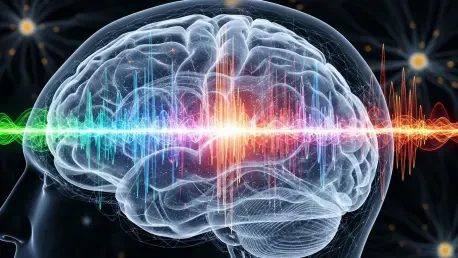

While it seems nearly impossible to look directly at a pair of misplaced car keys and fail to register their presence, this frequent lapse in human perception highlights a fundamental truth about how the brain constructs reality. The eyes do not function as simple cameras recording a passive stream of data; instead, the mind relies on a complex, fluctuating system of electrical signals to interpret the surrounding environment. Recent findings by neuroscientists at the Salk Institute suggest that the ability to perceive the world depends on neural traveling waves. These oscillations sweep across the brain like ripples moving through a pond, serving as a dynamic mechanism that dictates what the conscious mind ultimately acknowledges or ignores.
These traveling waves were once dismissed as mere background noise or secondary byproducts of neural activity. However, the current understanding places them at the center of the brain’s computational hardware. By functioning as a continuous flow of electrical energy, these waves ensure that sensory information is not just received, but actively processed and organized. This paradigm shift suggests that the timing and movement of these waves are the primary drivers of conscious experience, determining whether a stimulus is captured by the senses or lost in the chaotic flurry of neural firing.
Beyond Static Signals: The Ripples That Define Our Reality
The human brain is a dynamic environment where the flow of electricity is constantly reshaping the boundaries of perception. Neural traveling waves represent a rhythmic movement of activity that traverses the cortex, coordinating the firing of millions of neurons in a synchronized fashion. Unlike static signals that remain localized, these ripples integrate information across different regions of the brain, creating a cohesive narrative from disparate sensory inputs. This suggests that the brain is not a collection of isolated processors but a unified system driven by fluid dynamics.
When a person focuses on a specific task, these waves organize the neural landscape to prioritize relevant information. If the waves are not in the correct phase when a visual stimulus enters the system, the information may fail to reach the threshold of awareness. This mechanism explains why performance on sensory tasks can fluctuate so significantly from one moment to the next. The presence of these waves provides a structured framework that allows the brain to maintain a stable perception of reality despite the constant influx of unpredictable data.
The Evolution of Cortical Theory and the Discovery of Neural Flow
For many decades, the visual cortex was described as a passive processor, essentially a relay station that translated light and shapes into electrical signals. This older model struggled to explain the inconsistencies of human perception and why the same stimulus could produce different responses at different times. Research involving awake, behaving subjects eventually revealed that traveling waves are not only present but are also essential for successful sensory detection. This discovery transformed a long-standing neurological mystery into a study of temporal dynamics and electrical flow.
The perception conundrum—the mystery of why we miss what is right in front of us—is now understood as a matter of timing. If a visual signal hits the cortex during a specific phase of a traveling wave, it is amplified and processed; if it hits during an opposing phase, it is effectively suppressed. This realization forced a re-evaluation of how the brain manages its resources. Instead of seeing the cortex as a static grid, researchers now view it as a shifting sea of electrical activity where the success of information transfer depends entirely on the state of the wave at any given microsecond.
Four Fundamental Pillars of the Neural Wave Computational System
The computational engine of the brain operates through four distinct functional pillars that streamline interaction with the physical world. First, these waves act as a moment-to-moment gatekeeper, modulating the sensitivity of sensory regions to ensure that the most important information is prioritized. This gating mechanism explains the inherent fluctuations in attention and why some sensory details are ignored while others are brought into sharp focus. Second, the waves serve as architects of internal representation, organizing chaotic raw data into structured neural maps that the brain can easily interpret and manipulate.
The third pillar involves a predictive edge that allows the brain to forecast the immediate future. By projecting waves across the cortex, the brain anticipates the trajectory of moving objects or changes in environmental lighting before they occur. Finally, these waves play a critical role in the storage and replay of memory. They record patterns of activity as they unfold and replay them during rest or reflection to consolidate learning. Together, these four pillars transform the brain from a simple sensory receiver into a sophisticated machine capable of managing complex, real-time interactions.
Insights from the Salk Institute: The Brain as a Biological Generative AI
A profound comparison has emerged between the architecture of the brain and the design of Large Language Models. Much like an artificial intelligence predicts the next word in a sequence based on statistical probability, the brain uses traveling waves to predict the next moment in the physical world. The synaptic weights—the strengths of connections between neurons—are not fixed; they are constantly adjusted based on experience to improve the accuracy of these predictions. This turns the brain into a biological generative model that is always working to create a “best-guess” version of reality.
This active inference machine does not simply observe the world; it generates it. By filtering out the immense amount of environmental noise, the brain uses its wave-generating circuitry to focus on the most likely causes of sensory input. This process allows for a coherent experience of the world that would otherwise be an overwhelming onslaught of data. The efficiency of this system is what allows humans to navigate complex environments with minimal effort, as the brain is always one step ahead of the actual sensory input it receives.
Decoding the Mechanism: How the Brain Models the Physical World
The brain encodes the fundamental laws of physics into its own circuitry through a lifetime of experience and interaction. By learning how objects behave in three-dimensional space and how light reflects off surfaces, the neural networks embed these regularities into their very structure. This internal model allows the brain to generate waves that infer the most probable state of the world at any given time. This strategy of predictive coding ensures that the brain only expends energy on information that deviates from its internal model, significantly increasing computational efficiency.
This transition toward a network-based view marks a major milestone in neuroscience, moving away from the study of isolated brain parts. Understanding the brain as a unified, wave-driven system provides a clearer picture of how complex behavior emerges from simple biological rules. As the mechanics of these traveling waves become clearer, the distinction between the biological mind and advanced computational systems continues to blur. This framework establishes that the brain is not just reacting to the world but is actively constructing it through a continuous flow of rhythmic, electrical energy.
The identification of neural traveling waves as a computational engine provided a transformative perspective on the nature of the mind. Researchers established that these oscillations served as the primary bridge between raw sensory data and conscious awareness. By analyzing the brain through the lens of a biological generative AI, the scientific community developed a deeper appreciation for the predictive power of the human cortex. These insights fostered new approaches to understanding cognitive health and paved the way for future developments in neuro-technology and artificial intelligence. The study of wave dynamics ultimately clarified how the brain transformed a chaotic environment into a predictable and navigable reality.