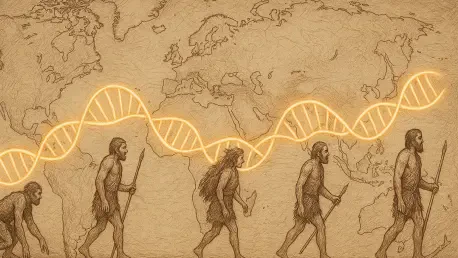

The ability to reconstruct the history of our species using ancestral recombination graphs has exposed genetic depths that were previously invisible to traditional fossil analysis. This methodology allows researchers to look beyond the physical remains of our ancestors, revealing a complex tapestry of interbreeding events that occurred hundreds of thousands of years ago. Recent studies from the University of California, Berkeley, suggest that the Denisovans—a mysterious group of hominins—were already a hybrid population long before they encountered the ancestors of modern humans. By applying advanced statistical modeling to ancient genomes, scientists have identified a super-archaic genetic signature that branched off from the human lineage nearly 1.8 million years ago. This discovery indicates that our evolutionary path was not a simple, linear progression but rather a series of merging and diverging populations. The presence of this ancient DNA in contemporary humans proves these prehistoric interactions have a lasting impact.
Tracing the Super-Archaic Legacy
Historical Divergence and the Identity of the Ghost Lineage
The identity of the super-archaic population is a subject of intense scientific debate, as this group diverged from the lineage leading to modern humans approximately 1.8 million years ago. This specific timeframe is particularly noteworthy because it aligns with the appearance of Homo erectus in the fossil record, suggesting that this well-known ancestor may be the source of the mysterious genetic material. While researchers are cautious about making a definitive link without more physical evidence, the genomic data confirms that this population remained isolated for an immense duration before ever mixing with other hominin groups. This isolation allowed the super-archaic lineage to develop a highly distinct genetic profile, which acted as a marker for their eventual re-entry into the broader human gene pool. The fact that three to five percent of the Denisovan genome comes from this ancient source highlights the significant role that these ghost populations played in shaping archaic groups.
It is vital to distinguish between the moment of genetic divergence and the actual period of interbreeding, as these two events are separated by over a million years. Although the super-archaic lineage split from the modern human line nearly two million years ago, it did not mix with the Denisovans until a much later period, likely around 200,000 years ago in Eurasia. This vast window of isolation allowed the ghost population to accumulate a unique set of genetic mutations that became their biological signature. When contact finally occurred, the resulting hybridization events integrated these unique markers into the Denisovan gene pool. Consequently, the Denisovans acted as a biological bridge, preserving DNA that would have otherwise been lost to time. This process shows that the ancient world was a place of unexpected encounters, where groups that had been separated for dozens of millennia could still exchange genetic material and influence the future of the human species.
Innovative Methodologies in Modern Genomics
Detecting these ancient genetic signatures without having a physical sample of the ghost lineage is made possible by a tool known as TRACE. This innovative method analyzes ancestral recombination graphs, which function as detailed family trees for specific segments of our chromosomes. Because DNA breaks and recombines with every generation, each chromosome is essentially a mosaic of different historical segments, each with its own unique ancestry. TRACE specifically looks for segments that appear significantly older or show a deeper branching pattern than the rest of the genome, indicating a long period of genetic isolation followed by a sudden merging. By utilizing these patterns, scientists can infer the presence of an unknown ancestor and even estimate the timing of their divergence. This technique marks a significant leap forward in paleogenomics, as it allows researchers to reconstruct the lives of hominins who left behind no known bones or artifacts for us to study in the present day.
To ensure the accuracy of the TRACE methodology, the research team validated the tool against extensive simulated datasets and known genetic sequences from Neanderthals and Denisovans. These tests confirmed that the algorithm could reliably distinguish between standard genetic variation and the specific patterns left by interbreeding with a super-archaic source. The results showed that the super-archaic signal was consistently found within the Denisovan genome but was notably absent from Neanderthal lineages in the same regions. This asymmetry provided strong evidence that the interbreeding event was specific to the Denisovan line, reinforcing the idea that different hominin groups had vastly different interaction histories. This methodological rigor is essential for building confidence in the existence of ghost populations that only live on within our DNA. As computational power continues to grow, these techniques will likely uncover even more layers of hidden ancestry.
The Mechanics of Genetic Transmission
The Two-Stage Route to Modern Humans
The transmission of super-archaic DNA into the modern human gene pool is best understood as a two-stage evolutionary process that occurred over vast spans of time and geography. The first stage began over 200,000 years ago when the super-archaic lineage interbred with Denisovans in the vast landscapes of Eurasia, permanently altering the genetic makeup of the Denisovan population. This resulted in a hybrid group that carried a small but significant percentage of ancient DNA from a group that had diverged nearly two million years prior. The second stage occurred much later, as modern humans migrated out of Africa and encountered these hybrid Denisovans in Southeast Asia and the Pacific. During these encounters, the already-mixed genetic material was passed into the modern human lineage. This fraction of a fraction of ancient inheritance represents a nested history, where the genetic legacy of the super-archaic group was carried forward by a second group before finally reaching contemporary humans.
This nested inheritance pattern is particularly fascinating because it shows how the Denisovans acted as a biological conduit for genetic material that would have otherwise gone extinct. Without the Denisovans serving as an intermediary, the 1.8-million-year-old genetic markers of the super-archaic group likely would not have survived into the present day. The data suggests that these interactions were not uniform across the globe; rather, they were concentrated in specific regions where these different groups overlapped. For modern humans, this means that our genomes are not just a record of our own migration and survival, but also a museum of the extinct groups that we met along the way. The complexity of this two-stage route highlights the importance of Southeast Asia and Oceania as key theaters of human evolution, where multiple waves of hominins met and merged. This dynamic history challenges the idea that modern humans simply replaced older groups, suggesting instead a much more integrated biological transition.
Genetic Preservation in Contemporary Populations
The highest concentrations of this Denisovan-derived super-archaic DNA are found today in contemporary populations across Oceania, particularly in Papua New Guinea and the surrounding islands. To study this phenomenon, researchers analyzed 92 high-coverage genomes from people in these regions, as they possess the largest reservoir of Denisovan ancestry in the world. By focusing on these specific groups, scientists were able to scan large segments of DNA for the subtle signatures of the super-archaic ghost lineage that had been nested within their Denisovan inheritance. While the total percentage of this ancient material in living individuals is quite small, it provides an invaluable window into the past. The presence of these markers in Oceanian populations serves as a biological archive of the movements and social interactions of hominin groups that lived long before the dawn of recorded history. These genetic footprints allow us to map migrations that led to the colonization of our planet.
The study of ancient genomes concluded that the story of human evolution was a narrative of constant adaptation and genetic exchange, demanding a new approach to anthropological research. Scientists recognized that the discovery of super-archaic DNA within the Denisovan lineage required a more fluid definition of species, moving away from rigid biological categories. Moving forward, the focus shifted toward integrating computational biology with the search for new fossil sites in under-sampled regions of Africa and Asia. These actionable steps aimed to identify the physical remains of the ghost populations that have long been known only through their genetic legacy. By combining these advanced tools with traditional archaeology, the scientific community prepared to map the full complexity of our shared ancestry. This work laid the foundation for future discoveries that will continue to challenge our understanding of what it means to be human in a world shaped by millions of years of hidden interactions.