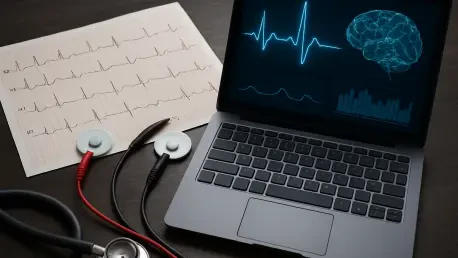

The century-old electrocardiogram, a cornerstone of cardiac diagnostics, is being fundamentally reinvented by artificial intelligence, unlocking predictive capabilities that were once the domain of science fiction. This fusion of computational power and medical data represents a significant advancement in cardiology, moving the field away from purely reactive diagnostics toward a more predictive and personalized paradigm. This review will explore the evolution of this technology, its key features and performance, and the profound impact it has on clinical applications. The purpose is to provide a thorough understanding of AI-ECG analysis, its current capabilities, and its potential for future development.
Introduction to AI in Electrocardiography
The integration of artificial intelligence into electrocardiography marks a pivotal shift from traditional interpretation methods that have dominated for decades. Historically, ECG analysis relied on human experts applying a set of established rules and pattern recognition skills to diagnose cardiac conditions. This process, while effective, is subject to inter-observer variability and can be time-consuming. The advent of AI introduces a new paradigm, leveraging machine learning and deep learning models that are trained on vast datasets of ECGs to identify complex patterns, some of which are imperceptible to the human eye. This data-driven approach automates and enhances the diagnostic process, offering greater speed and consistency.
This technological evolution is not occurring in a vacuum; it is a central component of the broader digital health transformation. AI-powered ECG analysis aligns perfectly with the goals of precision medicine, which seeks to tailor healthcare to the individual patient. By extracting more nuanced information from a ubiquitous and non-invasive test, these tools enable earlier and more accurate diagnoses, facilitate remote patient monitoring, and provide the foundation for predictive risk stratification. Consequently, AI is elevating the humble ECG from a simple diagnostic tool to a powerful source of personalized cardiovascular insight.
Core Technologies and Methodologies
Foundations in Feature-Based Machine Learning
The initial forays into applying AI to ECG analysis were dominated by traditional machine learning algorithms. Models like Support Vector Machines (SVMs) and Random Forests were trained to classify cardiac abnormalities based on a set of predefined, manually engineered features. In this approach, domain experts first extract specific, quantifiable characteristics from the ECG signal, such as the duration of the P-Q-R-S-T intervals, the amplitude of various waves, and heart rate variability metrics. The machine learning model then learns the relationships between these features and specific clinical diagnoses.
These feature-based methods represented a critical step forward, successfully automating the classification of common arrhythmias and other conditions with a high degree of accuracy. Their primary advantage lies in their relative simplicity and interpretability, as the features used for decision-making are explicitly defined by clinicians. However, this approach is inherently limited by its reliance on human-defined features. It cannot discover novel predictive patterns in the ECG waveform that fall outside the scope of existing clinical knowledge, a key constraint that advanced neural networks have since overcome.
The Deep Learning Revolution in ECG Interpretation
The most significant recent advancements in AI-ECG analysis have been driven by deep learning, particularly Convolutional Neural Networks (CNNs) and Recurrent Neural Networks (RNNs). Unlike traditional machine learning, these models do not require manual feature extraction. Instead, they learn hierarchical features directly from the raw, unprocessed ECG waveform data. CNNs, originally designed for image analysis, excel at identifying spatial patterns within the ECG signal, while RNNs are adept at interpreting the time-series nature of the cardiac cycle.
This ability to perform end-to-end learning has unlocked unprecedented diagnostic capabilities. Deep learning models can detect subtle morphological changes in the ECG that are linked to a wide range of conditions beyond simple arrhythmias. For example, they can identify the electrical signatures of structural heart diseases like hypertrophic cardiomyopathy or predict a patient’s biological age and sex from their ECG alone. This leap in performance has firmly established deep learning as the dominant methodology in modern AI-ECG development.
The Importance of Data Preprocessing and Augmentation
The performance of any AI model is fundamentally dependent on the quality and quantity of the data used for its training. In ECG analysis, this begins with rigorous data preprocessing steps to ensure the signal is clean and standardized. This typically involves applying digital filters to remove noise from muscle tremors or powerline interference, algorithms to correct for baseline wander caused by patient movement, and normalization techniques to standardize the signal’s amplitude across different recordings and devices.
To build robust models that generalize well to diverse patient populations, developers often employ data augmentation. This involves creating new, synthetic training examples by applying various transformations to the existing ECG data, such as adding controlled noise, stretching or compressing the signal, or altering its amplitude. These techniques artificially expand the size and diversity of the training dataset, helping to prevent the model from overfitting to specific characteristics of the original data and improving its performance when deployed in new clinical environments.
Emerging Trends and Recent Innovations
Integration with Wearable and Remote Monitoring Devices
One of the most transformative trends is the application of AI analytics to data from wearable and remote monitoring devices. The proliferation of smartwatches, skin patches, and other ambulatory monitors equipped with single-lead ECG sensors has generated an unprecedented volume of long-term cardiac data. AI algorithms are essential for making sense of this continuous data stream, enabling real-time detection of intermittent arrhythmias like atrial fibrillation that are often missed during a brief, in-clinic 12-lead ECG.
This shift toward continuous surveillance outside the hospital is redefining cardiovascular care, moving it from an episodic to a proactive model. AI-powered remote monitoring allows for the early detection of deteriorating cardiac conditions, facilitates timely clinical intervention, and empowers patients to take a more active role in managing their health. This trend is not just about convenience; it is about creating a safety net for high-risk individuals and capturing critical cardiac events as they happen.
Predictive Analytics for Future Risk Stratification
A groundbreaking frontier for AI-ECG analysis is its use in predicting future cardiac events from a seemingly normal ECG. Researchers have demonstrated that deep learning models can analyze a standard 12-lead ECG and identify subtle signals that predict a patient’s risk of developing conditions like atrial fibrillation within the next year, even when the current ECG shows a normal sinus rhythm. These algorithms can also predict the risk of silent myocardial infarction or sudden cardiac death.
This capability to “see the future” in an ECG has profound implications for preventative cardiology. For instance, a recent multicenter study showed that an AI tool could effectively identify patients with repaired tetralogy of Fallot who were at high risk of adverse ventricular remodeling, a complication that traditionally requires expensive cardiac MRI scans for detection. By using the ECG as a powerful and accessible screening tool, clinicians can identify at-risk individuals early and initiate preventive therapies or more intensive surveillance, potentially averting serious adverse outcomes.
Fusing ECG Data with Multimodal Information
The future of diagnostic accuracy lies in multimodal data fusion, an approach where AI models integrate information from the ECG with other sources of patient data. By combining ECG signals with data from electronic health records (EHR), such as demographics, lab results, and comorbidities, models can create a more holistic and context-aware assessment of a patient’s cardiovascular health.
Further advancements involve fusing ECG data with other diagnostic modalities. For example, an AI model could combine electrical information from an ECG with structural information from cardiac imaging (like an echocardiogram or MRI) and even genetic markers from genomic data. This synergistic approach allows the AI to build a far more comprehensive and accurate picture of a patient’s pathophysiology, leading to more precise diagnoses and highly personalized prognostic predictions.
Clinical Applications and Use Cases
Automated Arrhythmia Detection and Classification
The most mature and widely adopted application of AI in electrocardiography is the automated detection and classification of arrhythmias. AI algorithms integrated into both hospital-grade monitors and consumer wearables can instantly identify and categorize a wide spectrum of heart rhythm disorders, from common conditions like atrial fibrillation and premature ventricular contractions to life-threatening ones such as ventricular tachycardia.
In clinical practice, this technology serves as a powerful decision-support tool, helping clinicians to quickly sort through hours or even weeks of ECG recordings to pinpoint significant events. This dramatically improves diagnostic efficiency and accuracy, reducing the risk of missed diagnoses and enabling faster treatment. For patients using wearable devices, these AI-driven alerts can be the first indication of a previously undiagnosed and potentially serious heart condition, prompting them to seek timely medical care.
Rapid Triage of Ischemia and Myocardial Infarction
In emergency medicine, where time is critical, AI-ECG tools are being deployed to accelerate the identification of acute coronary syndromes, including myocardial ischemia and infarction (heart attack). AI models can be trained to recognize the subtle ECG patterns indicative of a blocked coronary artery, often with a level of accuracy and speed that surpasses human interpretation alone.
This capability is invaluable in pre-hospital settings, such as in ambulances, and in busy emergency departments. An AI-powered system can automatically flag high-risk ECGs, alerting the medical team to a potential heart attack and facilitating faster triage and activation of the cardiac catheterization lab. By reducing the time from diagnosis to intervention, these tools have the potential to significantly improve patient outcomes and save heart muscle.
Screening for Hidden Structural Heart Disease
Perhaps one of the most innovative applications is the use of AI to screen for underlying structural heart diseases that do not have obvious or classic ECG manifestations. Advanced deep learning models have been developed that can analyze a standard ECG and infer the presence of conditions like a low left ventricular ejection fraction (a weak heart pump), hypertrophic cardiomyopathy, or aortic stenosis.
Traditionally, these conditions require an echocardiogram or other imaging studies for diagnosis. By leveraging the ECG as a low-cost, widely available screening tool, AI makes it possible to identify asymptomatic or at-risk individuals in the general population who may unknowingly have these serious conditions. This creates an opportunity for early intervention that could prevent the progression to heart failure or other severe complications, heralding a new era of opportunistic cardiovascular screening.
Challenges and Current Limitations
Data Quality Bias and Generalizability
Despite its promise, the widespread adoption of AI-ECG analysis faces significant technical hurdles, primarily related to data. The performance of AI models can be severely degraded by poor-quality or noisy ECG signals, a common problem in real-world clinical settings. Furthermore, a critical challenge is algorithmic bias. If a model is trained predominantly on data from a specific demographic group, its performance may be substantially worse when applied to underrepresented populations, potentially exacerbating existing health disparities.
Ensuring that a model generalizes well—meaning it performs accurately across different hospitals, patient populations, and ECG acquisition devices—is a major ongoing challenge. As demonstrated in recent validation studies, an algorithm that performs exceptionally well at its development institution may show a significant drop in performance when deployed elsewhere. This necessitates rigorous, multicenter validation and, in some cases, site-specific calibration before a tool can be safely integrated into clinical practice.
The Black Box Problem and Clinical Trust
A significant barrier to clinician adoption is the “black box” nature of many sophisticated deep learning models. While these models can make highly accurate predictions, their internal decision-making processes are often opaque, making it difficult for a physician to understand the clinical reasoning behind a particular output. This lack of interpretability can undermine trust, as clinicians are understandably hesitant to base critical medical decisions on a recommendation they cannot comprehend or verify.
To address this, the field of eXplainable AI (XAI) is gaining prominence. Researchers are developing techniques, such as saliency maps, that highlight the specific portions of the ECG waveform that most influenced a model’s prediction. By providing this visual evidence, XAI aims to make the models more transparent and trustworthy, bridging the gap between algorithmic output and clinical intuition and thereby fostering greater acceptance and safer implementation.
Regulatory Hurdles and Workflow Integration
Beyond technical challenges, AI-ECG tools face significant market and logistical obstacles. Navigating the complex regulatory pathways for medical devices, such as obtaining clearance from the U.S. Food and Drug Administration (FDA) or CE marking in Europe, is a lengthy and resource-intensive process. Developers must provide extensive evidence of a tool’s safety, efficacy, and clinical validity before it can be legally marketed.
Even after regulatory approval, seamless integration into existing clinical workflows remains a major hurdle. Hospitals often have legacy IT infrastructure that makes it difficult to incorporate new software. The AI tool must be integrated smoothly into the electronic health record and the existing ECG management systems without disrupting established processes. Successfully overcoming these practical integration challenges is just as important as the performance of the algorithm itself for achieving widespread, impactful adoption.
Future Outlook and Potential Breakthroughs
AI as a Driver of Personalized Cardiovascular Medicine
Looking forward, AI-powered ECG analysis is poised to become a cornerstone of personalized cardiovascular medicine. The technology is moving beyond simple classification tasks toward providing patient-specific risk predictions and treatment guidance. In the future, an AI model might analyze a patient’s ECG in conjunction with their clinical and genomic data to recommend the most effective antihypertensive medication or to predict their individual response to a particular therapy. This will enable a shift from one-size-fits-all guidelines to a more proactive and highly tailored approach to care.
Enabling Population-Scale Screening Programs
The long-term vision for AI-ECG technology involves its use in large-scale public health screening programs. Given the low cost and accessibility of the ECG, AI-driven analysis could be deployed to screen entire populations for asymptomatic individuals at high risk for cardiovascular disease. Such programs could identify people with silent atrial fibrillation, undiagnosed structural heart disease, or a high risk for future heart failure, allowing for early intervention at a scale that is currently unfeasible. This has the potential to fundamentally change public health strategy, focusing on prevention rather than treatment of advanced disease.
Breakthroughs in Advanced AI Methodologies
The next wave of innovation will likely come from next-generation AI methodologies that address current data limitations. Federated learning, for example, allows models to be trained across multiple hospitals and health systems without requiring the sharing of sensitive patient data, thereby protecting privacy while enabling the creation of larger and more diverse training datasets. Concurrently, self-supervised learning techniques are being developed that can learn powerful representations from vast quantities of unlabeled ECG data, reducing the reliance on time-consuming and expensive expert annotation. These breakthroughs promise to accelerate the development of more robust, accurate, and generalizable AI-ECG models.
Conclusion and Final Assessment
AI-powered ECG analysis is rapidly maturing from a promising research concept into an impactful clinical tool that is reshaping cardiovascular medicine. By leveraging both traditional machine learning and advanced deep learning networks, this technology extracts diagnostic and prognostic information from the ECG with a depth and accuracy previously unattainable. Its applications already span from automated arrhythmia detection and emergency triage to the innovative screening for hidden structural heart diseases, demonstrating its versatility and clinical utility.
While significant challenges related to data quality, algorithmic bias, model interpretability, and clinical integration remain, the pace of innovation is relentless. The emerging trends of integration with wearable devices, predictive risk stratification, and multimodal data fusion are setting the stage for an even greater impact. Ultimately, AI-powered ECG analysis is a transformative technology that is actively transitioning cardiology from a reactive to a predictive discipline, offering unprecedented opportunities to enhance diagnostic efficiency, personalize patient care, and improve cardiovascular outcomes on a global scale.