
The landscape of laboratory research is undergoing a profound transformation, moving away from siloed operations and toward a future defined by intelligent, interconnected automation. At the upcoming SLAS 2026 conference in Boston, ABB Robotics is set to demonstrate a significant leap forward in this evolution, showcasing how the powerful combination of artificial intelligence and collaborative robotics is creating more flexible and accessible laboratory workflows. The company’s presentation will focus on the industry-wide transition from isolated automation projects to fully integrated, data-driven, and AI-ready ecosystems. This shift promises to empower laboratories of all sizes to scale their operations more rapidly, improve the reliability of experimental outcomes, and extract deeper, more meaningful insights from their research. By emphasizing interoperability, ABB aims to present a practical vision of the “lab of the future,” where collaborative robots work in concert with existing analytical instruments and software from a multitude of vendors to form cohesive, end-to-end automated processes that were once the domain of science fiction.
The Vision of an Interconnected Ecosystem
A fundamental change is sweeping through the scientific community as laboratories pivot from standalone automated instruments to fully connected workflows powered by artificial intelligence. This evolution enables research facilities to not only enhance their throughput but also to achieve unprecedented levels of operational reliability and data-driven insight. According to Jose-Manuel Collados, a Product Line Manager for ABB Robotics, this transition is critical for enabling laboratories to scale more effectively and meet the growing demands for productivity and regulatory compliance. The focus is no longer on simply automating a single task but on orchestrating a complex series of processes seamlessly. The core of this new paradigm is interoperability—the ability for different systems, instruments, and software platforms to communicate and work together harmoniously. ABB is championing this vision by demonstrating how its collaborative robots can serve as the central hub, integrating with a diverse array of third-party analytical equipment and management software to create a unified and highly efficient automated environment.
This integrated approach represents a significant departure from traditional laboratory automation, which often resulted in islands of technology that could not easily share data or coordinate tasks. The “lab of the future” envisions a fluid ecosystem where robots, analytical instruments, and data management systems operate as a single, intelligent unit. ABB’s strategy involves showing how collaborative robots, or “cobots,” can be easily incorporated into existing laboratory setups, augmenting the capabilities of current equipment rather than requiring a complete overhaul. This emphasis on seamless integration lowers the barrier to entry for many laboratories, allowing them to adopt advanced automation in a phased and cost-effective manner. By connecting disparate pieces of equipment, these systems can automate entire workflows from sample preparation to final analysis, minimizing human error, freeing up skilled scientists for more complex work, and ensuring that experimental data is consistent, reliable, and captured digitally from start to finish.
Live Demonstrations of Collaborative Automation
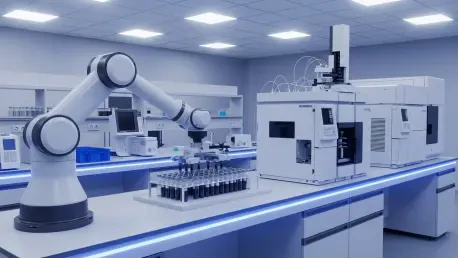
To bring this vision of an interconnected laboratory to life, ABB will present three live process cell demonstrations built around its GoFa™ collaborative robot platform, which is specifically designed for safe operation alongside human personnel. In a notable collaboration with Mettler Toledo, one demonstration will feature a complex, multi-step analytical workflow managed by the sophisticated LabX™ management software. The GoFa robot will adeptly handle a variety of delicate tasks, including precise pipetting, careful decanting of liquids, and secure vial capping. This automated process will span the entire workflow, from initial sample preparation and precise weighing to titration and final UV-Vis analysis. By automating these repetitive yet critical steps, the system dramatically improves the consistency and reproducibility of results while significantly increasing operator walkaway time, allowing highly trained staff to focus on data interpretation and experiment design rather than manual instrument tending. This exhibit serves as a powerful example of how robotics and intelligent software can orchestrate intricate processes.
A second display will highlight the robot’s versatility by focusing on the demanding requirements of gas chromatography sample preparation, a process that involves a combination of complex dry and wet lab tasks. The GoFa robot will flawlessly execute procedures such as automated solid dispensing, the precise handling of volumetric flasks, and the careful loading of samples into the GC instrument. This entire cell will be supported by ABB’s OptiFact™ software platform, a powerful tool for managing and analyzing facility-wide data, thereby underscoring the critical role of digital connectivity in modern laboratories. In a third collaborative demonstration at the Agilent Technologies booth, another system will showcase the robotic transfer of plates and consumables between various instruments. This will include moving materials between a plate hotel and an Agilent Bravo liquid handler, illustrating how cobots can provide repeatable, high-throughput handling that complements and enhances the functionality of existing high-end laboratory equipment.
Pioneering the Future of Laboratory Research
The convergence of AI, robotics, and advanced analytics was further explored in an industry roundtable that brought together leading experts to discuss the transformative impact of these technologies on laboratory operations. The session, titled “From insight to impact: AI, robotics and the convergence toward the lab of the future,” featured specialists from Atinary, Agilent, Mettler Toledo, Sanofi, and ABB, who collectively examined how this technological fusion is reshaping research and development. The discussion solidified the consensus that laboratories are facing mounting pressure to increase productivity, shorten discovery timelines, and adhere to increasingly stringent regulatory standards. The integration of AI-driven orchestration with flexible collaborative robotics was identified not as a luxury but as an essential component of the infrastructure required for future scientific discovery. These systems provided the tools necessary to manage complexity, improve data quality, and accelerate the pace of innovation, which ultimately set a new standard for research environments.