
Ivan Kairatov is a leading biopharma expert whose career has been defined by bridging the gap between fundamental molecular research and clinical innovation. With extensive experience in research and development, he has spent years investigating how cellular mechanics can be harnessed to treat complex diseases like cancer. In this discussion, he explores a groundbreaking discovery: the “nuclear metabolic fingerprint,” which reveals that hundreds of energy-producing enzymes are physically attached to our DNA, challenging the long-held belief that metabolism and genome regulation are separate systems.
The following conversation delves into the specifics of this “mini-metabolism” within the nucleus, the implications of tissue-specific enzyme patterns for cancer treatment, and the mysterious ways these large proteins bypass cellular barriers.
Over two hundred metabolic enzymes traditionally associated with the mitochondria have been identified sitting directly on human DNA. How does this discovery of a “nuclear metabolic fingerprint” redefine the relationship between metabolism and genome regulation, and what specific metrics suggest the nucleus maintains its own independent metabolism?
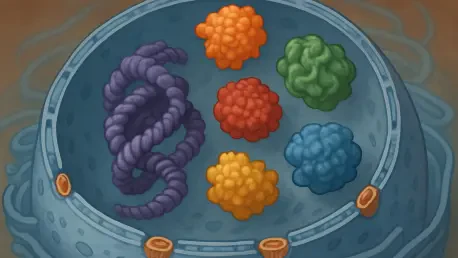
This discovery fundamentally shatters the “two-universe” model where we believed the nucleus handled the blueprints while the mitochondria handled the power. Finding over 200 metabolic enzymes directly on the chromatin suggests that the nucleus isn’t just a passive library, but an active metabolic hub. The most striking metric is that 7% of all proteins attached to chromatin are actually metabolic enzymes, a staggering proportion that points toward a specialized “mini-metabolism” tailored for the genome’s needs. We are seeing a shift from occasional crosstalk to a permanent, localized partnership where energy production and DNA maintenance are physically intertwined. It feels as though we’ve discovered a hidden engine room inside the control center of the cell, operating with its own set of rules and localized resources.
Research shows that oxidative phosphorylation enzymes are prevalent in breast cancer nuclei but largely absent in lung cancer samples. How might these tissue-specific patterns explain why identical mutations respond differently to chemotherapy, and what steps are necessary to turn these fingerprints into reliable diagnostic biomarkers?
The stark contrast between breast and lung cancer samples suggests that the “nuclear fingerprint” acts as a secondary layer of identity that can override or modify the effects of a genetic mutation. If a breast cancer cell has a heavy concentration of energy-generating enzymes on its DNA, it may possess the localized power to repair the damage caused by chemotherapy much faster than a lung cancer cell lacking those same tools. This explains the clinical frustration of seeing two patients with the same mutation respond in opposite ways to the same drug. To turn this into a diagnostic reality, we must move beyond identifying these enzymes and begin quantifying their abundance across thousands of patient samples. We need to establish a standardized map of these fingerprints to predict which tumors are using their nuclear metabolism as a shield against genotoxic stress.
The enzyme IMPDH2 appears to shift its function based entirely on its cellular location, contributing to genome stability only when it is inside the nucleus. Can you provide an anecdote or example of how location-dependent behavior changes a cell’s ability to resist genotoxic stress during medical treatments?
The behavior of IMPDH2 is a perfect example of a cellular “double life” that depends entirely on its zip code. In our experiments, when we observed this enzyme in the cytoplasm, it performed its standard role in general pathways, but when we forced it to remain strictly in the nucleus, it became a dedicated guardian of genome stability. Imagine a cancer patient undergoing radiation; if the tumor cells have successfully shuttled their IMPDH2 into the nucleus, they gain a localized factory for DNA building blocks right at the site of the damage. This proximity allows the cell to stitch its genome back together with incredible efficiency, effectively “ignoring” the treatment that was meant to be lethal. It is a hauntingly clever survival tactic where the cell repurposes a common metabolic tool to act as a frontline soldier against medical intervention.
Approximately 7% of proteins attached to chromatin are metabolic enzymes, many of which are larger than the known size limits of the nuclear pore. What unknown mechanisms might allow these bulky proteins to bypass standard cellular barriers, and how could blocking this transport offer a new strategy for treating tumors?
This is one of the most provocative mysteries in the study: these enzymes are massive, bulky structures that, by all traditional logic, should be too large to squeeze through the nuclear pore complex. The fact that they are found in such high numbers on the chromatin implies there is a “secret door” or a specialized transport mechanism we haven’t yet identified. From a drug development perspective, this is an incredibly exciting vulnerability. If we can identify the specific “chaperone” or the cellular “tugboat” that pulls these heavy enzymes into the nucleus, we could design inhibitors to block that transport. By keeping these enzymes locked in the cytoplasm, we could starve the nucleus of the tools it needs for repair, making the cancer cell far more vulnerable to existing treatments without needing to invent entirely new chemotherapies.
Since each metabolic enzyme may serve a unique, non-traditional role when interacting with DNA, the functional map of the nucleus is suddenly much more complex. What is the step-by-step process for determining if these enzymes are catalytically active or merely providing structural support for the genome?
Mapping this complexity requires a very methodical, enzyme-by-enzyme approach because we cannot assume they are all doing the same thing. First, we use native chromatome profiling to isolate the proteins physically attached to the DNA across various cell lines—as seen in the 44 cancer lines and 10 healthy tissues studied here. Next, we must perform “gain-of-function” and “loss-of-function” tests, specifically by trapping enzymes in either the nucleus or the cytoplasm to see if the cell’s DNA repair capacity changes. We also look for the presence of the actual metabolic products inside the nucleus; if the enzyme is catalytically active, we should see the chemical “exhaust” of its reaction near the chromatin. It is a painstaking process of elimination, but it’s the only way to determine if an enzyme is a primary worker or just a structural pillar supporting the DNA’s architecture.
What is your forecast for nuclear metabolism research over the next decade?
Over the next ten years, I expect we will stop viewing metabolism and genomics as two separate disciplines and instead see the emergence of “metabolic-genomics” as a unified field of medicine. We will likely move away from “one-size-fits-all” chemotherapy toward treatments that are tailored to a patient’s specific nuclear metabolic fingerprint, allowing us to hit tumors exactly where their localized energy supplies are highest. I predict we will discover the specific transport channels that allow those bulky enzymes to enter the nucleus, leading to a new class of “localization inhibitors” that can trap vital enzymes in the wrong part of the cell. Ultimately, this research will transform the nucleus from a static library of genes into a dynamic, metabolic engine, giving us the most precise map of cancer’s inner workings we have ever possessed.