
The diagnosis of B-cell acute lymphoblastic leukemia often strikes families like a sudden, life-altering storm, transforming a normal childhood into a grueling cycle of hospital stays, invasive procedures, and toxic chemical regimens. For decades, the medical community relied almost exclusively on intensive chemotherapy to manage this most common form of pediatric cancer, which accounts for thousands of new cases annually in the United States alone. While these protocols successfully drive many children into remission, the cost of survival is often measured in severe physiological damage and the persistent threat of relapse. For high-risk patients who do not respond to traditional frontline treatments, the outlook was historically bleak, characterized by failed bone marrow transplants and the devastating realization that the standard medical toolkit had been exhausted. This dire reality catalyzed the search for a more precise, less destructive intervention, eventually leading to the groundbreaking development of chimeric antigen receptor (CAR) T-cell therapy. By moving away from systemic poisoning and toward a sophisticated form of genetic engineering, clinicians have begun to rewrite the survival narrative for children who once had no remaining options. This transition marks a fundamental shift in oncology, where the focus has evolved from blunt-force trauma against cancer cells to the elegant, targeted application of the body’s own immune system, effectively turning a patient’s T-cells into living, breathing medicines capable of recognizing and destroying malignant cells with surgical precision.
The Mechanics: Precision Targeting in Cellular Immunotherapy
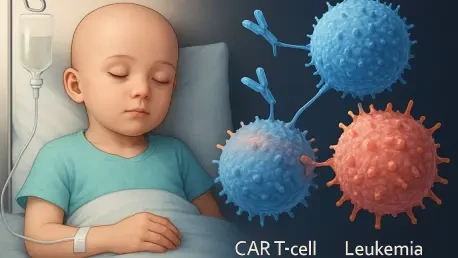
The first generation of approved CAR T-cell therapies represented a seismic shift in how physicians approached refractory B-cell acute lymphoblastic leukemia by focusing on a single protein marker known as CD19. This protein is expressed on the surface of approximately ninety percent of malignant B-cells, making it an ideal target for a cellular search-and-destroy mission. To create this therapy, a patient’s T-cells are harvested and genetically modified in a laboratory to produce synthetic receptors on their surface, which act as a high-tech navigation system designed to home in on the CD19 antigen. Once these engineered cells are infused back into the patient, they circulate through the bloodstream, identifying and binding to leukemia cells with a level of specificity that traditional chemotherapy simply cannot match. This approach was particularly revolutionary for pediatric patients because their cancers are often biologically “bland”—lacking the high mutation rates that typically trigger a natural immune response. By providing the immune system with an artificial GPS, CAR T-cells bypass the body’s natural inability to see the cancer, leading to remarkable initial remission rates. However, as the therapy moved into wider use, clinicians observed that the leukemia cells were capable of a sophisticated defensive maneuver called antigen escape. In about half of the patients who achieved remission, the cancer eventually returned by simply shutting down the expression of the CD19 protein, effectively rendering the leukemia invisible to the very cells designed to kill it.
Recognizing that the adaptability of leukemia cells was the primary obstacle to a permanent cure, researchers began to investigate secondary targets that could serve as a backup to the CD19 marker. The most promising candidate emerged in the form of CD22, another protein commonly found on the surface of B-lineage leukemia cells. Initially, the strategy involved a sequential approach, where patients who had relapsed following CD19-targeted therapy were then treated with a separate infusion of T-cells engineered to find CD22. While this demonstrated that CD22 was indeed a viable target, the results were often fleeting, as the cancer cells eventually learned to hide that marker as well. This led to the scientific consensus that hitting the cancer with two different immune pressures simultaneously would be significantly more effective than applying them one after the other. This dual-targeting logic is rooted in the long-standing principles of multi-drug chemotherapy, where a cocktail of medications is used to prevent the development of drug resistance. By forcing the leukemia cells to navigate two different biological traps at once, the statistical likelihood of the cancer successfully mutating to drop both targets simultaneously becomes vanishingly small. This shift toward dual-targeting represents a more proactive and comprehensive defensive strategy, designed to ensure that even if the leukemia attempts to hide its primary marker, the immune system remains equipped with a secondary line of sight that can maintain the pressure and prevent a lethal relapse.
Structural Sophistication: Bispecific and Bicistronic Architectures
The engineering required to target two proteins simultaneously proved to be far more complex than simply adding a second gene to the T-cell’s genetic code. Researchers first attempted to create what are known as bispecific CAR T-cells, which utilize a single protein structure that features two distinct targeting domains stacked together in a tandem arrangement. On paper and in early laboratory models, this design appeared to be a masterpiece of molecular efficiency, as it allowed one receptor to recognize both CD19 and CD22 antigens. However, as these constructs moved into human clinical trials, the medical community discovered that the physical architecture of the receptor played a critical role in its effectiveness. The stacked “tandem” design often resulted in structural interference, where the proximity of the CD19 and CD22 targeting domains caused them to obstruct one another’s ability to bind with the leukemia cells. This lack of physical “reach” meant that the T-cells were unable to establish a firm connection with their targets, preventing them from releasing the necessary cytokines—the chemical signals required to keep the immune response robust and persistent. Without this sustained activity, the engineered cells would often die off before they could complete the task of eradicating every last malignant cell in the body. This realization forced scientists to reconsider not just what they were targeting, but how the targeting proteins were physically arranged on the cell membrane to ensure maximum biological impact.
Building on the lessons learned from the failures of bispecific models, researchers pivoted toward a bicistronic construct, which represents a more sophisticated leap in genetic engineering. In this side-by-side design, the T-cell is modified to express two entirely separate receptors on its surface, each with its own independent anchoring and signaling mechanism. This is achieved by using a single viral vector to deliver two distinct sets of genetic instructions into the T-cell, ensuring that both the CD19 and CD22 receptors have the space and structural independence needed to function at full capacity. This architectural shift solved the problem of steric hindrance, allowing each receptor to bind to its respective antigen without being blocked by the other. The results from clinical trials initiated between 2024 and 2026 have been nothing short of transformative, with data indicating that this side-by-side configuration leads to significantly better T-cell persistence and more durable remissions. Patients who were once expected to relapse within months have now remained cancer-free for over two years without needing further intervention or bone marrow transplants. This success has demonstrated that the “persistence” of these cells—their ability to survive and continue patrolling the body long after the initial infusion—is the key to preventing the late-stage relapses that had previously plagued single-target therapies. By refining the molecular geometry of the CAR T-cell, scientists have finally developed a weapon that is as persistent and adaptable as the cancer it was designed to fight.
Clinical Implementation: Protecting the Most Vulnerable Patients
One of the most profound implications of dual-target CAR T-cell therapy is its potential to transform the standard of care for infants, a demographic that has traditionally faced some of the most aggressive forms of B-cell acute lymphoblastic leukemia. Treating babies with leukemia is exceptionally difficult because their developing bodies cannot easily withstand the high-dose chemotherapy required to kill the cancer, often leading to lifelong developmental issues, organ damage, and secondary malignancies. Historically, if an infant relapsed after their initial treatment, the chances of long-term survival were remarkably low because there were few “salvage” therapies that were safe enough for their fragile systems. The introduction of targeted cellular therapy offers a way to bypass these toxic chemical loads by using the immune system rather than systemic poisons to achieve a cure. Researchers at leading pediatric institutions are now working to move dual-target CAR T-cell therapy further up the treatment timeline, testing its efficacy as a second-line or even a frontline therapy for high-risk infants. The goal is to establish a paradigm where the youngest patients are spared from the most damaging aspects of traditional oncology, receiving a “one-and-done” cellular infusion that provides lasting protection without the long-term toxicity of chemotherapy. By integrating these advanced immunotherapies into the earliest stages of treatment, physicians hope to significantly improve the quality of life for survivors, ensuring that the cure does not leave behind a legacy of permanent physical harm.
Despite the immense promise of this therapy, it is not without significant clinical challenges, most notably the management of cytokine release syndrome and neurotoxicity. As the CAR T-cells encounter and destroy leukemia cells, they release a massive amount of inflammatory chemicals into the bloodstream, which can cause high fevers, dangerously low blood pressure, and respiratory distress. In the early days of immunotherapy, these side effects were a major barrier to widespread adoption, often requiring intensive care monitoring and complex intervention. However, between 2024 and 2026, clinicians have become far more adept at predicting and mitigating these risks through the use of targeted immunosuppressive drugs that can dampen the inflammatory response without killing the CAR T-cells themselves. This refined management protocol has made the therapy significantly safer, allowing it to be administered in a wider range of clinical settings beyond specialized research hospitals. Furthermore, ongoing studies are investigating the relationship between the dosage of cells infused and the severity of side effects, aiming to find the “sweet spot” where the cancer is eradicated with minimal systemic distress. As the medical community moves toward a deeper understanding of these biological reactions, the focus is shifting from simple survival to optimizing the patient experience. This progress ensures that while the treatment remains powerful enough to defeat the most resilient leukemia, it is also becoming gentle enough to be tolerated by children whose bodies have already been weakened by previous rounds of failed traditional treatments.
Future Trajectories: The Path Toward a Permanent Cure
The transition of dual-target CAR T-cell therapy from a last-resort “salvage” option to a cornerstone of modern pediatric oncology marks a definitive turning point in the fight against childhood cancer. For decades, the goal of treatment was merely to extend life, often at a high cost to the patient’s future health and well-being. Today, the focus has shifted toward achieving a permanent cure that restores a child’s ability to live a normal, healthy life, free from the shadow of relapse and the burden of chronic medication. The success of bicistronic constructs has provided a blueprint for how genetic engineering can be used to outmaneuver the most adaptive cancers, and researchers are already looking for ways to apply these lessons to other forms of pediatric illness. The integration of longitudinal data tracking from 2024 to 2026 has allowed scientists to identify specific biomarkers that predict which patients will respond most favorably to the therapy, paving the way for a new era of personalized medicine. As these therapies become more standardized and accessible, the reliance on high-dose chemotherapy is expected to diminish, potentially ending the era of “shotgun” medicine in favor of the “sniper” precision of cellular immunotherapy. The ongoing refinement of these treatments signifies a future where a diagnosis of B-ALL is no longer a cause for despair, but a manageable condition that can be resolved through the sophisticated manipulation of the human immune system, returning children to their classrooms and families to a life beyond the hospital walls.
The human impact of these scientific milestones is best measured by the return to normalcy for families who were once trapped in an endless cycle of medical trauma. When a child achieves durable remission through dual-target therapy, the effects ripple outward, allowing parents to return to their careers and siblings to regain a sense of stability that is often lost during long-term cancer battles. This psychological restoration is as vital as the biological cure, as it allows families to move from a state of constant survival mode into a future defined by growth and possibility. By reducing the duration of treatment from years of chemotherapy to a matter of weeks for T-cell modification and infusion, the medical community is effectively giving children their childhoods back. Furthermore, the reduction in long-term side effects means that these survivors are more likely to reach adulthood without the cognitive impairments or physical disabilities that once characterized the “leukemia survivor” experience. As cellular therapy continues to evolve, the goal is to refine the production process to make it faster and more affordable, ensuring that every child, regardless of their socioeconomic background, has access to the most advanced genetic medicine available. The progress documented through 2026 serves as a powerful testament to the fact that when clinical expertise and molecular innovation are aligned, even the most formidable pediatric diseases can be successfully and permanently dismantled.
The Legacy: Establishing a New Standard in Pediatric Care
The scientific advancements achieved in dual-target CAR T-cell therapy effectively bridged the gap between experimental laboratory research and standard clinical practice, providing a definitive answer to the problem of antigen escape. By the mid-2020s, the medical community successfully shifted its focus toward the bicistronic model, which addressed the structural limitations of earlier designs and ensured that the immune system maintained a dual-pronged surveillance of leukemia cells. This shift not only improved the durability of remissions but also provided the necessary clinical evidence to support the use of cellular therapies earlier in the treatment cycle. Clinicians began prioritizing the preservation of a patient’s long-term health, recognizing that the precision of T-cell engineering offered a superior alternative to the systemic damage caused by traditional protocols. Moving forward, the emphasis was placed on expanding global access to these therapies and refining the manufacturing processes to reduce costs and wait times for families in need. The lessons learned from the evolution of CD19 and CD22 targeting created a foundational framework for tackling other resilient pediatric cancers, suggesting that the era of cellular medicine was only just beginning. By documenting the success of these refined constructs, the oncology community established a clear path toward the eventual elimination of childhood leukemia as a life-threatening condition. These actionable steps toward personalized, dual-targeted intervention ensured that the biological complexity of the disease was finally met with an equally sophisticated and permanent medical solution.