
The landscape of vaccinology is undergoing a seismic shift, moving away from the traditional, reactive methods that have defined the industry for decades. At the forefront of this revolution is Ivan Kairatov, a biopharma expert whose career has been dedicated to bridging the gap between cutting-edge technology and pharmaceutical research and development. With the recent announcement of successful human trials for a universal Sarbeco coronavirus vaccine developed at the University of Cambridge, Kairatov offers a unique perspective on how digital simulations are finally becoming a clinical reality. This breakthrough represents the first time an active vaccine component, designed entirely through computer modeling, has proven safe in humans, signaling a potential end to the “cat-and-mouse” game of updating shots for every new viral variant. In this discussion, Kairatov explores the mechanics of AI-driven antigen design, the logistical advantages of needle-free delivery systems, and the profound implications of a “future-proofed” approach to global health security.
Machine learning now allows for the creation of “super-antigens” by analyzing global genetic sequences. How exactly does this computational process identify features that remain effective even as a virus mutates?
The beauty of this approach lies in its ability to look past the superficial changes of a virus and focus on its biological core. In the past, we were essentially taking a snapshot of a circulating variant and trying to build a defense against that specific image, which is why we often felt like we were chasing our tails. With machine learning, we processed a massive influx of genetic sequence data for the entire Sarbeco coronavirus group, which includes not just SARS-CoV-2, but also the original SARS and various viruses currently circulating in bat populations. The algorithms identify “conserved” regions—structural features that these viruses cannot afford to change because they are vital for the virus’s survival or its ability to infect cells. By synthesizing these common traits into a single “super-antigen,” we create a target for the immune system that doesn’t disappear when a new strain emerges. It’s a transition from being reactive to being truly predictive, allowing us to train the human body to recognize pathogens that haven’t even jumped from animals to humans yet.
The Phase I trial involved 39 healthy volunteers between the ages of 18 and 50. Given that this was the first time an entirely computer-designed antigen was tested in humans, what specific safety benchmarks were achieved?
The primary goal of any Phase I trial is to ensure that our innovation doesn’t cause harm, and the results published in the Journal of Infection are incredibly encouraging. Among the 39 participants who received the vaccine at facilities in Southampton and Cambridge, there were no significant side effects reported, which validates the safety of this entirely new design philosophy. We weren’t just looking for a lack of adverse reactions, though; we were looking for a specific type of biological “handshake” between the synthetic antigen and the human immune system. The data confirmed that the vaccine triggered robust immune responses across a broad spectrum, covering SARS-CoV-2, the original SARS virus, and related zoonotic threats. Seeing these results in a human cohort, rather than just in animal models, proves that a vaccine designed by a computer can effectively navigate the complexities of human biology without the traditional risks associated with live or attenuated virus platforms.
Traditional vaccines often require frequent reformulations to keep up with new variants, but you’ve described this new class as “future-proofed.” What does this mean for the future of seasonal booster shots and global vaccine distribution?
We are looking at the potential end of the annual update cycle that characterizes our current approach to viruses like the flu or COVID-19. Currently, by the time a traditional vaccine is manufactured and distributed, the virus has often mutated enough to significantly reduce the shot’s efficacy. By focusing on the “super-antigen” features common to the whole Sarbeco group, we are creating a shield that remains relevant regardless of minor mutations in the spike protein or other surface markers. This means we wouldn’t need to reformulate the vaccine every few months to “catch” a new variant like Omicron or Delta; the protection is already baked into the design to cover the entire viral family. For global distribution, this is a game-changer because it reduces the immense logistical and financial burden of constant manufacturing shifts. We can move away from a system that struggles to keep pace and instead deploy a single, stable solution that provides lasting protection against both known and unknown threats.
This trial utilized a needle-free micro-fluid jet to deliver the DNA vaccine. Beyond addressing “needle phobia,” how does this specific technology improve the scalability and speed of mass vaccination campaigns?
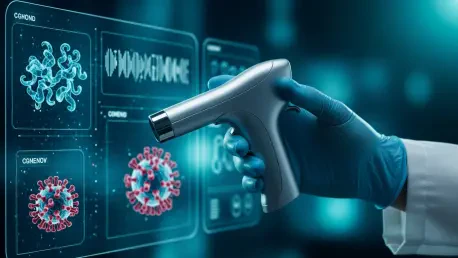
The move to a micro-fluid jet delivery system is a masterstroke in terms of public health logistics and patient experience. During the trial, this micro-fluid technology delivered the DNA vaccine directly through the skin without the use of a traditional needle, which immediately removes one of the biggest psychological barriers to vaccination for a significant portion of the population. From a clinical perspective, this method can be much faster to administer in high-volume settings, such as during a pandemic outbreak where every hour counts. It also simplifies the supply chain in regions where the disposal of “sharps” and the maintenance of sterile needle supplies can be a major hurdle. When you combine an AI-designed, broad-spectrum antigen with a delivery system that is easy to use and less intimidating, you create a tool that can be deployed rapidly across diverse global landscapes, from modern city hospitals to remote rural clinics.
The DIOSynVax pipeline apparently extends beyond coronaviruses to include threats like Ebola and pandemic influenza. How does the success of this Sarbeco trial accelerate the development of vaccines for these other high-risk virus groups?
The success of this trial provides a definitive “proof of concept” for the entire Digitally Immune Optimised Synthetic (DIOS) platform, which was founded back in 2017. Because the underlying technology relies on a repeatable computational framework, we can now apply the same machine learning logic to the Ebola group or various strains of Influenza with a much higher degree of confidence. We have shown that the computer simulations can accurately predict which antigens will be both safe and effective in the human body. This allows us to fast-track the early stages of research and development for other hemorrhagic fevers and respiratory threats that pose a continuous risk of spillover from animal populations. Essentially, we have built a universal “engine” for vaccine creation; now, it’s just a matter of feeding the genetic data of different viral families into that engine to produce a library of future-proofed vaccines before the next pandemic even begins.
While the Phase I results are promising, what specific challenges do you anticipate as the vaccine moves into a larger and more diverse Phase 2 clinical trial?
The transition to Phase 2 is always a critical juncture because we move from a small, controlled group of 39 healthy volunteers to a much larger and more heterogeneous population. We need to ensure that the “super-antigen” triggers the same high-quality immune response in elderly individuals, people with underlying health conditions, and those from different ethnic backgrounds who may have varying baseline immunities. The next phase will also focus heavily on the duration of the protection; we want to see how long these broad-spectrum antibodies persist in the bloodstream and whether the “memory” of the immune system is as lasting as the computer models suggest. There is also the logistical challenge of scaling up the production of the DNA vaccine and the micro-fluid jet devices to meet the needs of a larger trial. However, given the primary funding from Innovate UK and the infrastructure provided by the NIHR in Cambridge and Southampton, I believe we have the necessary environment to safely and effectively navigate these complexities.
What is your forecast for the role of AI-designed universal vaccines in our global health infrastructure over the next decade?
I believe that within the next ten years, the “reactive” model of vaccine development will become an artifact of the past, replaced by proactive, digitally-optimized platforms. We will likely see the establishment of a global library of AI-designed vaccines for the top ten or twenty viral families most likely to cause a pandemic, allowing us to have “off-the-shelf” solutions ready before a spillover event occurs. This would mean that instead of facing lockdowns and economic devastation for years while we scramble for a cure, we could theoretically suppress an outbreak within weeks of its discovery. The integration of machine learning into biopharma will not only save millions of lives but will also stabilize our global economy by removing the catastrophic uncertainty that viruses currently bring. We are moving toward a world where we no longer fear the “unknown” virus because our immune systems will have already been trained to recognize its fundamental signature.