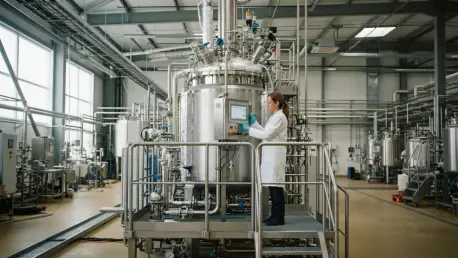

Finland has outperformed both the United States and Germany in value creation capacity by establishing sophisticated decentralized forestry-based circular networks for biochemical production. This revelation comes at a time when the global industrial landscape is undergoing a profound biological transformation, a paradigm shift aimed at reconciling large-scale industrial output with the urgent demands of environmental sustainability. At the core of this evolution is the concept of biointelligence, which represents a sophisticated stage where technical, informational, and biological systems converge through a dynamic, bottom-up integration process. Unlike earlier phases of bio-inspiration or bio-integration, biointelligence envisions a future where production systems are not merely processing biological matter but are integrated entities utilizing immense computational power and hardware engineering to harness biological processes within a circular bioeconomy. Despite the growing recognition of this sector, there has been a significant lack of empirical, data-driven comparisons between nations until the publication of a major international benchmarking study in the journal Cleaner and Circular Bioeconomy. This research evaluated eleven leading industrial nations to determine which regions possess the structural conditions and innovation capacities necessary to lead this emerging sector in 2026 and beyond.
Methodological Framework: A Multi-Tiered Evaluation System
The researchers utilized a five-tier hierarchical benchmarking model to ensure an objective evaluation of the participating nations, moving systematically from specific research questions to standardized indicators. This framework analyzed fourteen distinct topic areas grouped into three primary dimensions: framework conditions, innovation capacity, and value creation capacity. To populate this model, the data collection process was dual-pronged, combining quantitative metrics from global databases like the World Bank and UNCTAD with seventy-nine qualitative interviews with international experts across academia, government, and industry. These qualitative assessments were meticulously coded and converted into standardized scales, allowing for a direct comparison between diverse industrial ecosystems while preserving the nuance of expert opinions. This rigorous approach ensured that the findings were not merely a reflection of academic output but represented a holistic view of how biological transformation is being implemented within actual industrial contexts across the globe.
According to the composite biointelligence scores, the United States and Germany emerged as the global frontrunners in this technological race. The United States secured the highest overall score of 0.64, while Germany followed closely with a score of 0.62, indicating that both nations possess the essential components to drive the next generation of biomanufacturing. However, the subsequent rankings showed a notable gap between the top two and the rest of the field, with Sweden securing third place and Finland following closely behind. Middle-tier economies, including Canada, China, and the Netherlands, showed significant potential but currently lack the full integration of computational and engineering layers required for true biointelligence. The study suggests that while many nations have successfully built the foundations for a traditional bioeconomy, only a few have managed to bridge the gap between biological research and advanced digital manufacturing systems effectively.
Foundational Frameworks: Stability and Financial Support
Framework conditions represent the foundational environment of a nation, encompassing political stability, financial capital, and resource availability. The study found that Scandinavian countries, specifically Norway, Finland, and Sweden, dominate in political stability and regulatory predictability, offering an ideal environment for long-term industrial investment. Norway achieved the highest score in this sub-category, followed by Finland and Sweden, reflecting their highly stable regulatory environments that are conducive to the long-term planning required for complex biomanufacturing facilities. In contrast, China scored significantly lower in this area due to regulatory volatility and legal unpredictability, which remains a substantial barrier for commercial enterprises looking to establish permanent biointelligent infrastructure. These framework conditions often dictate the speed at which a nation can pivot its industrial base toward more sustainable, biologically integrated practices.
In terms of financial capital and market access, the United States holds a commanding lead, primarily driven by its massive venture capital ecosystem which provides the necessary fuel for high-risk, high-reward technological ventures. However, experts noted that American capital has historically favored pure software or traditional biotechnology over the complex, hardware-heavy convergence of bio-digital systems, which may require a shift in investment strategies as the sector matures. Germany also showed strong performance in market access, benefiting from its central role in European trade agreements and its deeply integrated industrial base. Meanwhile, Sweden led the category for resource access, fueled by an abundance of renewable energy, minerals, and biogenic residual streams that are essential for powering and feeding a sustainable manufacturing economy. This distribution of strengths highlights how different regions must leverage their unique structural advantages to remain competitive in the global biointelligence landscape.
Innovation Capacity: Bridging Research and Industrial Application
The innovation capacity dimension focused on a nation’s ability to transition research from the laboratory into viable business models and scalable technologies. The United States led this category, driven by flexible consortia like BioMADE that bridge the gap between academic research and practical industrial application. These innovation networks allow for a more agile division of labor between small startups and massive corporations, fostering an environment where service-based models, such as therapy-as-a-service, can thrive. Germany followed closely in this dimension, utilizing formal institutional platforms and competence centers to foster collaboration across different sectors. The study highlighted that collaboration is no longer optional but essential for biointelligence, as no single entity possesses the wide-ranging expertise required in biology, data science, and mechanical engineering simultaneously.
Economic projections within the study underscore the massive potential of biointelligent technologies, with the global market volume expected to grow significantly between 2026 and 2040. The research categorized enabling technologies by their maturity, finding that application-oriented fields like bioreactors are closer to market readiness than research-heavy fields like human-biomachine interfaces. Furthermore, the digitalization of biology is accelerating rapidly, with digital twins and advanced digital platforms seeing a thirtyfold increase in publication volume over the last several years. This growth signals a transition where biological processes are increasingly managed through advanced digital frameworks, allowing for real-time monitoring and optimization of complex biomanufacturing cycles. The study emphasizes that those who can master the digital layer of biology will likely dominate the market in the coming decades.
Value Creation: Integrating Solutions into Production Networks
Value creation measures how effectively biointelligent solutions are integrated into actual production networks and how much economic benefit is derived from these systems. Finland secured the top spot in this dimension, outperforming both Germany and the United States through its sophisticated, decentralized circular networks in the forestry sector. Companies like Metsä Group and UPM have excelled at processing wood residues into a cascade of high-value biochemicals and materials, demonstrating a masterclass in how to extract maximum value from a single biogenic resource. This decentralized approach allows for a more resilient and sustainable value chain, where waste from one process becomes the raw material for another. Finland’s success serves as a blueprint for other nations looking to build a truly circular bioeconomy that is both ecologically responsible and highly profitable.
While the United States leads in entrepreneurship, with a high concentration of small and micro-enterprises, the study identified a significant “scaling wall” caused by the high capital requirements of biomanufacturing. Many American startups struggle to grow beyond the initial micro-scale within their first five years because the infrastructure needed for large-scale bioproduction is far more expensive than traditional software development. Germany also faces specific challenges, particularly regarding academic-to-commercial barriers. Administrative complexities and slow regulatory processes in Germany often prompt startups to seek commercialization pathways in more agile international markets such as Israel or Singapore. These translation barriers suggest that even the most innovative research can fail to generate national wealth if the regulatory and financial path to commercialization remains too cumbersome for small actors to navigate.
Societal Acceptance: The Cultural Dimensions of Biomanufacturing
The transition to a biointelligent economy is influenced by cultural and ethical factors as much as technical or financial ones. In Germany, ecological sustainability is increasingly viewed by corporations as an existential necessity for the long-term viability of domestic manufacturing. This perspective led the nation to a top ranking in the impact on sustainability category, where the goal is to ensure that industrial growth does not come at the expense of environmental health. In the United States, however, sustainability is more frequently evaluated through the lens of short-term economic returns and shareholder value. This difference in motivation often dictates which types of biointelligent technologies receive the most support, with German actors focusing on long-term ecological resilience and American actors prioritizing rapid market penetration and profitability.
Public perception also varies significantly across borders, impacting the speed of technological adoption and the regulatory environment. Finland ranked highest in societal acceptance, reflecting a public that demonstrates a high level of adaptability and curiosity regarding technological innovation, supported by a government commitment to carbon neutrality. In contrast, Germany and the United States showed more mixed results; Germany, for instance, maintains a persistent cultural hesitation regarding genetic modification, even though there is broad support for clean industrial and clinical applications of biointelligence. The study noted that societal acceptance is a critical enabler of the biological transformation, as public opposition can lead to restrictive regulations that stifle innovation. Therefore, clear communication and ethical frameworks are just as important as the technologies themselves in ensuring the success of biointelligent systems.
Global Outliers: The China Factor and Data Transparency
The researchers acknowledged specific methodological limitations within the study, particularly regarding the expert-data ratio used for different nations. Some countries, like Germany and Finland, had a high reliance on qualitative expert insights, which provided a deep, nuanced understanding of their respective industrial landscapes. Others were evaluated primarily through standardized database indices, which can sometimes miss the underlying trends or cultural shifts that have not yet been reflected in formal data. This distinction is important for understanding the depth of the qualitative nuances captured in the rankings, as nations with high expert participation often provided a more comprehensive view of their future trajectories and internal challenges that are not easily captured by simple quantitative metrics.
A significant outlier in the data was China, whose standing appeared lower than its known technological capabilities would suggest. The researchers noted that this was likely an underrepresentation caused by restrictive data-sharing regulations and language barriers, as many domestic Chinese publications are not indexed in global databases. This highlights the ongoing difficulty of benchmarking nations with closed data ecosystems, where domestic industrial progress is not always transparent to international researchers. The study suggested that while China may appear to lag in some rankings, its massive internal investment in biotechnology and digital infrastructure means it remains a formidable competitor. Achieving a more accurate global picture of biointelligence will require greater transparency and more inclusive data-sharing practices across all major industrial powers to ensure that benchmarking remains fair and reflective of reality.
Future Directions: Strategic Policy and Educational Reform
The benchmarking study concluded that the advancement of biointelligence from a laboratory curiosity to a global industrial standard required targeted policy interventions. Stable, multi-year funding frameworks were identified as essential to overcome the high capital intensity associated with biomanufacturing. Researchers suggested that the development of technology-agnostic standards would be necessary to allow for the seamless integration of biological and computational systems across different sectors and jurisdictions. These policies should aim to de-risk the initial stages of industrial adoption, providing a bridge for companies that are willing to lead the transition but are wary of the financial risks. By creating a more predictable economic environment, governments can encourage the private sector to invest more heavily in the hardware-digital convergence that defines true biointelligence.
Education and regional infrastructure were also highlighted as critical components for long-term success in the circular bioeconomy. The study proposed an urgent need for new interdisciplinary curricula that bridge the traditional divide between the life sciences and engineering to prepare a future workforce capable of operating at this intersection. Furthermore, the creation of regional living laboratories, modeled on the principles of smart specialization, was recommended as a way to allow companies to test biointelligent systems in real-world settings before full-scale deployment. These regional hubs could serve as testing grounds for new technologies, reducing the risks associated with innovation and helping to bridge the gap between academic discovery and commercial success. Moving forward, the race to define the future of manufacturing will likely be won by those who can best align their technological progress with societal needs and ecological boundaries.