
Scaling up carbon removal requires a transparent monitoring framework, which is provided by the predictable stoichiometric ratios of mineral-based alkalinity generation. As the world moves through 2026, the urgency of the climate crisis has shifted the global conversation from simple emissions reduction to the necessity of active, large-scale atmospheric scrubbing. Traditional methods, while promising, often struggle with either permanence or scalability, leaving a critical gap in the strategies required to meet stringent international temperature targets. Rock weathering, a natural geochemical process that has stabilized the Earth’s climate over millions of years by converting carbon dioxide into stable mineral forms, offers a theoretically perfect solution. However, the glacial pace of this natural cycle remains the primary obstacle to its implementation as a viable industrial tool. Recent breakthroughs in synthetic biology are now providing the keys to unlocking this process, as researchers demonstrate that the intersection of marine microbiology and geochemistry can compress millions of years of geological time into a matter of days or weeks through targeted biological intervention. By utilizing engineered microorganisms to catalyze the breakdown of silicate rocks, scientists have created a path toward an industrial-scale carbon removal technology that is both durable and measurable.
Molecular Catalysis: The Role of Siderophores in Mineral Dissolution
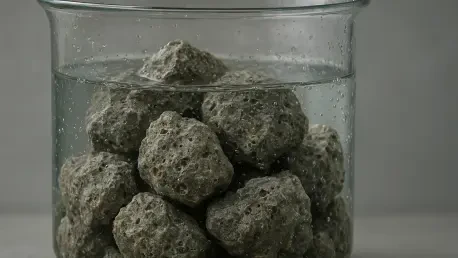
The primary mechanism driving this accelerated weathering is the production and secretion of siderophores, which are specialized organic molecules that marine bacteria use to scavenge iron. In the iron-starved environments of the open ocean, these molecules act as highly efficient molecular tweezers, binding to iron atoms with incredible precision and pulling them into the bacterial cell. Research has revealed that when these bacteria are introduced to silicate minerals such as olivine, the siderophores do more than just collect nutrients; they actively destabilize the crystalline lattice of the rock. This interaction creates microscopic deformations known as etch pits, which significantly increase the reactive surface area of the mineral. As the siderophores continue to strip iron from the mineral surface, they lower the activation energy required for the rock to dissolve in seawater. This biological approach allows the weathering front to advance at a rate that far exceeds what is possible through abiotic chemical reactions, effectively turning the bacteria into tiny, living excavators that chew through solid stone to facilitate the capture of atmospheric carbon.
This biological method offers a transformative efficiency advantage over current mechanical proposals for enhanced weathering. Most traditional schemes suggest grinding silicate rocks into an ultra-fine powder to maximize surface area, a process that is notoriously energy-intensive and often undermines the net carbon benefits of the operation. In contrast, the use of siderophore-mediated dissolution allows for the processing of much coarser mineral particles. By utilizing the biochemical energy of specialized microbes to advance the dissolution process at the molecular level, the requirement for massive mechanical grinding is drastically reduced. This shift not only lowers the overall energy footprint of carbon removal but also makes it possible to utilize a wider variety of mineral feedstocks that were previously considered too slow-reacting for climate applications. The ability of these molecular machines to work at the interface of solid rock and liquid seawater provides a scalable alternative to the heavy machinery typically associated with industrial carbon capture, moving the focus from brute force engineering to the subtle precision of marine biochemistry.
Genetic Optimization: Tailoring Alteromonas for Industrial Applications
The search for the ideal microbial host led researchers to Alteromonas macleodii, a robust and ubiquitous marine bacterium known for its rapid growth and natural ability to survive in diverse oceanic conditions. This species is already an expert at producing petrobactin, a specific type of siderophore that plays a vital role in iron acquisition across the global ocean. Because the genetic architecture of Alteromonas is well-characterized, it provides a stable and predictable platform for synthetic biology. Scientists have utilized advanced transcriptomic mapping to identify the precise regulatory pathways that govern how these bacteria sense iron levels and trigger the synthesis of siderophores. By understanding these internal biological switches, the research team was able to modify the bacteria to bypass their natural regulatory limits. This engineering ensures that the microbes continue to produce and secrete high concentrations of siderophores even when their internal iron needs are met, transforming them into specialized biological factories dedicated to the dissolution of silicate minerals for climate mitigation.
To achieve maximum industrial efficiency, the optimization of these bacteria involved more than just increasing siderophore production. The engineering process also focused on enhancing the bacteria’s ability to colonize mineral surfaces and maintain high metabolic activity in the high-pressure, low-temperature environments often found in deep-sea or coastal deployment sites. By fine-tuning the transport mechanisms that export petrobactin out of the cell and the receptors that bring iron-bound complexes back in, researchers created a highly efficient loop of mineral degradation. These optimized strains demonstrate a significant increase in dissolution rates compared to wild-type ancestors, proving that complex geological interactions can be reduced to programmable biological functions. This level of control allows for the development of standardized microbial “catalyst packs” that can be deployed in controlled environments, ensuring that the carbon removal process remains consistent and efficient regardless of the specific local conditions or the mineral composition of the feedstock.
Energy Efficiency: Integrating Electrosynthesized Acetate Feedstocks
A significant hurdle for any large-scale biological system is the environmental and economic cost of the nutrients required to sustain the microbial population. If engineered bacteria were to rely on traditional agricultural sugars like glucose or fructose, the land-use requirements and the emissions from fertilizer production would likely cancel out a large portion of the carbon sequestered. To address this sustainability challenge, the research team integrated the bioweathering system with electrosynthesized acetate. This simple two-carbon compound can be manufactured by using renewable electricity to convert captured carbon dioxide and water into a liquid fuel for fermentation. This creates a circular feedstock model that does not compete with global food supplies or require vast tracts of arable land. The acetate acts as a clean, concentrated energy source that the Alteromonas bacteria can readily metabolize, providing the necessary carbon and energy to drive the continuous production of mineral-dissolving siderophores without adding new emissions to the atmosphere.
The integration of electrosynthesis and microbial catalysis creates a powerful “double-win” for climate strategy. In the first stage of the process, carbon dioxide is captured from the air or industrial exhaust to produce the acetate feedstock, representing an initial removal or recycling of greenhouse gases. In the second stage, the microbes powered by this acetate facilitate the dissolution of silicate minerals, which results in the permanent storage of even greater quantities of CO2 in the form of stable ocean alkalinity. Because the entire system can be powered by localized renewable energy sources such as offshore wind or solar arrays, it presents a truly scalable industrial model for carbon removal. This approach decouples the growth of the carbon removal industry from the constraints of traditional biomass, allowing for the establishment of distributed coastal facilities that can operate independently of the agricultural sector. The result is a highly efficient, energy-positive system that leverages the best of electrochemical engineering and synthetic biology to maximize the net-negative carbon impact.
Environmental Stewardship: Verification and Ecological Constraints balance
One of the most critical aspects of modern carbon removal is the ability to provide rigorous Monitoring, Reporting, and Verification (MRV) to ensure that the promised climate benefits are actually realized. The bioweathering process is particularly well-suited for this because it relies on the predictable chemistry of mineral dissolution. When silicate minerals like olivine dissolve, they release magnesium and calcium ions that react with dissolved CO2 to form bicarbonate. This reaction follows a strict stoichiometric ratio, meaning that for every ton of mineral dissolved, a specific and measurable amount of carbon is permanently sequestered. This allows scientists to track the effectiveness of the system by measuring changes in total alkalinity and dissolved inorganic carbon in the surrounding waters, as well as the loss of mass from the mineral feedstock. Such a transparent accounting framework is essential for the integration of this technology into global carbon markets, providing a level of certainty that is often difficult to achieve with purely biological sequestration methods like reforestation.
While the potential for carbon removal is vast, the deployment of engineered microbes into marine environments necessitates a cautious and evidence-based approach to ecological safety. Marine ecosystems are incredibly sensitive to changes in nutrient availability, and since siderophores redistribute iron—a primary limiting nutrient in many parts of the ocean—large-scale application could inadvertently alter the composition of local microbial communities. There is also the consideration of how increased alkalinity might affect local pH levels and the health of calcifying organisms like corals and shellfish. To manage these risks, future implementation strategies focus on contained or semi-contained coastal systems where the environmental impact can be closely monitored and controlled. Establishing comprehensive ecological baselines and using advanced sensors to track real-time changes in seawater chemistry will be vital for ensuring that the process of “bioweathering” does not disrupt the very marine life it is intended to protect. This balance of innovation and caution is fundamental to maintaining the public trust and regulatory support necessary for large-scale climate intervention.
Industrial Evolution: The Path Toward Global Implementation
The development of engineered marine bacteria for carbon removal represents a fundamental shift in the role of environmental biotechnology. Rather than focusing on the production of high-value chemicals or pharmaceuticals, these microbes are being reimagined as geochemical catalysts capable of reshaping global chemical cycles at an industrial scale. This blueprint for a modular, distributed network of carbon-removal hubs could allow coastal regions to utilize their local mineral deposits and renewable energy infrastructure to actively scrub the atmosphere. These facilities could be designed as bioreactors or specialized coastal enclosures, providing a controlled environment where the dissolution of volcanic rocks can be maximized while minimizing environmental leakage. By framing carbon removal as a modular engineering problem that combines renewable energy, electrosynthesis, and microbial biology, the research provides a scalable solution that can be tailored to the specific geographical and economic needs of different regions.
The research community determined that the successful integration of synthetic biology into carbon management required a multi-faceted approach involving rigorous ecological monitoring and the establishment of robust carbon credit markets. Stakeholders recognized the importance of pilot programs that could demonstrate the safety and efficacy of siderophore-mediated dissolution in real-world coastal conditions from 2026 to 2028. Government agencies and private investors coordinated to fund the development of modular bioreactor designs that allowed for the rapid scaling of the technology without requiring massive centralized infrastructure. Scientists also focused on the creation of standardized protocols for measuring alkalinity shifts, ensuring that every ton of carbon removed was verified through transparent data sharing. These collective efforts established the foundation for a new biogeochemical industry that transformed the way society approached atmospheric restoration. By moving beyond theoretical models and into practical, verifiable implementations, the initiative provided a durable path toward stabilizing the global climate through the precision of engineered biology.