
By integrating a selectively permeable endothelial lining, this new technology forces cancer cells to demonstrate their ability to traverse vessel walls. This breakthrough represents a monumental shift in oncology, moving away from the static culture plates and animal models that have dominated research for many years. Developed under the leadership of Professor Gordana Vunjak-Novakovic at Columbia Engineering, the metastasis-on-a-chip platform replicates the human metastatic process with a level of fidelity previously deemed impossible. Since metastasis accounts for two-thirds of cancer deaths, understanding how tumor cells migrate from a primary site to distant organs is vital. This microfluidic innovation creates a transparent window into biological behaviors, allowing researchers to monitor spread in real-time. By bridging the gap between laboratory benchwork and clinical outcomes, the platform provides a predictive environment for testing therapies and unraveling complex cellular dynamics.
Overcoming the Limitations: Traditional Research Models
Addressing the Failure: Rodent Testing and Discrepancies
The scientific community has long grappled with the persistent failure of anti-metastatic drugs during human clinical trials, despite promising results in preclinical studies. Historically, researchers relied heavily on rodent models to predict how a drug might behave in the human body, but these animal subjects often fail to replicate the nuanced complexities of human physiology. For instance, mice and rats frequently possess different immune responses and molecular signaling pathways than humans, leading to misleading data regarding drug efficacy and toxicity. This biological discrepancy explains why so many oncology treatments that appear successful in the lab ultimately fail to meet safety or performance standards when they reach patient trials. The metastasis-on-a-chip technology directly addresses this issue by utilizing human cells, thereby ensuring that the experimental data gathered is directly applicable to human biology and reducing the reliance on inadequate animal surrogates.
Capturing the Complexity: Human-Based Microphysiological Systems
Beyond the general biological differences, traditional animal models are particularly ill-equipped to capture the subtle organ colonization phase of cancer progression. During this critical stage, tumor cells exit the bloodstream and must adapt to an entirely foreign environment to form secondary tumors. Capturing this transition in a living animal is notoriously difficult due to the lack of real-time visibility and the inability to isolate specific variables within a complex organism. By contrast, the microphysiological systems found in the chip allow scientists to zoom in on these specific interactions with extreme precision. Researchers can observe exactly how human cancer cells interact with human tissues in a controlled setting, providing insights into survival mechanisms that were previously hidden. This transition toward human-based models marks a necessary evolution in cancer research, shifting the focus toward methodologies that are more likely to yield successful clinical interventions.
The Bioengineering: Advanced Microfluidic Platforms
Simulating Human Physiology: Millimeter Scale Precision
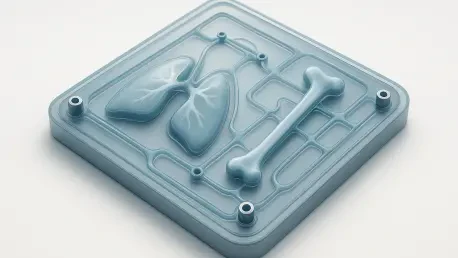
The internal architecture of the metastasis-on-a-chip represents a masterpiece of modern bioengineering, specifically designed to host functional human tissues within a millimeter-scale device. Utilizing induced pluripotent stem cells, researchers can cultivate specialized tissues, such as bone and lung, which are the most common destinations for metastatic breast cancer. These tissues are not merely collections of cells; they are matured within specialized bioreactors that provide the physical and chemical cues necessary for them to function as they would in a human body. This maturation process ensures that the engineered tissues exhibit the structural integrity and metabolic activity required for realistic experimentation. By integrating these mature organoids into a single microfluidic platform, the system creates a miniature human landscape where the behavior of cancer cells can be tracked as they navigate through a truly representative biological environment for extended periods.
Replicating Organ Environments: Microscopic Niche Control
Connecting these distinct tissue compartments is a continuous fluidic flow that serves as a surrogate for the human circulatory system. This artificial bloodstream is vital for transporting nutrients and signaling molecules, but its primary function in this context is to provide a pathway for circulating cancer cells. To maintain the highest level of physiological relevance, the designers incorporated a selectively permeable endothelial lining that acts as a gatekeeper between the fluid channels and the organ tissues. This barrier forces the cancer cells to demonstrate their actual ability to adhere to and eventually traverse the vessel walls, a process known as extravasation. This physical challenge is a hallmark of metastatic spread and is notoriously difficult to replicate in traditional lab settings. By forcing the cells to perform this complex biological feat, the chip provides a rigorous test of their metastatic potential, ensuring the simulation is as authentic as possible.
Groundbreaking Insights: Cancer Behavior and Clinical Translation
Observing Cellular Intelligence: Organ Tropism and Survival
Recent implementations of this technology have already provided groundbreaking findings regarding the phenomenon of organ tropism. This refers to the tendency of specific types of cancer to gravitate toward certain organs over others, such as breast cancer’s affinity for the bone and lungs. In experimental runs, cancer cells that were genetically predisposed to seek out bone tissue showed an aggressive colonization of the bone compartment within the chip, leading to visible degradation of the engineered tissue. In contrast, lung-seeking cancer cells ignored the bone section and focused their destructive activity entirely on the lung compartment. These results are highly significant because they confirm that the chip accurately reflects the patterns of spread observed in human patients. This validation proves that the platform can serve as a reliable tool for studying why certain cancers prefer specific environments, potentially leading to targeted therapies that block these preferences.
Discovering the Secreted Factors: Pre-Metastatic Niche Remodeling
One of the most profound discoveries enabled by the chip is the observation of niche remodeling, a process that occurs even before cancer cells arrive at a distant site. Researchers found that primary tumors release factors into the fluidic flow that begin to reprogram the environment of distant organs. This chemical messaging prepares the soil of an organ to make it more receptive to the incoming seed of a cancer cell. By monitoring this pre-metastatic phase, scientists can now study how to intercept these signals, opening a new frontier in preventative oncology. This capability allows for the development of drugs that disrupt the colonization process before a secondary tumor has the chance to form. By identifying the specific proteins and signaling pathways involved in this early remodeling, the research team provided a roadmap for stopping metastasis at its inception, fundamentally shifting the focus of cancer treatment toward early-stage prevention rather than late-stage intervention.
Evaluating the Impact: From Observation to Actionable Results
Through the application of these microphysiological systems, researchers established a transformative approach to cancer management and personalized therapy. They successfully utilized patient-specific stem cells to grow individualized tissues on the chip, which allowed for the prediction of how a particular individual’s cancer would spread. This advancement facilitated the testing of targeted drug combinations, ensuring that patients received the most effective treatments while avoiding toxic side effects. Moving forward, the clinical community emphasized the necessity of integrating these chips into standard diagnostic pipelines to support real-time medical decisions. Stakeholders also identified the expansion of high-throughput manufacturing as a critical step for making this technology accessible to oncologists worldwide. By prioritizing these human-centric models, the scientific community moved closer to a standard of care where every patient’s treatment plan was as unique as their own biological signature.