
The ability to peer inside the human body in real-time, observing the dynamic motion of organs and guiding surgical instruments with unparalleled precision, has transformed from a futuristic concept into a daily clinical reality. This capability is the domain of fluoroscopy, an imaging technique that provides a live X-ray video feed, and it is the central force behind a global market projected to swell from USD 3.36 billion in 2024 to an impressive USD 5.0 billion by the end of 2035. This sustained expansion, representing a steady compound annual growth rate of 3.7%, is not driven by a single factor but by a powerful confluence of evolving surgical philosophies, shifting global demographics, and a relentless wave of technological innovation. As the medical field continues to prioritize less invasive procedures and better patient outcomes, the demand for the real-time visualization offered by fluoroscopy has become more critical than ever, cementing its role as a cornerstone of modern diagnostic and interventional medicine.
The Core Engines of Market Expansion
Clinical and Demographic Shifts
A fundamental shift in surgical philosophy towards minimally invasive interventions stands as the most significant catalyst propelling the fluoroscopy device market forward. These advanced procedures, which involve small incisions through which specialized instruments are guided to the treatment site, have become the standard of care across numerous specialties due to their profound patient benefits. Patients experience less postoperative pain, reduced scarring, shorter hospital stays, and significantly faster recovery times compared to traditional open surgeries. However, the very nature of these techniques makes them impossible without high-quality, real-time intraoperative imaging. Fluoroscopy devices provide this essential visual guidance, acting as the surgeon’s eyes inside the patient’s body, enabling the precise navigation of catheters, the placement of stents, and the alignment of orthopedic implants. This reliance ensures that as minimally invasive surgery continues its global adoption, the demand for both fixed and mobile fluoroscopy systems will grow in lockstep.
This clinical trend is powerfully amplified by profound demographic and epidemiological transitions occurring worldwide. The burgeoning healthcare needs of a rapidly aging global population are a major market driver. Older individuals are disproportionately affected by chronic conditions such as cardiovascular diseases, degenerative joint disorders, and certain types of cancer, all of which frequently necessitate the diagnostic and therapeutic procedures guided by fluoroscopy. For instance, interventional cardiology relies heavily on fluoroscopy for procedures like angiography and angioplasty to treat coronary artery disease, a condition prevalent among the elderly. Similarly, orthopedics depends on this technology for fracture reduction and joint replacement surgeries. The increasing global prevalence of these chronic illnesses, coupled with longer life expectancies, guarantees a consistent and escalating demand for the interventions that depend on fluoroscopic imaging, creating a stable and predictable growth environment for the market.
Infrastructure and Economic Factors
The market’s robust economic outlook is further strengthened by the continuous expansion and modernization of healthcare infrastructure, particularly in emerging economies across the Asia-Pacific and Latin American regions. As these nations invest heavily in upgrading their diagnostic and surgical capabilities to meet the demands of their growing populations, the need for advanced imaging systems is soaring. This creates significant and lucrative market opportunities for manufacturers to penetrate new regions and replace legacy analog systems with more efficient, safer, and feature-rich digital solutions. Governments in countries like China, India, and Brazil are actively promoting the construction of new hospitals and specialized clinics, which require state-of-the-art equipment to handle a higher volume of complex procedures. This wave of infrastructure development is a primary engine of growth, fueling the demand for the entire spectrum of fluoroscopy devices, from large fixed systems for dedicated suites to versatile mobile C-arms for operating rooms.
In established markets like North America and Europe, growth is sustained by different but equally powerful economic and regulatory dynamics. North America’s position as the largest market is underpinned by its sophisticated healthcare ecosystem, high adoption rates of cutting-edge medical technologies, and favorable reimbursement policies that encourage the use of advanced imaging in a wide range of procedures. In Europe, stringent patient safety regulations serve as a key driver, mandating the use of low-dose imaging systems and pushing healthcare providers to invest in the latest digital fluoroscopy technology that minimizes radiation exposure. Furthermore, the global trend toward outpatient care, driven by cost-effectiveness and patient convenience, is fueling the rapid growth of ambulatory surgical centers (ASCs). These facilities are becoming major end-users of fluoroscopy devices, particularly mobile C-arms, creating a vibrant new segment for market expansion as more complex procedures shift from traditional hospital settings to these more agile environments.
Technological Revolution in Medical Imaging
The Digital Transformation
At the very core of the market’s current growth phase is a transformative technological evolution: the decisive industry-wide transition away from traditional analog systems and image intensifiers toward advanced digital flat-panel detectors (FPDs). This shift is not merely an incremental upgrade but a fundamental revolution in the capabilities of fluoroscopy, with digital systems now dominating the market share. The adoption of FPDs provides profound clinical advantages, most notably vastly superior image quality. These detectors offer exceptional clarity, higher spatial resolution, and a wider dynamic range, which translates into sharper and more detailed real-time images. This enhancement in visualization allows clinicians to perform delicate procedures with greater confidence and precision, improving diagnostic accuracy and, ultimately, patient outcomes. The ability to see finer anatomical details and subtle movements is critical in complex interventions, making digital technology the undisputed new standard of care in modern medical imaging.
Beyond the remarkable improvements in image quality, the digital transformation offers critical benefits in terms of safety and workflow efficiency, which are paramount in today’s healthcare environment. One of the most significant advantages of digital fluoroscopy is its ability to achieve superior images at a substantially lower radiation dose compared to older analog systems. This dose efficiency is a major concern for both patient and practitioner safety, aligning with the “As Low As Reasonably Achievable” (ALARA) principle of radiation protection. Furthermore, digital systems are designed for seamless integration into modern hospital information networks. They can connect directly to Picture Archiving and Communication Systems (PACS) and Electronic Health Records (EHR), streamlining the entire clinical workflow. This integration allows for instant image storage, easy retrieval, and effortless sharing among medical professionals, eliminating the cumbersome processes associated with film-based imaging and enhancing overall departmental productivity.
The Dawn of Intelligent Imaging
As the digital transition matures, the industry is now entering the era of “Smart Imaging,” where leading manufacturers are actively incorporating Artificial Intelligence (AI) and machine learning algorithms into their fluoroscopy systems. These AI-driven features are poised to redefine the technology’s capabilities, moving beyond simple image acquisition to offer intelligent, automated support for clinical tasks. For instance, AI algorithms can automate complex image processing and enhancement in real-time, reducing noise and sharpening anatomical structures without manual intervention. More importantly, these intelligent systems can provide sophisticated dose management, automatically adjusting radiation exposure based on the specific anatomical region and procedural requirements. This intelligent dose modulation ensures optimal image quality is maintained while minimizing radiation exposure to the lowest possible level, representing a significant leap forward in patient and staff safety.
The integration of advanced software is also expanding the utility of fluoroscopy systems into the realm of clinical decision support and enhanced surgical navigation. AI and machine learning algorithms are being developed to provide analytical insights, such as automatically identifying anatomical landmarks or highlighting potential abnormalities, which can aid clinicians during both diagnostic and interventional procedures. Another major trending aspect is the integration of 3D imaging capabilities. By acquiring a series of 2D images from different angles, modern systems can reconstruct a three-dimensional view of the anatomy, offering surgeons vastly improved spatial awareness. This is particularly valuable during complex interventions in fields like neurosurgery and vascular surgery, where understanding intricate spatial relationships is critical for procedural success. These “smart” features are transforming fluoroscopy from a simple visualization tool into an active partner in clinical care.
A Closer Look at the Market Segments
Device Types and End Users
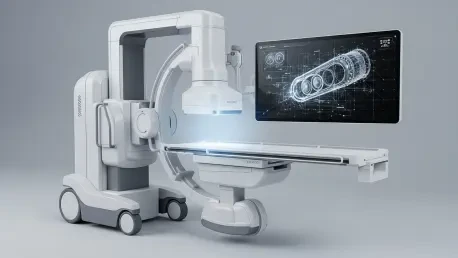
A granular analysis of the market reveals a multifaceted landscape segmented by device type. The market is primarily divided into fixed fluoroscopy systems, mobile C-arms, and more compact mini C-arms. Fixed systems, which are permanently installed in dedicated suites, currently command a substantial market share. They serve as the workhorses in high-volume hospital departments like cardiology, gastroenterology, and interventional radiology, where they are used for complex and lengthy procedures that demand the highest image quality and power. In contrast, the mobile C-arm segment is experiencing the most rapid expansion. The inherent flexibility and mobility of these devices meet the rising demand within dynamic clinical environments such as operating rooms, emergency departments, and pain management clinics. Their C-shaped design allows them to be easily positioned around a patient, providing imaging from multiple angles without disrupting the surgical workflow.
The strategic importance of different end-users is also shaping the market’s trajectory. While hospitals have traditionally been the largest segment due to the sheer volume of complex procedures they perform, ambulatory surgical centers (ASCs) represent a rapidly growing and highly significant segment. The global movement toward outpatient surgical care, driven by a combination of cost-effectiveness, patient convenience, and advancements in surgical techniques, is fueling the demand for fluoroscopy solutions in these centers. ASCs often specialize in procedures like orthopedic surgery and pain management, which are heavily reliant on fluoroscopic guidance. Because these centers prioritize efficiency and often have spatial constraints, they are major adopters of versatile mobile C-arms. This trend is not only expanding the market’s customer base but also influencing product development, with manufacturers focusing on creating compact, user-friendly mobile systems tailored to the specific needs of the outpatient setting.
Key Clinical Applications
From an application perspective, the fields of orthopedics and cardiology remain the primary drivers of segmental growth, consistently generating the highest demand for fluoroscopy devices. In the orthopedic specialty, fluoroscopy is an absolutely essential tool for a wide array of procedures. It is indispensable for trauma surgery, where it is used for the real-time visualization of fracture reduction and the precise placement of plates, screws, and rods. It is also critical for joint replacement surgeries, guiding the accurate positioning of prosthetic components to ensure optimal function and longevity. The high volume of musculoskeletal injuries and degenerative joint diseases globally ensures that orthopedics will continue to be a dominant application area for the foreseeable future, driving demand for both full-size and mini C-arms, which are frequently used for extremity procedures.
Cardiology stands as another powerhouse application, where interventional procedures performed under fluoroscopic guidance are the standard of care for diagnosing and treating numerous cardiovascular conditions. The technology is indispensable for life-saving procedures such as coronary angiography, which visualizes blockages in the heart’s arteries, and angioplasty, where balloons and stents are used to open those blockages. Furthermore, it is a cornerstone of electrophysiology studies, guiding the placement of catheters used to diagnose and treat heart rhythm disorders. While orthopedics and cardiology lead the way, other significant application areas are also showing strong and consistent growth. These include gastroenterology for procedures like endoscopic retrograde cholangiopancreatography (ERCP), urology for guiding stone removal and stent placement, and neurosurgery for spinal procedures, all contributing to the technology’s broad and expanding clinical footprint.
The Global Stage and Strategic Projections
Regional Dynamics and Competitive Forces
Viewed from a geographical perspective, the fluoroscopy device market exhibits distinct regional dynamics that reflect varying levels of healthcare development, economic strength, and regulatory priorities. North America currently holds the largest share of the global market, a position supported by its advanced and sophisticated healthcare ecosystem, high adoption rates for cutting-edge medical technologies, and well-established reimbursement policies that cover a wide range of fluoroscopy-guided procedures. The strong presence of key market players in the U.S. and Canada also fuels innovation and market penetration in this region. Europe follows as the second-largest market, with its growth driven by a strong emphasis on patient safety and stringent regulations that mandate the use of low-dose imaging systems. Countries like Germany, France, and the UK are major contributors to this regional market, consistently investing in next-generation digital systems to comply with these standards.
The most dynamic growth story, however, is unfolding in the Asia-Pacific (APAC) region, which is projected to experience the most rapid expansion during the forecast period. This remarkable surge is fueled by a combination of massive government and private sector investments in healthcare infrastructure, a rising tide of medical tourism, and increasing initiatives to improve healthcare access in populous countries such as China, India, and Japan. The widespread construction of new hospitals and specialized surgical centers in this region is creating a fertile ground for the deployment of both fixed and mobile fluoroscopy systems. The competitive arena is populated by established global leaders who are shaping the market through extensive research and strategic initiatives. Industry giants such as GE Healthcare, Siemens Healthineers, Philips Healthcare, and Canon Medical Systems lead the market, while other influential companies including Medtronic and Fujifilm Holdings contribute significantly to innovation and market reach.
Future Innovations and Concluding Outlook
Looking toward the 2035 horizon, the fluoroscopy device market’s trajectory was set to be defined by its convergence with other advanced medical technologies. The integration of real-time imaging with surgical robotics and AI-driven analytics became a key feature of next-generation systems, which further enhanced procedural precision and patient outcomes. The proliferation of hybrid operating rooms—specialized surgical suites combining a conventional operating room with an advanced imaging suite—was a primary catalyst for market growth. These state-of-the-art facilities required the most advanced fixed and mobile imaging solutions available, which drove significant demand for high-end fluoroscopy systems. Strategic collaborations between imaging hardware manufacturers and surgical robotics firms became increasingly common, redefining the standard of care and ensuring that real-time visualization remained the cornerstone of precision medicine. While the high initial capital cost of these advanced systems posed a potential challenge, the long-term clinical and economic benefits ultimately drove a robust replacement cycle, solidifying the market’s positive path toward its USD 5.0 billion valuation.