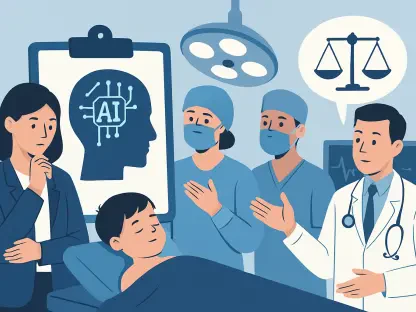

The quiet revolution happening in primary care clinics across the globe is driven by an artificial intelligence that promises to solve systemic pressures but is simultaneously creating a significant, unaddressed patient safety crisis. This paradox lies at the heart of AI’s rapid adoption into the foundational level of healthcare. Strained systems are increasingly turning to AI tools without the necessary evidence-based validation, a trend brought into sharp focus by a major University of Sydney study. This analysis will examine the statistics behind this rapid adoption, detail the real-world applications of these new technologies, present expert warnings about the inherent risks, explore the broader implications for health equity and the environment, and conclude with a necessary call for responsible innovation.
The Rapid Integration of AI into Clinical Practice
A Technology Sector Outpacing Evidence
The acceleration of AI into primary care is staggering, with adoption rates far exceeding the pace of clinical validation. As of last year, approximately one in five general practitioners (GPs) in the United Kingdom and up to 40 percent in Australia were reportedly using generative AI in their practice. This swift uptake reflects a global phenomenon, driven by the technology’s promise to alleviate administrative burdens and support clinical decision-making.
A comprehensive review published in The Lancet Primary Care synthesizes evidence from diverse health systems, including the United States, the UK, Australia, and nations across Africa and Latin America, confirming that this trend is widespread. However, the study reveals a critical disconnect: the vast majority of research on these AI tools is based on simulations rather than rigorous, real-world clinical trials. This has created a dangerous gap between widespread deployment and the evidence required to confirm the technology’s safety and effectiveness in live patient care environments.
AI Tools in Action From Scribes to Symptom Checkers
In clinics, physicians are using a new generation of clinician-facing tools designed to streamline their demanding workflows. Generative AI, for example, is being used to answer complex clinical queries, while digital scribes and ambient listening technologies are being deployed to automate the creation of consultation summaries. These tools aim to reduce the significant administrative burden on doctors, freeing them to focus more on patient interaction and complex medical reasoning.
Simultaneously, a booming market of patient-facing applications is bringing AI directly to consumers. AI-powered symptom checkers and sophisticated health apps are designed to provide convenient, personalized medical advice outside the traditional clinic setting. These tools promise to empower patients and improve access to information, yet they operate in a largely unregulated space, placing the onus of evaluation on the end-user.
Expert Consensus Flying Blind on Safety
The current state of AI adoption has been described as a “high-stakes environment” where healthcare systems are “flying blind on safety,” according to the study’s lead author, Associate Professor Liliana Laranjo. This stark warning reflects a growing expert consensus that while AI’s potential to transform primary care is immense, its current implementation is perilous. The primary concern is the regulatory vacuum in which these technologies are being deployed, coupled with the profound absence of real-world evaluation to verify their performance and impact.
This unchecked adoption is not occurring without reason. It is a direct response to the immense pressures facing primary care globally, including chronic workforce shortages, high rates of clinician burnout, and the escalating complexity of patient needs—all challenges that were significantly exacerbated by the COVID-19 pandemic. AI has been positioned as a powerful antidote to these systemic failures, but its hurried implementation risks introducing new, unforeseen problems into an already fragile system.
The Unseen Risks and Broader Implications
Clinical Dangers and Unintended Consequences
For clinicians, the convenience of AI tools masks significant risks. A key danger is automation bias, a phenomenon where professionals may over-rely on AI-generated outputs, potentially overlooking errors or nuances that their clinical judgment would otherwise catch. Furthermore, while AI scribes can reduce documentation time, they risk omitting subtle but vital social or biographical details from patient records—the kind of context that is often critical for accurate diagnosis and holistic care.
The threats to patients are equally concerning, particularly from direct-to-consumer health apps, which have been found to have highly variable accuracy. With little to no independent oversight, patients may receive incorrect or misleading information. Generative AI like ChatGPT poses a unique challenge due to its capacity to “hallucinate” and produce incorrect medical information that sounds authoritative and convincing. These models are often designed to agree with a user’s prompt, a trait that becomes incredibly dangerous when a patient is seeking guidance for a serious health concern.
The Dual Threat to Health Equity and the Environment
Beyond the clinic, the unchecked proliferation of AI threatens to deepen existing health disparities. A well-documented example is the tendency for AI diagnostic tools to misidentify skin conditions on darker skin tones, a direct result of biased training data that underrepresents diverse populations. This flaw risks embedding and amplifying systemic inequities within the very tools meant to improve care.
In contrast, when developed with intention, AI also holds the potential to advance health equity. An arthritis study demonstrated this by using an algorithm trained on a diverse dataset, which successfully doubled the identification of Black patients eligible for knee replacement compared to traditional methods. This highlights that thoughtful design is critical to ensuring AI becomes a breakthrough rather than a setback for fairness in healthcare. Moreover, the environmental footprint of AI is a growing concern, with the training of large language models generating significant carbon emissions and the data centers that power them consuming vast amounts of electricity, presenting a major challenge for sustainable healthcare innovation.
Charting a Responsible Path Forward
The evidence indicates that artificial intelligence is being integrated into primary care at a pace that far exceeds the development of necessary safety and regulatory oversight. This rapid, unvalidated deployment creates serious and multifaceted risks, not only to individual patients but also to the broader goals of health equity and environmental sustainability.
To realize AI’s truly transformative potential, innovation must be carefully balanced with safety, equity, and responsibility. The researchers behind the global review have proposed a five-point action plan as a forward-looking call to action. This plan urges the implementation of robust evaluation protocols and continuous real-world monitoring to ensure tools perform as expected in live settings.
This framework also calls for the creation of agile regulatory systems capable of keeping pace with rapid technological change, alongside significant investment in AI literacy for both healthcare professionals and the public. Finally, it emphasizes the need to develop and enforce strict bias mitigation strategies to promote equitable outcomes and to adopt sustainable practices that actively reduce AI’s considerable environmental impact.