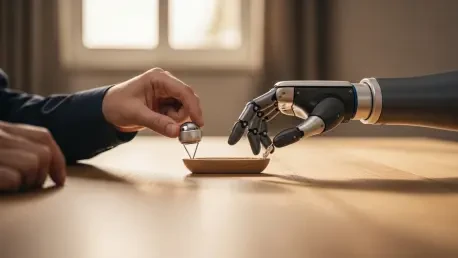

The seamless integration of advanced robotics with the human body represents a monumental leap in medical technology, yet the success of these innovations hinges on a factor far more subtle than mere mechanical efficiency. As AI-powered prosthetic limbs evolve to include semi-autonomous functions designed to assist users, a critical psychological hurdle has emerged: the user’s own sense of control and bodily ownership. If an artificial limb moves in a way that feels foreign or unexpected, it can create a profound sense of unease, undermining the very purpose of the device. A recent study delved into this complex human-machine relationship, specifically investigating how the speed of an autonomous prosthetic arm’s movement directly influences a person’s feelings of embodiment, agency, and overall acceptance. The research sought to quantify this subjective experience, exploring the delicate balance between high-performance engineering and the deeply personal, intuitive nature of human movement. The findings provide crucial insights for developers, suggesting that the most effective augmentations are not necessarily the fastest, but those that feel the most natural.
Simulating the Human-Machine Interface
Crafting a Virtual Reality Testbed
To meticulously isolate the impact of movement speed on user perception, researchers led by Harin Manujaya Hapuarachchi developed a sophisticated virtual reality (VR) simulation. This immersive environment provided a controlled and replicable setting where the complex variables of physical prosthetics could be standardized. Within the simulation, participants were fully embodied in a virtual avatar whose forearm was replaced with a sleek, robotic prosthesis. This allowed them to experience the artificial limb as an extension of their own body in a visually convincing manner. The core of the experiment involved programming the virtual arm to perform a simple yet fundamental autonomous action: a reaching task toward a designated target. The critical variable was the duration of this movement, which was systematically adjusted across six distinct speeds. These ranged from an incredibly swift 125 milliseconds, faster than a typical human reaction, to a deliberately slow 4 seconds. By having participants experience this full spectrum of velocities, the study could precisely measure how the timing of an autonomous action shapes the user’s psychological and emotional response to the technology.
Quantifying the User Experience
The virtual reality environment served as more than just a visual simulation; it was a sophisticated data-gathering tool designed to capture the nuanced, subjective feelings of each participant. After experiencing the autonomous reaching task at each of the six programmed speeds, participants were asked to complete a series of standardized questionnaires. These tools were carefully selected to measure key psychological metrics critical to the acceptance of prosthetic technology. Ratings were collected to assess the feeling of body ownership, which evaluates how much the user perceived the robotic arm as a genuine part of their own body. A separate metric measured the sense of agency, or the feeling of being in control of the arm’s actions, even when it moved autonomously. Usability was gauged using the System Usability Scale (SUS), a well-established industry standard for assessing ease of use. Finally, the Robot Social Attributes Scale (RoSAS) was employed to understand the social impressions the arm created, measuring perceptions of its competence and warmth, as well as any discomfort or unease it provoked in the user.
The Crucial Role of Natural Pacing
Identifying the Optimal Velocity
The comprehensive data collected from the study yielded a clear and compelling conclusion: when it comes to autonomous prosthetics, the ideal speed is one that mirrors natural human motion. The results consistently showed that a moderate movement speed, corresponding to a reaching duration of approximately one second, was overwhelmingly preferred by participants. This particular velocity generated the highest possible ratings for body ownership and sense of agency, indicating that at this pace, the robotic limb felt most like an integrated and controllable part of the user’s own body. Furthermore, this one-second movement duration also received the top scores for usability, suggesting that it felt the most intuitive and effective to operate. In stark contrast, the extremes on either end of the speed spectrum produced significantly negative reactions. Movements that were either excessively fast (125 milliseconds) or exceptionally slow (4 seconds) dramatically diminished these positive feelings. These unnatural speeds created a sense of alienation, making the limb feel less like a personal extension and more like an unpredictable, foreign object attached to the body.
Balancing Competence with Comfort
Delving deeper into the social perceptions of the robotic arm, the findings revealed a fascinating and complex trade-off between perceived capability and user comfort. While the moderate, human-like speed was optimal for embodiment, slightly faster speeds tended to increase the perception of the arm’s competence. Participants associated a quicker, more decisive movement with a higher degree of technological proficiency and effectiveness. However, this perception of competence came at a significant cost. The very fastest speed tested, while potentially seen as the most powerful from a purely mechanical standpoint, also provoked the highest levels of discomfort and unease among users. This crucial finding underscores that raw performance metrics are not the sole arbiters of a successful human-robot interface. An autonomous limb that moves with startling, machine-like velocity may be technically impressive, but it can also be profoundly unsettling, creating a psychological barrier that prevents true user acceptance. The research highlights the need for a balanced design philosophy, one that enhances perceived competence without sacrificing the essential element of user comfort.
Designing for Embodiment
The study ultimately underscored that the engineering of advanced robotic prosthetics and other bodily augmentations, such as exoskeletons or supernumerary limbs, required a paradigm shift. Prioritizing raw performance metrics like maximum speed and pinpoint accuracy was an insufficient, and at times counterproductive, approach to design. To achieve genuine user acceptance and foster a true sense of embodiment, where the device feels like a natural extension of the self, developers had to integrate principles of human psychology directly into the engineering process. The research demonstrated that the most successful devices would be those with movement profiles that felt intuitive and acceptable to the user, aligning with ingrained expectations of biological motion. This meant that future development would need to focus on tunability and personalization, allowing speeds to be calibrated to individual preferences. The investigation also opened avenues for future inquiry, particularly concerning how long-term use and adaptation might alter a user’s perception, potentially making faster, more efficient movements feel more normal over time.