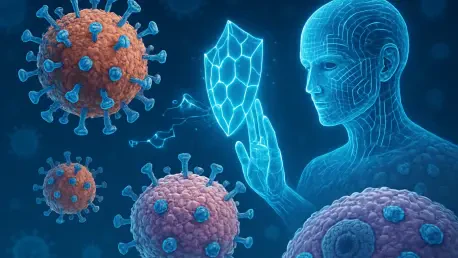

A sophisticated new strategy merging artificial intelligence with experimental biology has successfully identified and neutralized a key mechanism viruses use to invade human cells, a development that could revolutionize antiviral drug design. Researchers at Washington State University have pioneered a method that pinpoints a single, indispensable interaction within a viral protein and disables it, effectively locking the virus out. This breakthrough, detailed in the journal Nanoscale, offers a promising new pathway for combating persistent pathogens like the herpes virus, for which effective vaccines have remained elusive. By sifting through thousands of molecular interactions to find the one that matters most, this work showcases the transformative power of combining advanced computational analysis with traditional laboratory validation, dramatically accelerating the pace of discovery. The findings lay the groundwork for a new class of antiviral therapies designed with unprecedented precision.
A New Strategy Against Viral Invasion
Viruses employ a remarkably intricate process to gain entry into host cells, a sequence involving thousands of distinct molecular interactions that must occur in a precise order. The central challenge for scientists has been to distinguish the critical, non-negotiable steps from the surrounding molecular “background noise.” The research team focused its efforts on the herpes virus and its essential “fusion” protein, a complex molecular machine that acts as a master key. This protein is responsible for merging the virus’s outer membrane with that of a host cell, a crucial step that allows the virus to inject its genetic material and initiate an infection. For years, a significant barrier to developing effective treatments for herpes and similar viruses has been an incomplete understanding of the precise mechanics of how this fusion protein unfolds and triggers cell entry, making it difficult to design drugs that can reliably block its function and halt the infection before it starts.
The conventional approach to unraveling such a complex biological puzzle would involve a painstaking process of trial and error, a method that is both time-consuming and resource-intensive. Traditionally, researchers would have to systematically test thousands of potential molecular interactions one by one in a laboratory setting. A single experiment to test just one of these interactions could take several months to conduct and analyze. Consequently, identifying the single correct interaction necessary for viral entry without the guidance of a more advanced system could have taken many years, if not decades, of meticulous work. This slow pace of discovery has long been a major bottleneck in virology. The WSU team recognized that to overcome this hurdle and accelerate the development of new therapies, a fundamentally different and more efficient methodology was required—one that could navigate the immense complexity of the viral protein and deliver a highly targeted prediction for experimental validation.
The Power of AI in the Hunt
To address this challenge, the researchers implemented a two-pronged strategy that began with an intensive computational analysis. Led by specialists in mechanical and materials engineering, the first phase utilized cutting-edge artificial intelligence and highly detailed molecular-scale simulations to create a digital twin of the fusion protein. An advanced algorithm was developed to meticulously map and analyze the thousands of potential interactions occurring among the protein’s constituent amino acids. This process generated a massive and complex dataset, providing an unprecedentedly detailed blueprint of the protein’s internal dynamics. This initial step represented a crucial shift away from purely biological methods, leveraging the power of high-performance computing to explore the molecular landscape in a way that would be impossible through physical experiments alone, setting the stage for a more targeted and intelligent investigation.
Following the initial mapping, a sophisticated machine learning model was trained to analyze the vast and complex dataset generated by the simulations. The model’s primary function was to act as a highly intelligent filter, sifting through the thousands of mapped interactions to differentiate between them and rank their importance to the fusion process. By learning the patterns and relationships within the data, the AI could effectively predict which specific interactions were most critical for the virus to successfully enter a host cell. This computational deep dive allowed the researchers to bypass the slow trial-and-error process, as the AI model successfully pinpointed a single, specific amino acid that played the most pivotal role in the cell entry mechanism. This demonstrated the remarkable efficiency of an AI-driven approach, which navigated a problem of enormous scale and complexity to deliver a precise, actionable target for the next phase of the study.
From Prediction to Proof
Armed with the AI’s highly specific prediction, the research team transitioned from the computational realm to the experimental laboratory to validate the findings. This phase of the study was led by a professor from the Department of Veterinary Microbiology and Pathology, highlighting the project’s powerful interdisciplinary nature. Guided by the AI’s identification of the single most important amino acid, the team engineered a precise mutation at that exact location within the herpes virus’s fusion protein. The objective of this meticulously designed experiment was to physically test the hypothesis generated by the digital model. If the AI was correct, disrupting this single point of contact should be sufficient to disrupt the entire viral entry process, thereby proving that computational predictions could accurately guide real-world biological interventions and accelerate the discovery of new therapeutic targets.
The results of the laboratory experiment were both decisive and compelling, providing powerful validation for the computational model’s accuracy. The single, targeted mutation engineered into the fusion protein was found to significantly block the virus’s ability to successfully merge with and enter host cells. The modified herpes virus was rendered largely incapable of causing an infection, confirming that the researchers had successfully identified and disrupted an interaction that is absolutely essential for the virus’s pathogenic capabilities. This outcome underscored the immense potential of an integrated research model where advanced simulation and machine learning work in synergy with experimental biology. The success of this approach demonstrated a new, highly efficient pathway for uncovering critical biological weak points that can be targeted for therapeutic intervention, potentially revolutionizing how scientists approach the development of antiviral drugs.
Future Directions and New Frontiers
While this breakthrough represents a foundational step in understanding and combating viral entry, the researchers acknowledged that more work is needed to translate this discovery into a clinical therapy. A key challenge remains in bridging the gap between what can be observed in experiments and the highly detailed, dynamic processes visualized in the AI simulations. Although they successfully identified a critical small-scale interaction, the team does not yet have a complete picture of how this single amino acid mutation triggers larger, cascading effects that alter the three-dimensional structure and overall behavior of the entire fusion protein. Understanding this domino effect is the team’s next major objective, as it will be crucial for designing drugs that can mimic this disruptive effect and effectively neutralize the virus in a clinical setting.
The investigation into the broader structural consequences of the targeted mutation has already begun. The researchers plan to further leverage advanced simulations and machine learning to build a more comprehensive model that illustrates how disrupting one key interaction alters the protein’s overall shape and function, ultimately preventing it from performing its cell-fusion duty. This future work was considered vital for translating the fundamental discovery into practical therapeutic strategies. The successful integration of artificial intelligence with experimental biology established a powerful new paradigm for virological research. This project not only neutralized a key mechanism of viral entry but also pioneered a new and highly efficient pathway for scientific discovery, offering a promising avenue for designing future antiviral drugs against some of the world’s most challenging pathogens.