
The intricate network of blood vessels that sustains human life depends entirely on the structural integrity of the endothelium, a microscopic cellular barrier that regulates the flow of life-sustaining nutrients while keeping harmful toxins at bay. When this delicate system fails, the consequences are often catastrophic, leading to systemic inflammation, organ failure, or the lethal internal pressure shifts associated with strokes and severe sepsis. Central to this biological balancing act is a multi-faceted protein known as protease-activated receptor-1 (PAR1), a member of the G protein-coupled receptor family that serves as a high-stakes decision-maker within the circulatory system. For decades, scientists have struggled to understand why this single receptor sometimes acts as a guardian of vascular health and at other times initiates a cascade of self-destructive inflammatory responses. Recent breakthroughs have finally shed light on this molecular “Jekyll and Hyde” behavior, revealing a sophisticated switching mechanism that could redefine the future of emergency medicine and cardiovascular care.
Understanding the Dual Nature of PAR1 Signaling
The Molecular Mechanics of Receptor Activation
Unlike the vast majority of cellular receptors that respond to the simple docking of a floating chemical messenger, PAR1 employs a unique and irreversible activation method known as proteolysis. In this process, specialized enzymes physically cleave a specific portion of the receptor’s outer-facing tail, effectively “trimming” the protein to reveal a previously hidden sequence known as a tethered ligand. Once exposed, this ligand loops back and binds to the receptor itself, triggering a signal that echoes into the cell’s interior to dictate its next biological move. This physical transformation is a one-way street, making the precision of the initial cut the most critical moment in the life cycle of the receptor. The nature of the enzyme performing the cut determines the specific shape the receptor takes, which in turn dictates whether the vessel wall will tighten its defenses or begin to dismantle its protective barriers in response to a perceived threat.
The significance of this “outside-in” communication cannot be overstated, as it represents a fundamental level of biological programming that governs how the body reacts to trauma. In a healthy state, certain enzymes promote a cleavage pattern that instructs the endothelium to remain robust and impermeable, ensuring that blood stays within the vessels and reaches the necessary organs. However, during a severe infection or injury, different enzymes can hijack this process, clipping the PAR1 receptor in a way that signals the cell to loosen its junctions. This leads to the “leaky” vessel syndrome often seen in critical care units, where fluid escapes the circulatory system, causing dangerous drops in blood pressure and widespread tissue edema. Understanding the nuance of these physical cuts has provided the first real map of how a single protein manages two diametrically opposed physiological outcomes based on a single molecular snip.
The Role of Spatial Localization in Cell Health
The most profound discovery in recent vascular research identifies the intracellular enzyme G protein-coupled receptor kinase 5 (GRK5) as the primary arbiter of the cell’s ultimate fate. It was previously assumed that the mere presence of certain signaling proteins determined the outcome, but the data now shows that the physical location of GRK5 within the cell’s three-dimensional space is what truly matters. When the PAR1 receptor is activated in a protective manner, it recruits GRK5 to the plasma membrane—the oily outer boundary of the cell. In this specific membrane-anchored position, GRK5 works in tandem with other proteins to reinforce the cellular “glue” that keeps blood vessels watertight. This localized interaction acts as a stabilizing force, preventing the runaway inflammation that often follows an injury or a viral invasion, effectively serving as a biological shield for the circulatory system.
Conversely, the harmful inflammatory pathway is triggered when the same enzyme, GRK5, is released into the cytoplasm, the fluid-filled interior of the cell. This change in scenery fundamentally alters the proteins that GRK5 can interact with, shifting its function from a stabilizer to a disruptor. In the cytoplasm, the enzyme promotes the breakdown of cell-to-cell junctions, essentially opening the floodgates and allowing inflammatory markers to wreak havoc on the surrounding tissue. This spatial regulation represents a paradigm shift in our understanding of cell biology, moving away from a binary “on-off” model toward a more complex “where-and-when” logic. By tracking the migration of GRK5 from the membrane to the cytoplasm, researchers have successfully identified the exact moment a healing response turns into a destructive one, providing a clear target for future medical interventions.
Innovative Tools and Future Medical Applications
Visualizing Protein Complexes with Artificial Intelligence
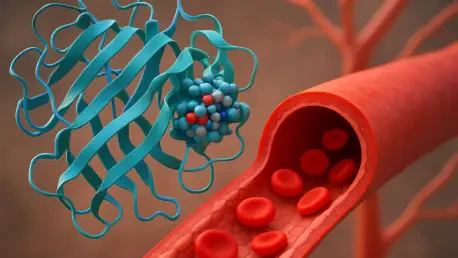
To unravel the complex geometry of these protein interactions, researchers turned to AlphaFold 3, an advanced artificial intelligence system that has revolutionized the field of molecular biology. This computational tool allows scientists to generate high-resolution, three-dimensional models of protein complexes that were previously impossible to see with traditional imaging techniques. By simulating how the PAR1 receptor changes shape after different enzymatic cuts, the AI provided a visual confirmation of the “outside-in” signaling theory. It demonstrated that the physical configuration of the receptor’s internal structure changes based on how its external tail was clipped, which directly influences whether it attracts GRK5 to the membrane or repels it into the cytoplasm. This level of detail has transformed a theoretical biological mystery into a visible, mechanical reality that can be studied and manipulated.
The use of AI in this context does more than just provide pretty pictures; it serves as a predictive engine for drug discovery and molecular design. By observing how PAR1 acts as a communication hub, the research team was able to identify specific “hot spots” on the protein where a drug might bind to influence its signaling bias. The AI models showed that even minor shifts in the receptor’s orientation can have massive downstream effects on vascular permeability. This digital mapping approach has drastically accelerated the timeline for identifying potential therapeutic compounds, moving away from slow, trial-and-error laboratory experiments toward a more targeted, data-driven methodology. As these AI tools continue to evolve, they are providing a blueprint for understanding how many other “dual-purpose” receptors in the human body operate, potentially unlocking treatments for a wide variety of diseases beyond the vascular system.
Developing Precision Therapies for Vascular Disease
The identification of this molecular switch offers a roadmap for the development of “biased ligands,” a new class of precision medicines designed to steer a receptor toward its beneficial functions while blocking its harmful ones. Current treatments for vascular issues often act like blunt instruments, either activating or blocking a receptor entirely, which frequently leads to unwanted side effects or the loss of natural healing processes. For instance, a drug that completely shuts down PAR1 might stop inflammation, but it would also prevent the receptor from repairing damaged vessel walls. By focusing on the spatial orientation of the PAR1-GRK5 complex, future therapies could be engineered to “lock” the enzyme at the plasma membrane. This would allow clinicians to harness the body’s own protective signals to treat conditions like brain swelling after a stroke or the systemic collapse seen in septic shock.
This move toward precision pharmacology represents a significant leap forward in how we manage acute cardiovascular crises. Instead of merely suppressing the immune system, doctors could theoretically reprogram the patient’s cells to maintain vascular integrity even in the face of severe trauma. Such a breakthrough would be particularly transformative for treating ischemic strokes, where the primary goal is to minimize secondary tissue damage caused by post-event inflammation and swelling. By encouraging the protective side of PAR1, these new drugs could preserve healthy brain tissue and improve recovery outcomes for millions of patients. This approach also holds promise for chronic conditions where low-level vascular leakage contributes to long-term organ decay, providing a versatile toolset for modern medicine to combat some of its most persistent and deadly challenges.
Shifting Paradigms in Modern Pharmacology
The success of this research reinforces the emerging concept of spatiotemporal signaling, which posits that the location and timing of molecular interactions are the most critical factors in biological health. Historically, pharmacology has been preoccupied with the “what”—identifying which molecules bind to which receptors—but this study proves that the “where” is equally significant. This shift in perspective encourages scientists to look beyond simple chemical reactions and consider the architectural layout of the cell as a dynamic environment. By understanding that a single molecule can be both a savior and a saboteur depending on its position, researchers can develop more sophisticated strategies for drug delivery and design. This holistic view of cellular behavior is paving the way for a more nuanced era of medical science where treatments are tailored to the specific spatial needs of the cell.
In the coming years, the insights gained from decoding the PAR1 switch will likely serve as a foundational element for a wide range of interdisciplinary studies. The ability to control the spatial localization of signaling proteins suggests that we may soon be able to “tune” the body’s inflammatory response with unprecedented accuracy. This research not only provides a solution to a long-standing mystery in vascular biology but also offers a strategic blueprint for the next generation of critical care medicine. As we move away from generalized treatments and toward these highly specific molecular interventions, the potential to save lives in the immediate aftermath of strokes, heart attacks, and severe infections grows exponentially. The work of these researchers has effectively opened a new chapter in pharmacology, one where the goal is no longer just to stop a process, but to guide it toward a healthier outcome.
The elucidation of the PAR1-GRK5 signaling axis has provided the medical community with a clear and actionable path forward for treating complex vascular disorders. By recognizing that the membrane-anchored state of GRK5 is the essential requirement for vessel stability, scientists have moved past the initial confusion of the receptor’s dual nature. Moving forward, the focus must shift toward the synthesis of specialized molecules that can stabilize these protective protein configurations in clinical settings. This will require continued investment in computational modeling and high-throughput screening to identify the most effective biased ligands for human use. As these precision therapies transition from the laboratory to the bedside, they will likely become a cornerstone of cardiovascular and emergency medicine, offering a level of control over the body’s healing processes that was once considered impossible. This study stands as a testament to the power of combining advanced AI with fundamental biological inquiry to solve the most pressing challenges in human health.