
Ivan Kairatov is a leading biopharma expert whose career has been defined by bridging the gap between raw material science and clinical application. With extensive experience in research and development, he specializes in how emerging technologies—like advanced sensors and AI—can transform our understanding of the human body in real-time. His work often focuses on the intersection of bioelectronics and diagnostic accuracy, making him a pivotal voice in the discussion surrounding the next generation of health tech.
The following discussion explores the breakthrough development of a metahydrogel sensing platform designed to solve one of the oldest problems in wearable technology: motion noise. We delve into how this system achieves clinical-grade precision for blood pressure and ECG monitoring during physical activity, the role of deep learning in diagnosing mental exhaustion, and the practical challenges of bringing such high-tech materials from the lab to the factory floor.
Current commercial wearables often struggle with signal-to-noise ratios between 10 and 20 dB during movement. How does achieving a 37.36 dB ratio change the diagnostic potential for chronic fatigue, and what specific physiological markers become visible that were previously obscured by motion artifacts?
The jump to a 37.36 dB signal-to-noise ratio is a total game-changer because it moves us from “estimations” to clinical reality. In standard commercial trackers, motion artifacts usually cause a 40 percent drop in signal quality, which effectively hides the subtle heart rate variability and ECG waveform features that indicate a stressed autonomic nervous system. By hitting that 37.36 dB threshold, we can increase peak-detection accuracy from a measly 52 percent to a robust 93 percent even while the wearer is moving. This clarity allows us to see the exact timing between heartbeats and the specific morphology of the ECG signal, which are the primary physiological markers that tell us if someone is experiencing the onset of chronic fatigue or just standard physical exertion.
Diagnosing burnout typically relies on subjective questionnaires, yet your system classifies fatigue with 92 percent accuracy. What are the specific steps in your machine-learning denoising process, and how do you differentiate between general physical exhaustion and the cardiovascular traces of clinical mental health conditions?
The process begins at the hardware level with the metahydrogel, but the AI is what finishes the job by applying a denoising algorithm that strips away any remaining unstructured noise while protecting the integrity of the physiological features. We then feed this high-fidelity cardiovascular data into a deep-learning system that has been trained to recognize the specific patterns of the autonomic nervous system under mental strain. Our research showed that without this specialized filtering, accuracy drops to 64 percent, but with it, we hit 92 percent because the system can finally “hear” the distinct cardiovascular signatures of fatigue through the noise. This allows us to move away from subjective, intermittent self-reporting and toward an objective, continuous stream of data that reflects the user’s true internal state.
The metahydrogel platform utilizes periodic nanoparticle bands and a glycerol-water electrolyte to filter noise at the physical interface. Could you describe the mechanical trade-offs involved in keeping the material breathable and stretchable while ensuring it maintains the ISO-grade accuracy required for blood pressure monitoring?
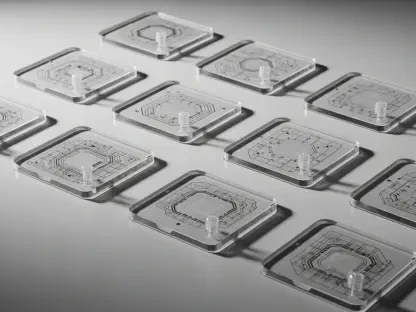
Engineering this material was a delicate balancing act because we needed it to be soft enough to match biological tissue while remaining durable under repeated stretching. We managed to develop a platform that is not only flexible but also highly breathable, with a water vapor transmission rate that actually exceeds that of human skin, ensuring it is comfortable for multi-day wear. Despite this soft structure, the material is rigid enough in its filtering properties to keep blood pressure deviation as low as 3 mmHg during movement. This precision is what allows the device to meet the ISO 81060-2 gold-standard requirements, proving that you don’t have to sacrifice wearer comfort for clinical-grade data.
High-frequency muscle noise and low-frequency heart signals often overlap during daily activities. How does the ionic travel speed within the sensor selectively suppress interference, and what specific anecdotes can you share from the driving simulations that proved this hardware-level filtering was superior to software-only solutions?
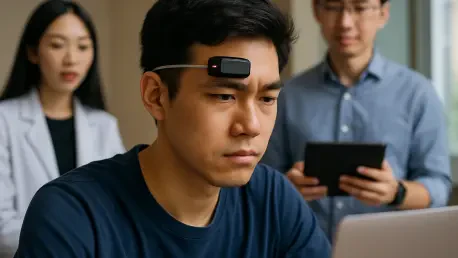
The secret lies in the biocompatible glycerol-water electrolyte, which we use to precisely control the speed at which ions travel through the hydrogel. We’ve designed it so that low-frequency signals, specifically heart signals below 30 Hz, pass through the material with ease, while higher-frequency electrical noise from muscles is physically suppressed before it ever reaches the processor. During our simulated driving tasks, we observed that participants’ movements would normally create a chaotic “wall” of noise that software algorithms struggle to peel back. However, because our hardware was already filtering out the muscle interference at the source, the resulting ECG was remarkably clean, allowing us to track the driver’s fatigue levels in real-time with a level of stability that software-only solutions simply cannot replicate.
Moving from a laboratory prototype to a scalable product requires consistent material synthesis and manufacturing. What are the primary hurdles in mass-producing these specialized metahydrogels, and how would integrating this technology into industrial safety programs impact the economic costs associated with workplace fatigue?
Right now, the primary hurdle is that our synthesis and fabrication are still rooted in labor-intensive laboratory processes that took us years to refine. We need to transition these “hand-crafted” metahydrogels into a streamlined industrial manufacturing strategy to ensure every sensor produced is identical in its filtering capabilities. If we can successfully scale this, the impact on industrial safety would be massive, as workplace fatigue carries a staggering economic cost due to accidents and lost productivity. By integrating these sensors into safety programs, companies could monitor the alertness of workers in high-stakes roles—like heavy machinery operators—and intervene before a fatigue-related incident occurs, potentially saving billions of dollars and countless lives.
This sensing platform has shown success in recording brain waves, eye movements, and heart sounds simultaneously. How might a multi-modal approach like this reshape neurophysiological monitoring, and what practical steps are necessary to ensure the data remains actionable for mental-health physicians in real-world settings?
A multi-modal approach completely changes the landscape because it allows us to see the “whole picture” of a patient’s health, linking brain waves (EEG) directly with heart and respiratory sounds in a single, wearable platform. To make this data actionable for physicians, we must work closely with them to determine which specific markers are most relevant to their clinical needs and establish clear, pathological links within the data. We’ve already spent four years developing the underlying technology and another year on application validation, but the next step is building a library of these materials that can be tailored to different medical use cases. This ensures that a doctor isn’t just looking at a mountain of data, but at a curated set of insights that lead to better diagnostic outcomes.
What is your forecast for the future of wearable mental health monitoring?
I believe we are moving toward a world where mental health diagnostics are as objective and routine as taking a temperature reading. In the coming years, we will see the end of “one-size-fits-all” wearables as we transition to specialized materials like metahydrogels that are physically tuned to the wearer’s environment and specific health conditions. We will likely see these sensors integrated into every aspect of professional life, from pilot headsets to construction vests, providing a continuous safety net that detects burnout days or even weeks before a person realizes they are struggling. Ultimately, the future of this field lies in hardware that is so integrated into our lives—and so accurate—that the barrier between the patient’s experience and the physician’s understanding finally disappears.