
Medical diagnostics often present a difficult choice between speed, detail, and safety, forcing clinicians to navigate a complex landscape of imaging technologies, each with its own set of compromises. While some methods offer rapid, real-time views, they may lack the resolution needed for a definitive diagnosis. Conversely, highly detailed scans can be prohibitively expensive, time-consuming, and sometimes involve exposure to radiation or the use of contrast agents. This persistent challenge has spurred a new wave of innovation aimed at bridging these gaps. Researchers from the California Institute of Technology and the University of Southern California have now developed a groundbreaking imaging technique that promises to eliminate these trade-offs. Their new system, known as RUS-PAT, cleverly integrates two distinct technologies to produce swift, high-resolution 3D color images of soft tissues and blood vessel activity, heralding a significant advancement in medical imaging with the potential to transform diagnostics for conditions ranging from cancer to nerve damage.
Overcoming Diagnostic Limitations
The impetus behind the development of the new hybrid system stemmed directly from the inherent limitations of established imaging modalities that have long been the bedrock of clinical practice. For instance, conventional ultrasound is widely used due to its speed, low cost, and safety, but its utility is often hampered by its two-dimensional output and a restricted field of view, which can make it difficult to visualize complex anatomical structures comprehensively. On the other hand, photoacoustic imaging, a technique that uses laser pulses to generate sound waves from tissue, excels at visualizing blood vessels and their oxygenation levels but falls short in capturing the surrounding tissue architecture. Meanwhile, more powerful technologies like computed tomography (CT) and magnetic resonance imaging (MRI) provide exceptional detail but come with significant drawbacks, including high operational costs, lengthy scan times, the necessity for potentially problematic contrast agents, and, in the case of CT scans, patient exposure to ionizing radiation. These constraints create a critical need for a more versatile and efficient diagnostic tool.
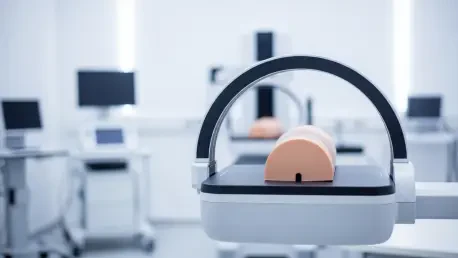
To address these long-standing challenges, the research team, led by medical engineering expert Lihong Wang, engineered a sophisticated solution that represents more than a simple merging of two existing systems. The RUS-PAT (rotational ultrasound tomography combined with photoacoustic tomography) system is a fundamental re-imagination of hybrid imaging. Instead of creating a bulky and expensive apparatus that houses two separate technologies, the team developed an elegant and integrated design. Their key innovation lies in the use of a single, wide-field ultrasound transducer that generates sound waves in a manner that effectively mimics light excitation. This allows the device to simultaneously capture both the detailed structural information provided by ultrasound and the functional data on blood flow from photoacoustics. The physical setup is remarkably compact, featuring an array of arc-shaped detectors that rotate to function as a single hemispheric sensor, making the system significantly simpler and more economical than previous hybrid concepts.
A New Frontier in Clinical Applications
The clinical potential of RUS-PAT is vast, offering a powerful new tool for a wide array of medical applications wherever laser light can penetrate tissue. Currently, the system can image tissues up to four centimeters deep, and ongoing research suggests that its reach could be extended even further into the body through the use of endoscopic tools. In the field of oncology, particularly for breast cancer detection, this technology could provide clinicians with the ability to precisely locate a tumor while simultaneously gaining critical insights into its biological activity, such as its blood supply, which is a key indicator of its aggressiveness. For patients with diabetes, the system offers a non-invasive way to monitor for neuropathy by providing a comprehensive assessment of both nerve structures and their associated oxygen supply in a single, rapid scan. Furthermore, in neuroscience, researchers can use RUS-PAT to examine anatomical brain structures and their corresponding blood flow at the same time, opening new avenues for studying brain function and disease.
The development and initial validation of the RUS-PAT system marked a pivotal moment in the advancement of medical imaging technology. This collaborative effort, supported by funding from the National Institutes of Health, brought together a dedicated team of scientists from both Caltech and USC who successfully translated a novel concept into a functional diagnostic tool. The efficiency of the system, which completes a full 3D scan in under a minute, underscores its suitability for busy clinical environments where time is often a critical factor. Crucially, the technology has moved beyond the laboratory bench, with preliminary trials on human volunteers and patients already demonstrating its remarkable capabilities in real-world scenarios. These successful early-stage applications have validated the system’s potential and laid a solid foundation for its journey toward broader clinical adoption, representing a significant step forward in providing safer, faster, and more comprehensive diagnostic information to physicians and their patients.