
I’m Ivan Kairatov, and for years, my work has been centered at the intersection of biotechnology and engineering, specifically focusing on how we can bridge the gap between the human brain and external technology. The progress we’re seeing in brain-computer interfaces, or BCIs, is nothing short of revolutionary, particularly for individuals who have lost the ability to communicate. We’re now moving beyond simple motor commands to decoding the very essence of language directly from the brain. In our conversation, we’ll explore the incredible nuance of distinguishing intentional speech from private thoughts, walk through the patient’s journey from surgery to regaining a voice, and examine how large-scale collaboration and artificial intelligence are fueling this new frontier.
Recent advancements have shown that brain-computer interfaces can not only detect imagined words but also differentiate them from private thoughts. What are the specific technical challenges in making this distinction, and how does this capability impact the user’s sense of privacy and autonomy?
The primary technical hurdle is the sheer complexity and subtlety of neural signals. Your brain is a constant storm of activity. The signals for an internal thought, a fleeting idea, and an imagined word you intend to speak are remarkably similar. The challenge lies in finding the specific, faint neural signature that flags a thought for “export.” It’s like listening to a massive orchestra and trying to isolate the one musician who is not just practicing but performing for the audience. We believe the key is in identifying patterns in the speech cortex that signify communicative intent. This capability is absolutely fundamental for user autonomy. Imagine if every passing thought was broadcast; it would be paralyzing. By ensuring the BCI only transmits what the user consciously wants to say, we preserve that sacred inner space, giving them complete control and protecting their privacy, which is the cornerstone of making this technology truly liberating rather than invasive.
For patients with conditions like ALS, implanted electrodes can read brain signals related to attempted speech. Could you walk us through the process, from surgical implantation to a patient learning to control an assistive device, and what are the key recovery milestones?
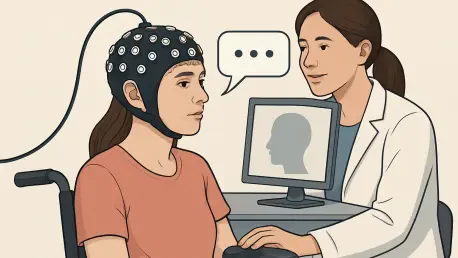
The journey is a profound partnership between the patient, medical team, and engineers. It begins with a highly precise neurosurgical procedure where an array of tiny electrodes is placed on the surface of the brain, specifically over the speech cortex. After a recovery period, the real work begins. The patient is asked to try to speak words, and even though no sound is produced, their brain generates the corresponding electrical activity. This is the raw data our system captures. Initially, the process is one of calibration; the patient repeats specific words or phonemes so the AI can learn to map their unique neural patterns to language. The first major milestone is when the system can accurately decode a word for the first time—it’s an incredibly emotional and validating moment. From there, the milestones are about speed and fluency, moving from single words to building full sentences, and eventually, having the system learn and adapt in real-time to the user’s thoughts, making communication feel more natural and intuitive.
The development of speech-focused BCIs involves a large collaboration between institutions and leverages artificial intelligence. How does this multi-institutional approach accelerate innovation, and what specific role does AI play in translating raw brain signals from the speech cortex into coherent communication?
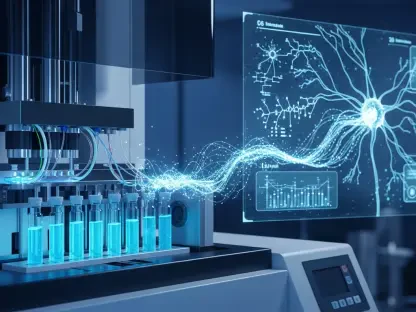
No single lab has all the answers, which is why collaboration is our greatest accelerator. When you bring together biomedical engineers from places like Georgia Tech and Emory with neuroscientists and clinicians from Stanford, Mass General, and others, you create a powerful ecosystem. One institution might excel in electrode design, another in surgical techniques, and another in software development. This multi-institutional model allows us to share data, refine protocols, and solve complex problems much faster than we could in isolation. Artificial intelligence is the engine that drives this entire process. The raw electrical signals from the brain are incredibly noisy and complex. AI algorithms, specifically deep learning models, are trained on vast amounts of this data to find the hidden patterns. The AI acts as the translator, taking this chaotic neural activity as input and converting it into the clear, coherent words the person is trying to say. It’s this intelligent decoding that turns a stream of electrical pulses into meaningful communication.
What is your forecast for the future of brain-computer interfaces in restoring communication for those who have lost the ability to speak?
I am profoundly optimistic. We are on the cusp of a major breakthrough where BCIs will not just be a tool for basic communication but a means to restore a person’s linguistic identity with nuance and personality. In the next five to ten years, I forecast the development of systems that are less invasive, possibly even non-invasive, with much higher resolution. The speed and accuracy of decoding will increase exponentially, moving from typing out words to generating synthesized speech that sounds natural, perhaps even mimicking the user’s original voice. We’ll see smarter, adaptive AI that learns a person’s unique way of speaking, including their humor and tone. The ultimate goal is seamless, real-time conversation, effectively giving a voice back to those who have lost it and allowing them to reconnect fully with their loved ones and the world.