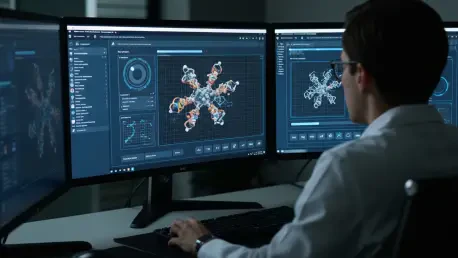

The blueprint for a life-saving drug can often be found in the intricate, three-dimensional architecture of a single protein, yet viewing this structure with perfect clarity has remained a persistent challenge for modern science. For pharmaceutical researchers, this microscopic world is the battlefield where new therapies are designed. A new software company, Intellicule, has just secured a significant federal grant to bring this battlefield into sharper focus, aiming to eliminate a critical bottleneck in the quest for more effective medicines. The funding supports the development of an artificial intelligence platform designed to interpret complex biological images, potentially accelerating drug discovery pipelines worldwide.
Designing Better Medicines by Seeing the Unseeable
Understanding the precise three-dimensional shape of biomolecules like proteins and nucleic acids is fundamental to modern medicine. These molecules are the primary targets for most drugs, and their specific structures dictate how they function and interact within the body. When scientists can visualize a target protein’s exact form, they can design a drug molecule that fits into it like a key into a lock, a process known as rational drug design. This approach is far more efficient and effective than traditional trial-and-error methods, leading to therapies with higher efficacy and fewer side effects.
To achieve this level of visualization, researchers rely heavily on cryogenic-electron microscopy (cryo-EM), a revolutionary technique that images flash-frozen molecules. Cryo-EM has become an indispensable tool in both academic labs and major pharmaceutical companies, offering unprecedented insights into the machinery of life. The ability to see these biological targets in their near-native state provides the structural data necessary to develop treatments for a vast range of diseases, from viral infections to cancer.
The Multi-Million Dollar Blind Spot in Drug Discovery
Despite its power, cryo-EM has a significant and costly limitation. The technique does not always produce images at a consistently high resolution, which is defined as being better than 3 angstroms. When the resolution is lower, the resulting molecular map becomes blurry and difficult to interpret accurately. This ambiguity creates a major hurdle in the drug discovery process, transforming a powerful tool into a source of uncertainty and delay.
This “blind spot” is more than just a technical inconvenience; it represents a substantial bottleneck that slows down innovation. According to Daisuke Kihara, who leads Intellicule, modeling the structures of potential drug molecules from lower-resolution images is an incredibly time-consuming and error-prone task. Researchers can spend weeks or even months trying to manually fit molecular models into fuzzy data, a process that requires deep expertise and still carries a high risk of error. This challenge effectively limits the accessibility of cryo-EM, especially for non-specialists who are crucial to the broader drug development ecosystem.
A $217,941 Grant to Power an AI-Driven Solution
To address this critical gap, Intellicule has been awarded a $217,941 Small Business Innovation Research (SBIR) Phase I grant from the National Institutes of Health. This funding is dedicated to the development of the company’s advanced biomolecular modeling software. The goal is to create a solution that can automatically and accurately determine the 3D structures of biomolecules from cryo-EM data, even when the image quality is suboptimal.
At the heart of Intellicule’s software is a sophisticated application of deep learning, a subset of artificial intelligence renowned for its prowess in image recognition and processing. The intellectual merit of the project lies in its innovative approach to overcoming the resolution barrier. The software is being trained to detect the precise location of atoms within the cryo-EM density maps, a task that is nearly impossible for the human eye in low-resolution images. By automating this process, the technology promises to dramatically reduce modeling time, minimize human error, and make structural biology more accessible.
The Minds and Momentum Behind the Innovation
The initiative is steered by a team with deep roots in both academia and computational science. The project is led by Daisuke Kihara, a distinguished professor of biological sciences and computer science at Purdue University. He co-founded Intellicule with senior computational scientist Charles Christoffer and assistant research scientist Genki Terashi, combining academic rigor with entrepreneurial drive. Their collective expertise forms the foundation of the company’s technical capabilities.
Formerly known as Molecular Intelligence, the company launched in the summer of 2024 and quickly built momentum. In January 2025, it was granted an exclusive license from Purdue University to commercialize the software, marking a critical step in translating academic research into a market-ready product. This work also aligns with Purdue’s broader One Health initiative, which recognizes the interconnectedness of human, animal, and environmental health and seeks to develop holistic solutions to global health challenges.
From Blurry Images to a New Framework for Discovery
The ultimate objective of this NIH-funded project extends beyond merely improving an imaging technique. It is about establishing a new framework that accelerates the entire drug discovery pipeline. By providing researchers with faster and more accurate structural information, Intellicule’s software will enable the rational design of novel molecules that are more precisely targeted to their biological counterparts. This precision is the cornerstone of developing next-generation drugs with improved therapeutic outcomes.
This technological advancement has the potential to democratize a highly specialized field. By simplifying one of the most complex steps in structural biology, the software will empower a wider range of scientists to contribute to drug discovery. The transition from interpreting blurry images to achieving atomic-level precision marks a significant step toward the era of precision medicine, where treatments are tailored to the unique molecular landscape of an individual’s disease. This work offered a pathway to transform a challenging scientific process into a more streamlined and powerful engine for medical innovation.