
The aftermath of a stroke often leaves an indelible mark on the brain, creating a landscape of cellular devastation that the body has little inherent power to mend, but a landmark study has now unraveled the sophisticated internal mechanisms that guide stem cells to not only survive in this hostile environment but to actively rebuild what was lost. Unlike tissues that regenerate with remarkable speed, the brain’s intricate and stable structure makes recovery from significant injury a monumental challenge. For years, the promise of stem cell therapy has been a beacon of hope, yet progress was consistently thwarted by the complexities of the injured brain. New research, however, has finally cracked the code, revealing an innate guidance system within transplanted cells that directs them to form precise, functional connections, offering a clear and promising path forward for regenerative medicine. This discovery shifts the focus from merely replacing cells to understanding and harnessing their intrinsic ability to navigate and reconstruct damaged neural circuits.
The Challenge of Brain Repair
A Hostile Environment
Following a stroke, the site of the injury transforms into an environment that is profoundly inhospitable to new cellular life, presenting a primary obstacle to any regenerative therapy. The damaged area forms a cavity, or cyst, which quickly fills with a cocktail of inflammatory molecules, creating what researchers describe as a “dangerous swamp” full of threats for any transplanted cells. This chemical hostility is compounded by a physical barrier in the form of dense scar tissue that encapsulates the lesion. While this glial scar serves a crucial protective role by quarantining the injury and preventing the damage from spreading to healthy, surrounding brain tissue, it simultaneously blocks the growth of new nerve fibers, or axons. This dual-natured barrier has historically forced therapeutic strategies to attempt to bypass the damaged area entirely, grafting new cells adjacent to the lesion. However, such an approach fails to address the core problem: the broken circuit itself. True functional recovery necessitates not just working around the damage but directly repairing and reconnecting the severed pathways within the original site of injury.
A Novel Approach to Regeneration
To confront the formidable challenges of the post-stroke brain, scientists engineered a groundbreaking method for transplanting therapeutic cells directly into the epicenter of the damage. Using cells derived from human stem cells, the research team injected them into the stroke cavity within a mouse model, but with a critical innovation. They developed a supportive microenvironment—a specialized mixture of small-molecule drugs and structural proteins designed to act as a scaffold and a life-support system. This carefully crafted cocktail successfully nurtured the transplanted cells, shielding them from the inflammatory assault and providing the necessary cues for them to thrive. The results were dramatic: the cells not only survived but began to grow and mature into new neurons, progressively filling the entire lesion. This achievement marked a significant step forward, demonstrating that it was possible to overcome the brain’s hostile response and establish a healthy population of new cells within the damaged area, setting the stage for the far more complex challenge of functional integration into the brain’s existing circuitry.
Rebuilding the Brain’s Circuitry
Reconnecting the Wires
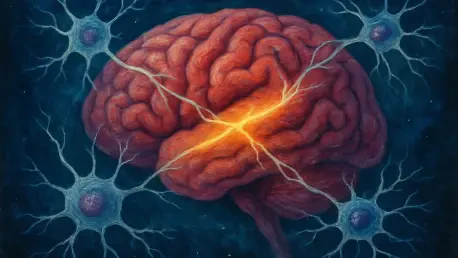
Once the survival and growth of the transplanted neurons were established, the pivotal question became whether these new cells could integrate into the brain’s complex architecture. The answer was a resounding yes. Through sophisticated three-dimensional reconstruction techniques, researchers were able to visualize the behavior of the new neurons and discovered they were extending long projections, known as axons, that successfully penetrated the dense scar tissue barrier. More importantly, these axons were not growing randomly; they were forming connections in patterns that closely resembled the natural wiring of a healthy brain. Specifically, they were rebuilding the critical pathway that runs between the cerebral cortex and the spinal cord, a key route for controlling motor function. This observation was profound, as it indicated that the transplanted cells were not merely filling a space but were actively participating in a guided reconstruction of the brain’s original circuitry, suggesting an inherent ability to navigate and re-establish meaningful connections.
Restoring Lost Function
The ultimate test of any regenerative therapy lies not just in its ability to repair tissue structure but in its capacity to restore lost capabilities, and in this regard, the study yielded compelling evidence. The precise structural reconnection observed in the brain translated directly into tangible functional recovery in the mouse models. Animals that had received the stem cell therapy demonstrated significant and measurable improvements in their motor skills, abilities that had been impaired by the stroke. This functional restoration provided definitive proof that the newly integrated neurons were not idle bystanders. Instead, they were actively communicating within the brain’s pre-existing neural network, firing signals and contributing to the complex processes required for coordinated movement. This outcome bridged the critical gap between cellular repair and meaningful patient outcomes, confirming that rebuilding the brain’s physical wiring with guided stem cells could indeed bring back function that was once thought to be permanently lost.
Cracking the Code: The Intrinsic Guidance System
Discovering the “Transcriptional Code”
The most groundbreaking revelation of the research was the discovery of how these newly grown neurons achieved such precise navigation through the chaotic environment of an injured adult brain. Using a powerful combination of advanced techniques, including a genetic barcode system to label and track individual cells and single-cell RNA sequencing to analyze their gene expression, the team uncovered an intrinsic guidance system. They found that the transplanted stem cells differentiate into distinct subtypes of neurons, and each subtype possesses a unique “transcriptional code.” This inherent genetic programming acts as a detailed set of instructions, a biological GPS that directs each specific type of neuron to send its axons toward the correct targets throughout the central nervous system. This finding represented a major paradigm shift, suggesting that if the correct neuronal subtypes are introduced into the damaged area, they already possess the innate knowledge of where to go and what to do to meticulously repair the brain’s broken circuits.
Proving the Genetic Blueprint
To validate their discovery of this internal navigation system, the researchers employed machine learning to analyze the vast amount of genetic data they had collected. This analysis identified four primary subtypes of neurons that developed from the transplanted stem cells, each distinguished by a unique pattern of genes known to be involved in guiding axon growth. This genetic variance elegantly explained why neurons of a particular subtype consistently formed connections with the same specific brain regions. The team then went a step further to provide definitive proof. In a controlled experiment, they took a batch of stem cells and used genetic tools to deactivate a key transcription factor known as Ctip2, a gene critical for guiding projections. When these modified cells were transplanted, their axons grew in significantly different patterns, forming more connections with unintended targets like the hippocampus and amygdala. This crucial experiment demonstrated unequivocally that the internal genetic code directly controls the navigational and connective behavior of the neurons.
A New Paradigm in Neurological Recovery
The comprehensive findings of this study represented a transformative leap in the pursuit of neurological repair. By moving beyond the fundamental goal of cell survival, the research provided an unprecedentedly deep understanding of the molecular mechanisms that govern how new neurons integrate into damaged circuits. The demonstration that transplanted neurons possess an innate ability to navigate and forge specific, functional connections fundamentally altered the landscape of cell-based therapies. The identification of the precise genetic codes that direct this intricate process has unlocked a future where treatments can be tailored with remarkable specificity. The ability to select or even engineer particular neuronal subtypes designed for the targeted reconstruction of specific pathways offered a powerful new strategy. This work laid a robust scientific foundation for developing highly effective therapies for the millions worldwide affected by the long-term consequences of stroke and other devastating neurological injuries.