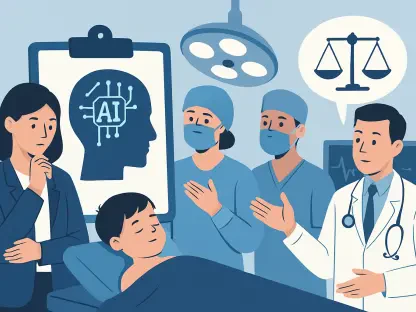

The rapid integration of sophisticated algorithms into the clinical environment has shifted the focus from whether technology can assist doctors toward how the doctors themselves perceive these digital collaborators. As medical artificial intelligence (AI) evolves from a futuristic concept into a daily reality, the success of its implementation no longer hinges solely on computational power or algorithmic accuracy. Instead, the psychological readiness of the next generation of physicians has emerged as a factor in determining how effectively these tools are utilized in patient care. This study explores the complex relationship between medical trainees and AI, seeking to quantify the attitudes that will ultimately shape the future of healthcare.
Assessing the Human Element: Perceptions of AI Among Medical Trainees
While the technical capabilities of AI continue to advance at an unprecedented speed, the human element remains a significant variable that can either facilitate or hinder technological adoption. Medical students and resident physicians face a unique set of challenges as they navigate an educational landscape that is increasingly permeated by automated systems. Concerns about ethical responsibility, data privacy, and the potential loss of professional autonomy are not merely theoretical; they are practical hurdles that influence how a young doctor interacts with a diagnostic tool or a clinical decision support system. The fear of job displacement also persists, creating a layer of skepticism that must be addressed through targeted educational frameworks.
The central focus of this research involves understanding the nuances of these perceptions to bridge the gap between technological potential and clinical practice. Educators and policymakers recognize that a doctor who distrusts an AI recommendation might ignore a life-saving insight, whereas an over-reliant doctor might overlook a critical algorithmic error. Therefore, measuring and analyzing the affective, cognitive, and behavioral dimensions of AI attitudes is essential. By identifying the specific drivers of anxiety or optimism, the medical community can develop more effective strategies to integrate AI into the workflow of future clinicians.
Bridging the Gap in Japanese Medical Education and AI Adoption
In the context of Japanese healthcare, the adoption of new technologies often intersects with specific cultural norms and social expectations. Japan has a history of high uncertainty avoidance, which can lead to a more cautious approach when implementing radical changes in professional sectors like medicine. Until recently, researchers in Japan lacked a validated instrument to objectively measure the attitudes of medical trainees toward AI. This absence made it difficult to compare the Japanese context with international trends or to design curriculum changes that were grounded in data.
To address this deficiency, a collaborative team led by researchers from Juntendo University and colleagues from the United Kingdom worked to adapt the 12-item attitudes toward artificial intelligence (ATTARI-12) scale. This original tool, developed in 2024, provided a brief yet reliable measure of AI attitudes. However, a literal translation would not have sufficed due to the linguistic and cultural nuances inherent in the Japanese medical education system. The development of the J-ATTARI-12 aimed to provide a psychometrically sound instrument tailored specifically for the Japanese medical community.
Research Methodology, Findings, and Implications
Methodology
The research team employed a rigorous cross-cultural adaptation process to ensure the J-ATTARI-12 was both linguistically accurate and culturally relevant. This process followed international guidelines for translation, back-translation, and expert review. Once the scale was finalized, a nationwide online survey was conducted between June and July 2025. The survey successfully recruited 326 participants, a cohort that included both medical students and resident physicians from various hospitals and academic institutions across the country.
To ensure the validity of the results, the researchers utilized a split-half validation approach. This involved performing an exploratory factor analysis on one portion of the data to identify the underlying structure of the participants’ responses. This was followed by a confirmatory factor analysis on the second portion to verify the stability and accuracy of the identified factors. This two-stage statistical approach ensured that the scale’s findings were not merely a result of chance but represented a consistent pattern of attitudes within the population.
Findings
The analysis revealed a distinct two-factor structure that defines how Japanese medical trainees perceive artificial intelligence. These two factors were identified as “AI anxiety and aversion” and “AI optimism and acceptance.” This finding is significant because it suggests that attitudes are not a simple spectrum from positive to negative. Instead, a single trainee can simultaneously experience hope for the benefits of AI while feeling anxious about its potential risks. The study demonstrated that this two-factor model provided a far superior fit for the data than a simpler model that tried to group all attitudes together.
Furthermore, the researchers established convergent validity by comparing the J-ATTARI-12 scores with the participants’ attitudes toward robots. The results showed a strong correlation, confirming that the scale accurately captures general technological sentiment while focusing on the medical AI context. The high level of internal consistency, measured through Cronbach’s alpha, indicated that the J-ATTARI-12 is a highly reliable tool for future research. This reliability ensures that the scale can produce consistent results across different groups of medical learners.
Implications
The creation of a validated measurement tool has immediate practical applications for medical schools and teaching hospitals. By using the J-ATTARI-12, educators can now identify specific groups of students who might require more support or different types of training. For those scoring high in the anxiety and aversion category, curriculum designers can focus on the ethical safeguards and the transparent nature of AI decision-making. Conversely, those showing high optimism can be trained as “digital champions” who help lead the adoption of new technologies in their respective departments.
In a broader sense, these findings imply that the successful integration of AI is as much a psychological challenge as it is a technical one. If the human element is ignored, even the most sophisticated AI systems may fail to reach their full potential. By making these underlying attitudes visible and measurable, the medical community can take a more proactive and personalized approach to professional development. This data-driven strategy allows for the creation of a more resilient and tech-savvy workforce that is prepared for the clinical realities of the modern era.
Reflection and Future Directions
Reflection
The process of validating the J-ATTARI-12 highlighted the importance of cultural context in technology adoption. One significant challenge encountered during the study was ensuring that the nuances of “anxiety” and “acceptance” were captured in a way that resonated with Japanese respondents. The researchers noted that while the technical performance of AI is universal, the human response is deeply local. Reflecting on the results, it became clear that the study could have been expanded to include a larger variety of healthcare professionals, such as nurses or pharmacists, to provide a more holistic view of the medical environment.
Despite these limitations, the research successfully filled a critical gap in the existing literature. It proved that a brief, 12-item scale could capture complex psychological states with a high degree of accuracy. The researchers also noted that the study was conducted during a period of rapid technological change, which may have influenced the participants’ perceptions. By providing a baseline measurement, the study allowed for the observation of how these attitudes might fluctuate as AI tools become more common in hospital wards and clinics.
Future Directions
The next phase of research should involve longitudinal studies to track how attitudes evolve as medical students transition into full-time clinical practice. It remains to be seen whether hands-on experience with AI tools reduces anxiety or if the pressures of a professional environment exacerbate concerns about autonomy. Additionally, using the J-ATTARI-12 in cross-national comparisons could reveal how different educational systems and cultural backgrounds influence the perception of technology. Such comparisons would be invaluable for establishing international standards for AI training in medicine.
Another area for exploration is the relationship between AI attitudes and actual clinical performance. Researchers could investigate whether students with high AI optimism are more likely to catch diagnostic errors when using decision-support software. Furthermore, exploring the impact of specific educational interventions, such as simulation-based learning, could provide a blueprint for the most effective way to build trust in AI. These future inquiries will ensure that the integration of artificial intelligence remains focused on improving patient outcomes through a balanced partnership between humans and machines.
Building Trust: The Future of AI Integration in Japanese Healthcare
The validation of the J-ATTARI-12 represented a significant advancement in the understanding of how future doctors engage with emerging technologies. This research provided the first culturally adapted and psychometrically sound tool for measuring AI attitudes within the Japanese medical community. By identifying the dual factors of anxiety and optimism, the study offered a more nuanced perspective on the psychological landscape of medical education. These results were essential for moving beyond anecdotal evidence toward a structured, data-driven approach to workforce preparation.
As the healthcare system continues to incorporate automated diagnostic and therapeutic tools, the focus must remain on building a foundation of trust. The research team successfully demonstrated that making attitudes visible is the first step toward managing the transition into an AI-augmented medical field. This work laid the groundwork for a future where clinicians are not only technically proficient with new tools but are also psychologically prepared to collaborate with them. Ultimately, the study confirmed that the evolution of medicine depends on the successful synergy between the innovative power of algorithms and the enduring expertise of the human physician.