
The African SIREN stroke cohort is uncovering genetic risk factors for stroke that are distinct from those found in Western populations, addressing a critical gap in genomic diversity. This specific initiative highlights a broader global shift where the study of human genomics has moved from localized, targeted investigations to a comprehensive era of population-scale initiatives. In 2026, national biobanks have evolved far beyond their original roles as simple repositories for biological samples, becoming sophisticated data ecosystems that integrate whole-genome sequencing with lifelong clinical records, environmental exposures, and lifestyle variables. This integration provides the essential foundation for precision medicine, a healthcare model where prevention and treatment strategies are tailored to the unique genetic makeup of every individual. As these massive datasets grow, they allow researchers to look past the protein-coding regions that make up a tiny fraction of our DNA and explore the vast regulatory elements that were previously hidden from view.
The Landscape of Modern Population Genomics
Global Scaling: Regional Initiatives and National Expansion
The UK Biobank continues to serve as a primary benchmark for large-scale genomic initiatives, maintaining a massive repository of genetic and phenotypic information that now influences clinical research worldwide. By completing the sequencing of nearly 500,000 participants, the program has cataloged more than 1.1 billion single-nucleotide polymorphisms and an equal number of insertion-deletion events, establishing a vital baseline for understanding how genetic variants distribute across a population. While the cohort remains predominantly European in its ancestry, the sheer volume of data it provides has enabled scientists to identify rare mutations and structural variations that were essentially invisible in smaller studies. This level of detail is necessary for distinguishing between benign genetic noise and the specific mutations that drive chronic conditions, ranging from cardiovascular diseases to complex psychiatric disorders that affect millions.
In Asia, genomic research has expanded rapidly through initiatives like Singapore’s PRECISE program and the National Project of Bio-Big Data of Korea, both of which address critical gaps in the representation of East and Southeast Asian genetic data. These programs focus on the unique ethnic compositions of their specific regions, such as the Chinese, Malay, and Indian groups in Singapore, ensuring that precision medicine tools are optimized for the populations they serve. South Korea’s national project is particularly notable for its deep-sequencing strategy, which utilizes a higher sequencing depth for cancer specimens to detect subtle mutations that might be missed by standard protocols. By 2028, these Asian biobanks are expected to reach the million-participant mark, providing a massive influx of diverse genomic information that will help refine drug targets and diagnostic markers for a significant portion of the global population.
Inclusion Strategies: Prioritizing Ancestral Diversity
The “All of Us” Research Program in the United States has fundamentally changed the approach to genomic representation by prioritizing participants from communities that have been historically underrepresented in biomedical research. By successfully recruiting a participant base where approximately 77% belong to underrepresented groups, including substantial representation from African American, Hispanic, and Asian populations, the program is actively correcting a long-standing bias toward European-centric data. This diversity is not simply an ethical goal but a scientific necessity, as many disease-linked variants are unique to specific ancestral groups. Without this inclusive data, precision medicine tools like polygenic risk scores would remain inaccurate for a large percentage of the global population, potentially widening existing disparities in healthcare outcomes.
The commitment to global diversity extends beyond North America and Europe, as evidenced by the growing number of biobanking projects in the Middle East and indigenous communities across the globe. The Qatar Biobank and projects involving indigenous populations in Australia are uncovering regulatory alleles and disease associations that are entirely unique to those specific groups, providing insights into human biology that cannot be found elsewhere. These findings are crucial for developing a truly universal understanding of the human genome, as they allow researchers to identify protective genetic variants that might be leveraged for new therapies. By incorporating these diverse genomes into the global research infrastructure, the scientific community is ensuring that the benefits of the genomic revolution are shared equitably across different backgrounds and geographies.
Overcoming Computational and Storage Barriers
Technological Acceleration: Processing and Workflow Management
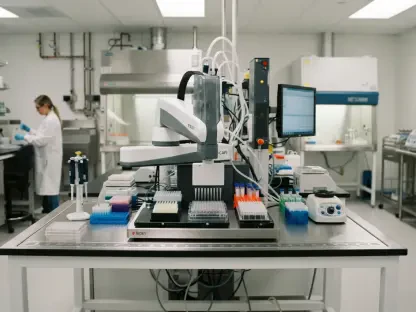
The transition to sequencing hundreds of thousands of whole genomes has created a massive data challenge, as a single human genome generates approximately 100 gigabytes of raw information. To manage this petabyte-scale influx, modern biobanks have moved away from traditional, time-consuming CPU-based methods in favor of hardware-accelerated platforms like DRAGEN. These systems use field-programmable gate arrays to perform alignment, duplicate marking, and variant calling at speeds dozens of times faster than previous methods without sacrificing the accuracy required for clinical diagnostics. This shift has turned what used to be a weeks-long processing task for a single cohort into an operation that can be completed in a matter of hours, allowing researchers to keep pace with the rapid generation of new biological data.
Beyond hardware acceleration, the strategic move toward variant aggregation has solved the logistical “N+1 problem” that previously hindered the growth of large genomic databases. In the past, adding even a few new participants to a study required the entire cohort to be re-analyzed to ensure consistency in variant calling, a process that became computationally impossible as biobanks grew to include hundreds of thousands of individuals. Today, iterative genotyping tools allow new data to be integrated seamlessly into existing databases without the need for redundant processing. This evolution ensures that biobanks remain living, growing resources that can expand indefinitely as more participants join, providing a sustainable infrastructure for long-term genomic research that can support the needs of scientists for decades to come.
Data Optimization: Compression and Sparse Matrix Formats
Sustainability in the era of population genomics depends heavily on how data is represented and stored, leading to the widespread adoption of reference-oriented compression methods. Traditional file formats like BAM are being phased out in favor of the CRAM format, which achieves a 50% reduction in file size by only storing the differences between an individual’s DNA and a standard reference genome. This reduction is critical for biobanks managing millions of samples, as it significantly lowers the costs associated with cloud storage and data transfer. By optimizing how the raw sequence is preserved, these initiatives ensure that valuable financial resources can be redirected toward actual scientific discovery rather than being consumed by the rising costs of digital maintenance.
The storage of identified variants has also undergone a transformation through the use of sparse matrix formats, which eliminate redundant information in large datasets. Rather than using dense files that record every position for every person, frameworks like Hail allow researchers to store only the relevant genetic variations, making it possible to perform complex analyses across millions of variants with high efficiency. This approach prevents researchers from being hindered by unnecessary data bulk, enabling more rapid queries and more complex statistical models. These advancements in data architecture are what make it possible to conduct genome-wide association studies on a scale that was previously unimaginable, paving the way for more precise identification of the genetic drivers of common and rare diseases alike.
Bridging Research with Clinical Utility
Access Models: Cloud Infrastructure and Privacy Governance
The sheer size of modern genomic datasets has necessitated a move from the traditional “download” model to a “bring the researcher to the data” approach. Because petabyte-scale files are far too large and sensitive to move between institutions, biobanks now provide secure, cloud-based analytical environments where scientists can run complex queries on-site using distributed computing frameworks. Platforms like the UK Biobank Research Analysis Platform and the All of Us Researcher Workbench allow scientists from across the globe to collaborate within a unified digital space. This modernization not only speeds up the research process but also democratizes access, allowing researchers at smaller institutions to work with the same massive datasets as those at major research universities without needing expensive local hardware.
Maintaining public trust is paramount for the success of these initiatives, leading to the implementation of rigorous tiered access models and robust privacy governance. National biobanks use “walled gardens” where individual-level genomic data is restricted to verified researchers and cannot be downloaded, ensuring that sensitive information remains within a controlled environment. Dynamic electronic consent models further empower participants by keeping them informed about how their data is being used and allowing them to adjust their preferences over time. By combining high-level security with transparent communication, these programs ensure that the privacy of participants is protected while still enabling the high-level data sharing that is necessary for groundbreaking medical discoveries in the field of precision medicine.
Functional Mapping: From Sequence to Clinical Application
The integration of whole-genome sequences with detailed clinical outcomes has led to a deeper understanding of the “functional genome” through advanced techniques like eQTL mapping. By comparing genetic variants with the actual expression levels of genes in different tissues, researchers can pinpoint how specific mutations contribute to disease pathology at a molecular level. This research has already yielded significant insights into conditions such as mood instability and psychiatric disorders by correlating genetic expression with structural connectivity in the brain. In oncology, the synthesis of data from multiple international biobanks has identified causal proteins associated with colorectal cancer, providing drug developers with concrete new targets that could lead to more effective and less toxic treatments for patients.
Whole-genome sequencing has also proven exceptionally effective at uncovering the “missing heritability” of complex diseases by identifying rare mutations in non-coding regions of DNA. In clinical settings, the use of trio-based sequencing—where a patient and both parents are sequenced simultaneously—has significantly increased the diagnostic yield for neurodevelopmental disorders that previously left families without answers. By identifying these rare variants, biobanks are helping clinicians provide more accurate diagnoses and are uncovering shared biological pathways between seemingly unrelated conditions. For example, researchers have identified rare mutations that link the inflammatory pathways of the gut with the neurodegenerative processes of Parkinson’s disease, opening up entirely new avenues for therapeutic intervention and preventive care.
Future Pathways: Equitable Risk Assessment and Implementation
The inclusion of diverse ancestral data has finally allowed for the creation of more accurate polygenic risk scores that can be applied to all populations with a high degree of confidence. Historically, these risk assessment tools were optimized using data from individuals of European descent, which often led to inaccurate or misleading results when applied to people of other backgrounds. By incorporating diverse genetic data from Africa, the Middle East, and various indigenous communities, scientists are now building equitable tools that can predict disease risk with high precision across the globe. This progress ensures that the next generation of preventive medicine benefits everyone, regardless of ancestral background, and helps mitigate the risk of creating a new digital divide in global healthcare.
To ensure these advancements reach the bedside, global health organizations coordinated the development of standardized frameworks for integrating genomic data into electronic health records. This effort involved creating clear guidelines for clinicians on how to interpret complex genetic reports and how to use them to inform everyday treatment decisions. Researchers also prioritized the development of affordable sequencing technologies to make these tools accessible in low-resource settings, fostering a more inclusive global health landscape. By focusing on both technical precision and practical implementation, the scientific community successfully moved precision medicine from a theoretical concept into a tangible reality that began to transform patient care on a worldwide scale.