
We’re speaking with biopharma expert Ivan Kairatov about a groundbreaking study that uses artificial intelligence to decode one of the immune system’s fundamental secrets: how antibodies are built. For decades, a key assumption about antibody assembly has shaped therapeutic design, but a new AI model, ImmunoMatch, has completely overturned it. We’ll explore how this AI was developed, the massive dataset that taught it nature’s rules, and what this new understanding means for designing the next generation of antibody therapies for diseases like cancer.
This study refutes the long-held assumption that heavy and light antibody chains pair randomly. Could you describe the key steps in developing the ImmunoMatch AI, and how it specifically analyzes sequences to prove that this assembly is, in fact, highly specific?
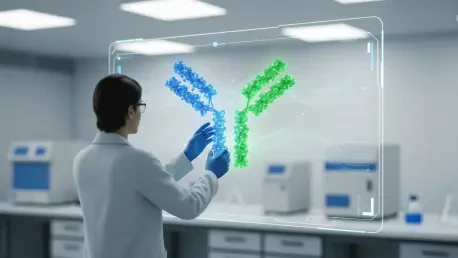
It’s a really fundamental shift in our thinking. For the longest time, the prevailing wisdom was that the two parts of an antibody—the heavy and light protein chains produced by our B cells—just came together by chance. We started by building ImmunoMatch as an antibody-specific language model. Think of it as teaching an AI the unique language and grammar of antibodies. We then fed it an enormous amount of sequence data, and its core task was to analyze these heavy and light chain sequences and find the underlying patterns. By doing this, it didn’t just guess; it learned the “nature-derived rules” that govern these pairings. What it showed, for the first time with this level of clarity, is that the assembly process is incredibly specific, not random at all.
The article states that ImmunoMatch was trained on sequences from millions of B cells. Can you elaborate on the process of collecting and preparing this massive dataset, and why was that scale crucial for the AI to learn the “nature-derived rules” of antibody pairing?
The scale of the data was absolutely the key to this breakthrough. We’re talking about antibody sequences collected from millions of individual human B cells. This isn’t a small, curated set; it’s a vast, real-world library of how our bodies actually build these critical immune proteins. Collecting and processing this information involves sophisticated single-cell sequencing techniques that allow us to isolate each B cell and read its genetic blueprint for the antibody it produces. Without that sheer volume, the subtle rules of pairing would remain hidden in the noise. It’s only by seeing millions of examples that the AI can distinguish a true biological preference from a random event and confidently say, “This is a rule.”
You successfully used ImmunoMatch to analyze sequences from immune cells in solid tumors and hematological cancers. What specific insights did this analysis provide, and how might these findings accelerate the design of new, more effective therapeutic antibodies for cancer treatment?
This is where the research becomes immediately practical. When we applied ImmunoMatch to analyze antibody sequences from immune cells found inside solid tumors and in hematological cancers, we weren’t just looking at a healthy immune system anymore. We were looking at how antibodies are assembled in the heat of the battle against disease. The analysis gives us an invaluable insight into which pairings are being selected by the immune system to fight that specific cancer. This knowledge is a massive accelerator for therapeutic design. Instead of discovering antibodies through trial and error, we can now rationally design them based on the very rules nature uses, potentially creating treatments that are more stable, more specific, and ultimately, more effective.
Beyond just predicting pairings, Professor Fraternali mentioned this knowledge is crucial for predicting antibody stability and performance. What other performance metrics can ImmunoMatch help us understand, and what are the next practical steps for translating these insights into rationally designed therapeutics?
Predicting the correct pairing is just the first step. That pairing directly influences the final three-dimensional shape of the antibody, which in turn dictates its stability and performance. A stable antibody is one that doesn’t fall apart and can last long enough in the body to do its job. Performance can mean many things: how tightly it binds to a virus or a cancer cell, whether it can effectively signal other immune cells to attack, or its overall longevity. The next practical steps involve taking these insights into the lab. We can now use ImmunoMatch to screen potential antibody designs in silico, predicting which heavy and light chain combinations will result in the most stable and high-performing therapeutic before we ever synthesize a single protein.
What is your forecast for how AI-driven tools like ImmunoMatch will transform the field of antibody engineering and therapeutic design over the next five to ten years?
My forecast is that tools like ImmunoMatch will completely reshape the landscape. Right now, antibodies are already the single largest class of modern therapeutics, with about a quarter of all newly approved drugs being monoclonal antibodies. Yet, much of the design process has been based on older, less precise assumptions. Over the next decade, AI will move us from an era of discovery to an era of true rational design. We will be able to engineer antibodies with predictable stability, pinpoint accuracy, and optimized performance from the ground up. This won’t just make the development process faster and more cost-effective; it will unlock the potential to create novel therapeutics for diseases that have been incredibly difficult to treat. We are essentially learning the language of the immune system, and that will allow us to speak it fluently.