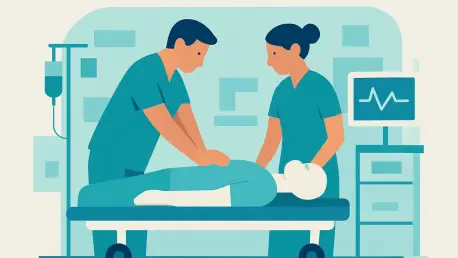

The chaotic, high-stakes environment of an emergency room, where split-second decisions and precise physical actions determine patient outcomes, has long represented one of the final frontiers for advanced artificial intelligence and robotics. For these technologies to learn and assist, they must first be able to see and understand the complex, dynamic movements of medical professionals in three dimensions. A groundbreaking initiative from researchers at Tianjin University now provides that vision, offering a meticulously crafted digital blueprint of life-saving procedures that could redefine medical training and automated assistance in critical care. This new resource, the Emergency Medical Procedures 3D Dataset (EMP3D), bridges a critical gap between human expertise and machine comprehension, potentially accelerating a new era of technologically enhanced emergency medicine.
The Digital Blind Spot in Medical Training
Emergency care is a field defined by intense pressure and physical dexterity, where procedural knowledge must translate into flawless execution in moments of crisis. The effectiveness of interventions like cardiopulmonary resuscitation (CPR), fracture fixation, or controlling a hemorrhage depends not just on knowing the steps but on performing them with precise force, timing, and coordination. This environment demands more than academic understanding; it requires a form of institutional muscle memory built through hands-on practice, where clinicians learn to navigate crowded spaces and adapt to unforeseen complications. The subtle shift in a rescuer’s posture or the exact angle of their hand placement can be the difference between a successful intervention and a failed one, highlighting the profound importance of capturing these physical nuances.
Historically, the tools used to transfer this critical knowledge have been fundamentally limited. Medical training has long relied on textbooks, 2D instructional videos, and basic manikins, all of which fall short of replicating the dynamic, three-dimensional reality of an emergency. A video can show what to do, but it cannot adequately convey the spatial relationships, the depth of compressions, or the fine motor skills involved. This creates a significant “digital blind spot” in both medical education and technological development. For AI systems, virtual reality simulators, and robotic assistants, this lack of high-fidelity data has been a persistent bottleneck, preventing them from accurately modeling, evaluating, or emulating the complex actions of human experts.
Bridging the Gap Between Simulation and Reality
The limitations of conventional training materials become starkly clear when compared to the demands of real-world emergencies. While 2D videos provide a flat, observational perspective, they cannot capture the intricate interplay of movements from multiple angles simultaneously. Basic manikins, although useful for practicing procedural steps, often lack the realistic feedback and anatomical complexity needed to develop advanced skills. Trainees may learn the sequence of an action but struggle to adapt it to a live patient in a chaotic setting. This gap between simulation and reality means that a significant portion of a medical professional’s expertise is acquired only through direct, often stressful, clinical experience, a process that is difficult to scale and standardize.
This challenge is magnified when attempting to teach machines. AI models require vast amounts of structured, detailed data to learn complex tasks. For a robot to assist in a rescue operation, it needs more than a simple command; it needs to understand the delicate kinematics of human motion—how a medic braces themselves to perform chest compressions or the subtle wrist articulation required for intubation. Capturing this nuance is incredibly difficult. Human actions are not isolated events but a continuous flow of adjustments in posture, balance, and force. The inability to digitize this expertise in a meaningful way has significantly slowed the progress of AI-powered tutors and robotic assistants in healthcare, leaving their potential largely untapped.
A New Digital Blueprint for Life Saving Actions
In response to this long-standing challenge, researchers have introduced the Emergency Medical Procedures 3D Dataset (EMP3D), a pioneering resource designed to capture and digitize the intricate choreography of life-saving actions. At its core, EMP3D is a comprehensive, open-access collection of 3D motion data showing medical professionals performing critical emergency procedures. Unlike any dataset before it, EMP3D provides a full-body, high-precision digital reconstruction of rescuers and patients, creating a foundational blueprint that machines can use to learn and understand human medical expertise. This innovation moves beyond the limitations of 2D video, offering a complete, spatially accurate record of how life-saving tasks are performed in a simulated but realistic environment.
The dataset is built upon three pillars of innovation that set it apart. First is its unprecedented precision, achieved through the use of advanced SMPL-H models that capture not only large body movements but also the fine motor skills of the hands and fingers, which are crucial for many medical tasks. Second, the data serves as a “gold standard” for AI development, as every single frame has undergone rigorous human validation to ensure its accuracy and reliability. This meticulous verification process eliminates the guesswork for machine learning models. Finally, by making the dataset open-access, the researchers are democratizing innovation, empowering developers and scientists globally to build the next generation of medical training tools, robotic systems, and workflow analytics platforms without the prohibitive cost and complexity of creating such data from scratch.
From Camera Feeds to Clinical Precision
The creation of EMP3D was a highly technical process involving a meticulously designed four-step pipeline to transform raw video footage into polished, AI-ready 3D models. The first step involved synchronizing chaos by using six strategically placed GoPro cameras to capture procedures from multiple viewpoints simultaneously. To ensure every frame across all cameras was perfectly aligned in time, the team employed audio signals as a synchronization marker, effectively creating a single, cohesive timeline of events from disparate video streams. This multi-view capture system was essential for overcoming the occlusions and rapid movements characteristic of a busy emergency room setting, ensuring no critical action was missed.
Once the synchronized footage was captured, the second step was to reconstruct 3D motion from these 2D perspectives. Using advanced AI algorithms, the system first extracted 2D skeletal poses from each camera view. It then employed a sophisticated technique to match corresponding joints across all six perspectives, building a robust 3D skeleton in a virtual space. This process was specifically designed to handle moments where a limb or body part was hidden from one camera’s view, allowing for a continuous and accurate reconstruction of movement. The third step introduced a custom tracking module to map the trajectories of each individual—both rescuer and patient—frame by frame, resolving potential collisions or identity swaps in crowded, fast-paced scenarios. In the final stage, this raw 3D data was refined into anatomically precise digital body models, with every frame undergoing manual inspection and correction by human experts to achieve a level of accuracy suitable for clinical applications.
Envisioning the Future of the Emergency Room
The availability of a dataset as rich and accurate as EMP3D opens the door to a host of practical applications that could soon become standard in emergency medicine. One of the most immediate uses is in the development of AI-powered tutors for medical trainees. Imagine a virtual reality training platform where a student can practice a procedure like fracture fixation and receive instant, objective feedback on their hand placement, posture, and technique, all benchmarked against the perfected motions of seasoned experts contained within the dataset. This type of real-time, data-driven coaching could dramatically shorten the learning curve for complex skills and improve patient safety by ensuring a higher standard of proficiency before a trainee ever interacts with a live patient.
Beyond training, EMP3D is poised to accelerate the rise of rescue robotics. With this digital blueprint of human actions, robots can be trained to mimic the movements of first responders with far greater fidelity, enabling them to assist in complex tasks on the front lines. A robot equipped with this knowledge could support human teams by performing physically demanding procedures like sustained chest compressions or by safely maneuvering patients in hazardous environments. Furthermore, the dataset can fuel the development of sophisticated crisis analytics tools. By training machine learning models on EMP3D, hospital administrators and team leaders could analyze real-time video feeds during mass casualty events to identify workflow inefficiencies, optimize team coordination, and ensure that resources are deployed in the most effective manner possible, ultimately leading to better patient outcomes.
The development of EMP3D marked a pivotal moment, transforming the abstract concept of expert medical intuition into a tangible, machine-readable format. Its creation provided the foundational data needed to build smarter training systems and more capable robotic assistants. The work of the researchers who meticulously captured, validated, and shared this knowledge has laid the groundwork for a future where technology and human expertise converge to make emergency care faster, safer, and more effective for everyone. This digital blueprint of life-saving actions was not just an academic achievement; it was a critical step toward enhancing human capability when it matters most.