
A groundbreaking artificial intelligence model developed by researchers at the Mayo Clinic is now capable of doubling the early diagnosis rate of advanced chronic liver disease, achieving this remarkable feat by analyzing data from a standard electrocardiogram (ECG). This pioneering innovation directly confronts a significant and escalating public health challenge, as the rising prevalence of related conditions such as type 2 diabetes, obesity, high blood pressure, and sleep apnea has triggered a corresponding surge in advanced chronic liver disease and its most severe consequence, cirrhosis. The primary difficulty in combating this disease lies in its insidious, silent progression; it is frequently asymptomatic until it has advanced to a late, often irreversible stage. Patients are commonly diagnosed only after presenting with severe symptoms like jaundice, gastrointestinal bleeding, or significant fluid retention, at which point available treatment options become extremely limited and the overall prognosis is substantially poorer. This new AI approach promises to shift the paradigm from reactive care to proactive, early detection.
The Heart-Liver Connection: How It Works
Uncovering a Hidden Link
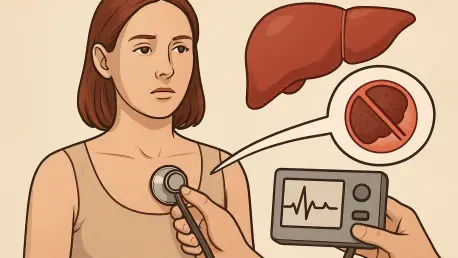
The foundational science behind this medical innovation, detailed in the peer-reviewed journal Nature Medicine, leverages the well-established physiological relationship between the heart and the liver. As advanced liver disease progresses, the formation of scar tissue, or cirrhosis, causes a significant increase in the local pressure within the liver’s intricate network of blood vessels. This condition, known as portal hypertension, does not remain isolated within the liver; its effects ripple outward, directly impacting the body’s overall cardiovascular function. This systemic impact, in turn, produces subtle but highly distinct alterations in the heart’s electrical activity. While these minute variations in electrical signals are far too faint and complex for the human eye to reliably detect on a standard ECG reading, they collectively form a discernible and consistent pattern. It is this unique electrical signature, a hidden message within a routine cardiac test, that serves as a powerful biomarker for underlying liver pathology, creating a novel opportunity for non-invasive screening.
Recognizing this diagnostic opportunity, the research team at Mayo Clinic, spearheaded by transplant hepatologist Dr. Doug Simonetto, embarked on developing an artificial intelligence model specifically engineered to decipher these complex signals. The core objective was to create a sophisticated algorithm capable of scrutinizing vast amounts of ECG data with a level of precision and pattern recognition far exceeding human capability. This AI was not a general-purpose tool but was meticulously trained to identify the unique electrical signatures intrinsically linked to the presence of advanced chronic liver disease. The model was designed to act as a highly specialized digital detective, sifting through the noise of a standard ECG to find the faint but crucial clues indicating that a patient’s liver was in distress. By transforming the ECG from a purely cardiac diagnostic tool into a potential screening method for a seemingly unrelated organ, the team aimed to create a low-cost, scalable solution to a widespread and often fatal condition.
Putting the AI to the Test
To validate the real-world efficacy of this innovative approach, the researchers designed and executed a pragmatic, large-scale, randomized clinical trial that engaged 248 clinicians across Mayo Clinic in Rochester and the wider Mayo Clinic Health System. The AI model’s journey began with an intensive training phase, where it was fed a substantial and diverse dataset comprising ECGs from 11,513 Mayo Clinic patients. This extensive training allowed the algorithm to learn and internalize the complex patterns and subtle nuances that differentiate an ECG of a person with advanced liver disease from that of a healthy individual. Once trained, the system was integrated into the clinical workflow, ready to analyze incoming ECGs in real-time. This trial design was crucial not only for testing the AI’s accuracy but also for demonstrating its ability to function seamlessly within the existing infrastructure of a busy healthcare system, a key factor for any new technology’s potential for widespread adoption and impact on patient care.
During the clinical trial, the AI system served as an automated, vigilant screening tool, analyzing every incoming ECG to flag individuals who showed a high probability of having undiagnosed advanced liver disease. However, an AI-generated flag was only the first step in a rigorous and multi-layered diagnostic process. To ensure the highest degree of accuracy and to eliminate the possibility of false positives, every patient identified by the AI was subsequently referred for confirmatory testing using established and validated diagnostic methods. This verification stage involved comprehensive evaluations, which could include specialized imaging techniques designed to assess liver stiffness or detailed blood tests that measure liver function and damage. This methodical, two-step approach was essential for building trust in the AI’s findings among clinicians and for confirming that the technology was not just a theoretical success but a reliable and clinically meaningful tool for identifying at-risk patients who would otherwise have gone undetected.
A Breakthrough in Early Detection
The Powerful Results
The outcomes of the clinical trial were both striking and clinically significant, providing powerful evidence of the AI’s effectiveness. The AI-enabled ECG screening tool successfully identified twice the number of patients with advanced chronic liver disease when compared to the diagnoses made through standard clinical methods over the same period. This doubling of the detection rate represents a monumental leap forward in the fight against a disease that thrives on its ability to remain hidden. Perhaps the most crucial aspect of this discovery was the clinical status of the newly identified patients. A large majority of those flagged by the AI were entirely asymptomatic and had no prior knowledge of their underlying condition. They were, in effect, walking around with a ticking time bomb, completely unaware of the progressive damage occurring in their liver. The AI’s ability to pierce this veil of silence and uncover these hidden cases underscores its immense potential to fundamentally change the trajectory of the disease for countless individuals.
Dr. David Rushlow, a family physician within the Mayo Clinic Health System and a co-author of the study, emphasized the profound impact this technology could have from a primary care perspective. He noted that by systematically uncovering these otherwise invisible cases, the AI tool provides a critical and unprecedented opportunity to connect patients with the appropriate hepatology specialists far earlier in the disease process. This early referral is not merely a procedural step; it is a gateway to timely intervention at a stage when treatment can be most effective, potentially halting or even reversing the progression of the liver damage. For many of these patients, this early detection and subsequent treatment could be the difference between managing a chronic condition and facing the eventual need for a liver transplant. Dr. Rushlow stated that in some instances, the intervention prompted by the AI’s finding may have been genuinely life-saving, illustrating the technology’s capacity to deliver tangible, high-stakes benefits in a real-world clinical setting.
A New Frontier in Preventive Care
This landmark study served as a powerful demonstration of how artificial intelligence can be seamlessly and effectively integrated into real-world clinical workflows to substantially enhance the practice of preventive medicine. Dr. Rushlow highlighted the particularly compelling nature of using a simple, noninvasive, and inexpensive test like the ECG for what is known as opportunistic screening. Instead of requiring a new, specialized, and costly test for liver disease, this approach cleverly repurposes a procedure that is already routinely performed for cardiac assessment. It transforms a standard test into a dual-purpose diagnostic tool, thereby maximizing its clinical value without imposing any additional cost, risk, or burden on either the patient or the healthcare system. The success of this trial strongly underscores the immense potential of AI-enabled tools to advance the fields of personalized and preventive care, heralding a significant shift in the medical paradigm from the reactive treatment of advanced disease to the proactive identification and management of risk.
The research team planned to build upon this success with a two-year follow-up study involving the cohort of patients who were newly diagnosed through the AI model. This longitudinal analysis was designed to provide more definitive data on the long-term clinical benefits of early detection and intervention, tracking patient outcomes over time to quantify the impact of the AI-driven screening. This research represented a key component of a larger, strategic effort at Mayo Clinic known as the Precure initiative. This initiative was dedicated to creating and implementing a suite of predictive tools that empower clinicians to foresee and intercept disease processes before they escalate into complex, life-threatening, and difficult-to-treat conditions. Ultimately, the development and successful deployment of this AI-ECG model represented a significant step forward in the battle against chronic liver disease, offering a scalable, cost-effective, and powerful method to find and help at-risk individuals long before their condition became critical.