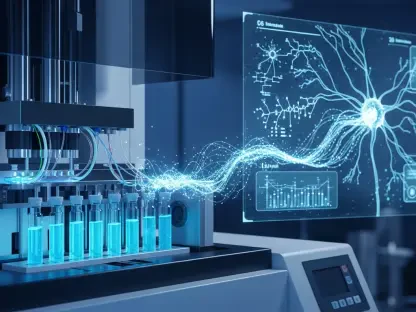

The holy grail of oncology has always been to catch cancer when it is most treatable—at its earliest, most nascent stages. For years, this has been an incredible challenge, but we’re now at a thrilling inflection point where artificial intelligence is meeting molecular biology to create solutions that were once science fiction. My work sits at this very crossroads, focusing on how we can use AI to design microscopic sensors that can hunt down the faintest signals of disease. We’re moving beyond the slow, trial-and-error methods of the past and into an era of intentional design, creating highly specific peptide sensors that can be detected in a simple, at-home urine test. This technology not only promises to revolutionize diagnostics but also has profound implications for targeted drug delivery, essentially creating ‘smart’ therapies that activate only at the site of a tumor.
Could you walk us through the journey of these molecular sensors, from when a patient takes them to the signal appearing in a urine test? How does this enzymatic process amplify faint signals from very early-stage cancers, making them detectable?
It’s a remarkably elegant system that leverages the body’s own processes. Imagine a patient ingests or inhales nanoparticles that are coated with thousands of our specially designed peptides. These particles are inert and travel harmlessly through the bloodstream. The real magic happens when they encounter a tiny, early-stage tumor. Cancer cells, in their effort to grow and spread, overproduce specific enzymes called proteases, which act like molecular scissors to cut through surrounding tissue. When our nanoparticles pass by, these hyperactive proteases immediately recognize and cleave the peptides off the surface. This single enzymatic event is the key to our sensitivity. One protease enzyme can snip thousands of peptide reporters, creating a massive amplification of the original, very faint signal from the small tumor. These now-freed peptide fragments are small enough to be filtered by the kidneys and concentrated in the urine, where we can detect them with a simple paper strip test, much like a home pregnancy test.
Before developing CleaveNet, your team used a trial-and-error process. Can you describe a specific challenge you faced with that older method and explain how the AI model now allows you to design peptides that are highly specific to a single cancer-linked protease?
The trial-and-error phase was both foundational and incredibly frustrating. We would spend months screening libraries of existing peptides, hoping to find one that was cleaved by a protease linked to, say, colon cancer. A major challenge was specificity. We’d find a peptide that was a decent substrate, but then discover it was also being cut by three or four other proteases in the same family. This created a blurry, ambiguous signal. You knew something was happening, but you couldn’t definitively say it was the one specific protease you were targeting. It was like trying to listen to a single voice in a crowded room. CleaveNet completely changed the game. For a peptide with just 10 amino acids, there are about 10 trillion possible sequences. No human team could ever search that space. The AI, however, can navigate this immense combinatorial landscape to design novel peptide sequences optimized for one single protease, effectively designing a key for a very specific lock while ensuring it won’t open any others.
The article notes CleaveNet created novel, effective peptides for the MMP13 protease. Could you share what it was like to validate these AI-generated sequences in the lab for the first time? What metrics did you use to confirm their superior efficiency and selectivity?
That was a genuinely exhilarating moment for the entire team. There’s always a gap between what a computer model predicts and what happens in a biological system. We had prompted CleaveNet to generate peptides for MMP13, a protease critical for metastasis, and it returned sequences that had never been seen before—they weren’t in any of our training data. The anticipation while waiting for the lab results was palpable. When the data came in, it was a huge validation. We primarily measured two things: efficiency and selectivity. Efficiency is how quickly and completely the protease cuts the peptide. Selectivity is whether only our target protease, MMP13, can cut it. The results were astounding. The AI-designed peptides were not only cleaved with remarkable efficiency but also showed incredible selectivity, remaining untouched by other closely related proteases. It was the proof we needed that the AI wasn’t just remixing old ideas; it was genuinely creating new, superior molecular tools from scratch.
Your work is part of an ARPA-H project for a multi-cancer at-home test. Besides diagnostics, how could this peptide technology be applied to therapeutics to release medicine only at the tumor site? What are the biggest hurdles to bringing these applications to clinical use?
The ARPA-H project is incredibly ambitious, aiming for a single at-home test that can detect and even distinguish between up to 30 different cancers. But the same core principle has fantastic therapeutic potential. Imagine attaching a potent chemotherapy drug or a powerful cytokine to an antibody using one of our AI-designed peptides as a linker. This therapeutic package would circulate harmlessly through the body. The drug remains inactive and tethered. However, once it reaches the tumor microenvironment, the same overactive proteases that we use for diagnostics will cleave the peptide linker, releasing the drug payload precisely where it’s needed. This would dramatically increase efficacy while minimizing the devastating side effects of systemic treatments. The biggest hurdles are, as always, the transition from the lab to human patients. This involves navigating complex regulatory approvals, proving safety and efficacy in rigorous clinical trials across diverse populations, and solving the challenges of manufacturing these sophisticated agents at scale.
What is your forecast for the role of generative AI in designing new diagnostics and therapeutics over the next decade?
I believe generative AI will become an indispensable partner in every biopharma research lab. It’s poised to fundamentally shift our entire paradigm from one of discovery to one of design. For centuries, we’ve been searching for useful molecules in nature or through random screening. Now, we can define the exact properties we need—whether it’s a peptide for a diagnostic sensor or a protein to inhibit a disease pathway—and have an AI model generate novel candidates to fit those specifications. This will compress development timelines from years to months, drastically reduce the costs of R&D, and unlock the ability to tackle diseases that have so far been considered “undruggable.” In ten years, I forecast that a biologist designing a new therapeutic with the help of a generative AI model will be as commonplace as an architect using CAD software to design a building today. It will democratize and accelerate innovation in medicine in ways we are just beginning to imagine.