
The boundary between biological matter and computational intelligence has blurred significantly following a series of experiments at the University of California, Santa Cruz, where researchers successfully trained lab-grown brain tissue to perform complex tasks. These microscopic clusters of neurons, known as organoids, demonstrated a remarkable ability to interact with digital environments and solve the “cart-pole” problem, a classic challenge typically reserved for testing the limits of artificial intelligence and robotics. By proving that these isolated neural networks can achieve goal-directed learning without the presence of a body or sensory organs, the study suggests that adaptive computation is an inherent, fundamental property of cortical tissue itself. This realization shifts the perspective of neuroscience from viewing the brain as a passive organ to recognizing it as a dynamic, tunable system capable of processing information and responding to feedback even in its most minimal form.
Proving Biological Intelligence Through Standardized Testing
Benchmarking Cognition with the Cart-Pole Task
The selection of the “inverted pendulum” or “cart-pole” task served as a rigorous metric to determine whether biological tissue could replicate the decision-making processes seen in advanced software. In this specific scenario, a vertical pole is attached by a hinge to a cart that moves along a horizontal track, requiring the controlling agent to move the cart left or right to prevent the pole from falling. For humans, this is a physical skill similar to balancing a broomstick on a fingertip, demanding constant visual attention and rapid motor adjustments to maintain equilibrium. By introducing this engineering benchmark to organoids, the research team established a quantifiable baseline for biological intelligence, allowing for a direct comparison between the learning curves of living neurons and traditional reinforcement learning algorithms used in modern computing.
Applying such a demanding task to a peppercorn-sized cluster of neurons revealed that even minimal neural circuits possess the requisite architecture for sophisticated problem-solving. This discovery challenges the long-standing assumption that complex, goal-directed behavior necessitates the structural “scaffolding” of a complete organism, such as a spinal cord, limbs, or a centralized nervous system. The success of the organoids in navigating the cart-pole challenge indicates that the capacity for micro-adjustments and dynamic responses is baked into the very fabric of cortical cells. Consequently, this provides a new experimental model for studying how intelligence emerges from basic cellular interactions, offering a window into the developmental milestones of human infants as they first learn to balance their bodies and interact with the physical world.
Validating Results with Comparative Analysis
To ensure that the observed improvements were the result of actual learning rather than random neural firing, the researchers employed a strict comparative framework between trained and untrained tissue. The experimental design contrasted organoids receiving structured, corrective feedback with a control group that was subjected to random electrical stimulation. The data revealed a stark divergence in performance; while the control group failed to maintain the pole’s balance with any regularity, the “coached” organoids showed a clear trajectory toward competence, adapting their output based on the signals they received. This statistical gap confirms that the neural spikes recorded by the system were not merely noise but were purposeful signals generated by the tissue in response to its environment.
Beyond the immediate success of the task, the findings highlight a level of biological plasticity that functions independently of traditional biochemical rewards. In a living brain, the chemical dopamine often acts as the primary driver for reward-based learning, signaling the success of an action to reinforce specific neural pathways. However, the UCSC organoids managed to solve the problem in the absence of dopamine and other systemic hormones, relying instead on purely bioelectrical feedback loops. This suggests that the fundamental “logic” of learning is stored within the electrical connectivity of the neurons themselves. Such a realization opens the door to understanding how the brain’s physical structure can be optimized for learning, even when the chemical environment is compromised by disease or injury.
The Mechanics of Training Synthetic Brain Tissue
Coaching Neurons via Bioelectrical Interfaces
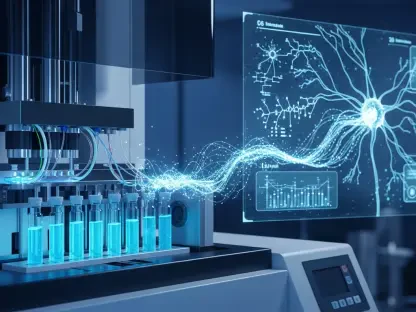
The technical bridge between the biological organoid and the digital simulation was facilitated by high-density electrophysiology chips that acted as a translator for neural activity. These chips, developed by MaxWell Biosystems, allowed the researchers to both record the electrical “spikes” produced by the neurons and deliver precise electrical stimulation back into the tissue. The experimental setup functioned as a closed-loop system where the angle of the virtual pole was encoded into electrical pulses and fed to the organoid. In response, the organoid’s neural activity was decoded by software and converted into physical force applied to the virtual cart. This seamless integration allowed the biological tissue to “see” and “feel” the state of the digital world, creating a hybrid system where biology and silicon worked in tandem.
To refine the organoid’s performance, the researchers introduced a reinforcement learning algorithm that functioned as an artificial “coach.” This AI monitored the stability of the virtual pole and, whenever the organoid struggled to maintain balance, delivered targeted training signals to specific neural clusters. This process did not simply provide the organoid with data; it actively shaped the internal architecture of the neural network by encouraging certain firing patterns while discouraging others. This methodology represents a significant departure from previous research that merely observed how brain tissue reacts to stimuli. By intervening in the learning process, scientists can now physically steer biological networks toward specific goals, providing a powerful tool for investigating how the brain reorganizes itself during the acquisition of new skills.
Analyzing Success Rates and Memory Constraints
The quantitative results of the coaching sessions provided undeniable evidence of short-term adaptation, with trained organoids reaching a 46% success rate in maintaining the pole’s balance. This was a monumental increase over the 4.5% success rate observed in organoids that were left to their own devices or given non-contextual feedback. The researchers observed that they could consistently move an organoid from a state of total failure to a state of relative competency within a single training episode. This rapid improvement demonstrates that cortical tissue is highly sensitive to external guidance and can quickly recalibrate its internal “logic” to solve an immediate problem, provided the feedback loop is fast enough to keep pace with the neurons’ natural firing rates.
Despite these impressive gains in performance, the study also identified a critical threshold in the organoids’ cognitive capacity: the transience of their memory. While the tissue excelled during active 15-minute training sessions, the progress was often lost after a 45-minute period of inactivity, with the neurons returning to their baseline state. This “forgetting” indicates that while simple organoids can be tuned for short-term tasks, they currently lack the long-term potentiation and structural complexity required to store information over extended periods. This limitation points toward a future research direction where scientists may need to integrate multiple specialized brain regions—such as the hippocampus and the cortex—into a single organoid system to replicate the enduring memory and learning capabilities seen in complex animals.
Future Horizons in Medicine and Technology
Modeling Dysfunction and Neurological Health
The most profound application of this research lies in its potential to revolutionize how we understand and treat neurological disorders by providing a living, tunable model of the human brain. By observing the specific electrical and structural changes that occur when an organoid learns a task, scientists can identify the exact points where the learning process breaks down due to pathology. This approach allows for the simulation of conditions like Alzheimer’s disease, where the ability to form new memories is lost, or neurodevelopmental disorders like autism and ADHD, which may involve differences in how the brain processes sensory feedback. Rather than relying on animal models that may not perfectly replicate human biology, researchers can use these lab-grown tissues to test how different drugs or therapies restore the capacity for goal-directed behavior.
Furthermore, this framework offers a unique vantage point for studying the physical effects of trauma, such as strokes or concussions, on the brain’s computational abilities. Because the organoids are housed in a controlled, measurable environment, researchers can induce specific “injuries” and then attempt to retrain the remaining healthy tissue to compensate for the loss. This could lead to the development of new rehabilitation protocols that utilize bioelectrical stimulation to “jump-start” the brain’s natural plasticity. By treating the mind as a physical, tunable system, the medical community can move away from generalized treatments and toward personalized interventions that address the specific neural connectivity issues present in an individual patient’s brain tissue.
Expanding Research Through Open-Source Innovation
To accelerate the pace of discovery, the research team developed an open-source software platform called “BrainDance,” designed to make complex neural simulations accessible to the broader scientific community. This tool simplifies the process of interfacing biological organoids with digital environments, removing the need for deep expertise in game coding or specialized hardware engineering. By lowering these barriers to entry, the UCSC team hopes to encourage a diverse range of scientists—from biologists to computer engineers—to contribute to the growing field of adaptive organoid computation. This collaborative approach is essential for tackling the monumental task of mapping the functional architecture of the human brain and understanding how intelligence emerges from cellular networks.
Looking ahead, the integration of biological plasticity with artificial intelligence coaching will likely lead to even more sophisticated models of human cognition. Future efforts should focus on increasing the longevity and complexity of these organoids, perhaps by incorporating vascular systems to provide better nutrient flow or by connecting different regional “modules” to simulate the interaction between different parts of the brain. As these systems become more advanced, they will provide an invaluable resource for testing the limits of biological computation and exploring the ethical boundaries of creating sentient-like tissue. The ultimate goal is not to replace silicon-based AI, but to harness the unique efficiency and adaptability of biological neurons to solve medical challenges that have long remained out of reach. Researchers should prioritize the development of multi-region organoids to better understand the transition from short-term adaptation to long-term memory storage.