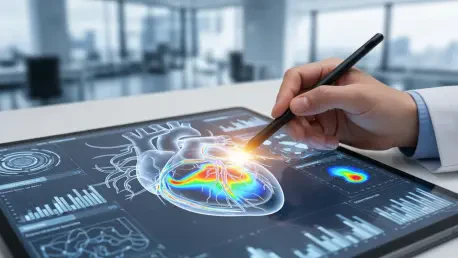

Physicians have long understood that the subtle dance of blood through a human heart cannot be captured by static imagery alone, yet the tools required to measure this flow have remained stubbornly invasive until now. For decades, the gold standard for diagnosing coronary obstructions involved threading a sensor-tipped wire directly into the beating heart, a task that demands extreme precision and carries inherent procedural risks. This mechanical approach, while effective, often creates a bottleneck in clinical workflows, leading many practitioners to rely on visual intuition rather than hard physiological data.
The emergence of high-speed artificial intelligence marks a definitive departure from this hardware-dependent history by offering a digital alternative that is both faster and safer. Sophisticated algorithms now process standard X-ray images to generate a comprehensive analysis of arterial health, effectively turning a simple picture into a dynamic map of pressure and flow. This transition represents more than a technical upgrade; it is the beginning of an era where software intelligence replaces the physical trauma of internal sensors, allowing doctors to make life-saving decisions without the need for unnecessary vascular intrusion.
The End of the Pressure Wire Era in Cardiac Diagnostics
The historical reliance on physical pressure wires has long been a double-edged sword in the world of interventional cardiology. While these devices provide critical data on whether a blockage is truly obstructing blood flow, their use adds significant time, cost, and complexity to what is already a high-stakes environment. By utilizing artificial intelligence to analyze the geometry and fluid dynamics of an artery, clinicians can now bypass the need for these delicate physical tools entirely. This shift promises to democratize physiological testing, making it a routine part of every cardiac assessment rather than a specialized exception.
Furthermore, the transition to software-based analysis removes the requirement for specialized medications that are typically used to stimulate the heart during invasive testing. These drugs can cause patient discomfort and complications, such as a drop in blood pressure or heart rhythm irregularities. By eliminating these chemical and mechanical requirements, the software-driven approach streamlines the entire diagnostic process. This advancement allows medical teams to focus on interpreting data rather than managing the logistical hurdles of invasive hardware, marking a fundamental change in how heart disease is evaluated.
Why Visual Estimation Fails and Physiology Matters
Relying on a 2D X-ray to judge a 3D blockage is a practice fraught with subjectivity, as different doctors looking at the same angiogram often disagree on whether a narrowing is truly dangerous. While visual “eyeballing” can identify the presence of a blockage, it cannot accurately determine if that blockage actually starves the heart muscle of oxygen. This gap between what is seen and what is felt by the patient’s heart has historically led to both over-treatment of benign narrowings and under-treatment of functional obstructions that appear minor on the screen.
Clinical guidelines have long insisted on physiological proof before a stent is placed, yet the complexity of using pressure wires has caused many labs to skip this critical step. The introduction of non-invasive software bridges this divide by providing the necessary functional insights without the physical complications that previously deterred physicians. By standardizing the diagnostic process, AI ensures that every patient receives a personalized assessment based on the unique fluid dynamics of their own vascular system, reducing the margin of error in surgical decision-making.
FFRangio and the ALL-RISE Trial: Software vs. Hardware
The ALL-RISE trial served as a rigorous proving ground for this digital shift, comparing the AI-based FFRangio system against the traditional wire-based fractional flow reserve method. Spanning nearly 2,000 patients across global medical centers, the study examined whether a software-derived model could match the accuracy of a physical sensor placed inside the coronary artery. The FFRangio technology works by applying computational fluid dynamics to standard angiographic views, creating a 3D reconstruction that simulates blood flow and calculates pressure drops without any extra internal equipment.
This trial was pivotal because it moved AI diagnostics from the realm of theoretical curiosity into the spotlight of evidence-based medicine. By eliminating the need for a physical wire, the software-guided approach removed several points of failure and patient discomfort associated with traditional methods. The trial results confirmed that the software-based strategy was not only feasible but also highly efficient, providing a streamlined pathway for interventionalists to assess complex cases with a level of detail previously reserved for the most invasive protocols.
Evidence-Based Success and Expert Insights
Data released at major cardiovascular conferences indicated that FFRangio achieved a primary endpoint rate of 6.9%, nearly identical to the 7.1% recorded for the wire-based group. This finding established “non-inferiority,” a clinical milestone proving that the software approach is just as safe and effective as the invasive hardware it seeks to replace. Leading researchers noted that the technology provides a “digital twin” of the patient’s heart, allowing for a functional analysis that goes far beyond the limitations of traditional anatomy, essentially predicting how blood will move under various conditions.
The medical community has responded with enthusiasm, recognizing that this technology addresses the long-standing problem of low physiological testing rates in standard practice. By removing the requirement for expensive single-use wires and the administration of vasodilator drugs, the software provides a more patient-centric experience that minimizes side effects. Experts suggest that the high fidelity of these 3D models allows for a more nuanced understanding of how multiple blockages interact within the same vessel, a level of complexity that traditional wires often struggle to map efficiently in real-time.
Implementing AI-Driven Diagnostics in the Modern Cath Lab
The shift toward digital diagnostics required hospitals to rethink the workflow of the catheterization lab, prioritizing the acquisition of high-quality imaging as the primary diagnostic tool. Medical teams found that by focusing on optimized angiographic views, they could generate actionable flow data in a fraction of the time it took to set up and calibrate traditional hardware. This transition simplified the logistical demands on nursing and technical staff, while simultaneously reducing the risk of arterial injury during the diagnostic phase of the procedure.
Future implementation strategies looked beyond basic coronary cases, focusing on the potential for AI to assist in evaluating post-bypass patients and complex multi-vessel disease where traditional wiring was exceptionally difficult. Hospitals also realized significant economic benefits by reducing their reliance on costly, specialized disposable equipment, which allowed for a more sustainable allocation of resources toward overall patient care. Ultimately, the integration of these AI platforms fostered an environment where precision medicine became the standard of care, ensuring that therapeutic interventions were reserved for the patients who would truly benefit from them.