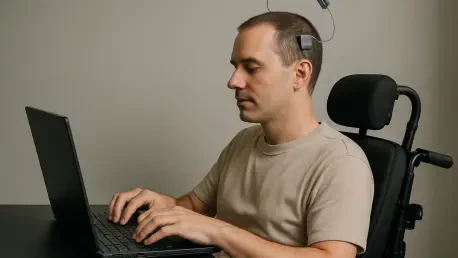

The silence imposed by total paralysis is perhaps the most profound isolation a human can experience, yet recent breakthroughs in neural decoding are finally turning internal thoughts into visible, rapid-fire text. For years, the gold standard for communication in patients with Amyotrophic Lateral Sclerosis (ALS) or high-level spinal cord injuries has been eye-gaze tracking, a method that is notoriously fatiguing and often restricted to a few words per minute. The BrainGate typing neuroprosthesis changes this paradigm by bypassing the eyes and the limbs entirely. By tapping directly into the motor cortex, this technology allows individuals to “type” simply by thinking about the physical motions of their fingers, effectively digitizing the intent of movement before it ever reaches a non-functioning muscle.
This development is not merely an incremental improvement over existing assistive tools; it is a fundamental shift in how we approach neuro-restoration. While traditional tools rely on residual physical functions—like a cheek twitch or an eye movement—the BrainGate system utilizes the brain’s innate, hard-wired mapping of the hands. This means that even years after a spinal cord injury, the neural representation of a “keystroke” remains intact and ready to be harvested. As we move through 2026, the focus has shifted from whether a brain-computer interface can work to how quickly and naturally it can integrated into a patient’s daily life.
Evolution of Neural Communication Interfaces
The journey toward fluid brain-to-text communication has been defined by a transition from external sensors to deep, intracortical integration. In the early stages of assistive technology, researchers focused on non-invasive caps that measured broad electrical patterns through the scalp, but these were often plagued by “noise” and low data rates. The BrainGate system represents the pinnacle of the second generation of these devices, utilizing implanted microelectrode arrays that sit directly within the brain tissue. This allows for the recording of individual neurons, providing the high-resolution data necessary for complex tasks like rapid typing.
What makes this specific evolution so relevant today is its departure from the “point-and-click” cursor model. Previous versions required users to mentally move a mouse to a letter and “click,” a process that was slow and cognitively demanding. By shifting the focus to imagined handwriting or finger typing, the consortium has leveraged the brain’s existing motor memory. This reduces the learning curve significantly, as the user is not learning a new skill but rather re-activating an old one in a digital environment.
Core Technological Components and Framework
Intracortical Microelectrode Array System
At the heart of the hardware suite are tiny silicon sensors, often no larger than a baby aspirin, which are surgically placed into the hand area of the motor cortex. These arrays contain dozens of fine electrodes that “listen” to the electrical discharges, or spikes, of nearby neurons. Even when the physical connection between the brain and the hand is severed by injury or disease, these neurons fire with the same rhythmic intensity as they did before the paralysis occurred. This hardware is the critical bridge that allows biological signals to enter the domain of digital processing.
The reliability of these sensors is a point of constant refinement. Modern iterations have improved the biocompatibility of the coating, reducing the body’s immune response and extending the functional life of the implant. Because the system detects the “intent” of movement rather than the movement itself, it functions effectively even in the late stages of neurodegenerative conditions. This capability ensures that the hardware remains relevant throughout the progression of a patient’s illness, providing a consistent lifeline of communication.
Finger-to-Letter Mapping and Neural Decoding
The software layer of the BrainGate system performs a feat of mathematical translation by turning raw neural spikes into specific characters. Instead of a generic signal for “typing,” the system identifies unique neural signatures for different finger movements. For example, the intent to move the index finger to the “J” key creates a distinct pattern of electrical activity compared to moving the pinky to the “A” key. By mapping these specific intents to a virtual QWERTY layout, the system creates a high-dimensional interface that feels intuitive to anyone who has used a computer keyboard.
This decoding process happens in real-time with remarkably low latency. Advanced machine learning algorithms are trained to recognize the subtle nuances in how a specific individual’s brain signals the intent to type. This personalized calibration is what allows the system to achieve such high levels of precision. By treating the brain’s motor output as a sophisticated code, the software can reconstruct a user’s thoughts into text at a speed that was previously thought impossible for an intracortical device.
AI-Driven Language Modeling
No matter how accurate the neural decoding is, the system still benefits from a “safety net” provided by artificial intelligence. The integration of large-scale predictive language models functions much like a hyper-advanced version of smartphone autocorrect. If the neural decoder misidentifies a single “keystroke,” the language model analyzes the surrounding context to fix the error instantly. This prevents the user from having to constantly stop and delete mistakes, which is a major source of frustration in older communication devices.
The significance of this AI integration cannot be overstated. It allows for a “near-natural” flow of conversation, where the user can focus on the message rather than the mechanics of the interface. This synergy between biological signal capture and algorithmic prediction represents a hybrid approach that maximizes the strengths of both human intent and machine efficiency. As language models become more personalized, they can even adapt to a user’s specific vocabulary and slang, further smoothing the communication process.
Recent Innovations and Performance Benchmarks
The most striking advancement in recent months has been the reduction in training time. Historically, BCI systems required hours of repetitive tasks to “tune” the software to the user. Current protocols have streamlined this into a rapid calibration phase that takes only minutes. This shift is vital for clinical adoption, as it reduces the exhaustion felt by patients and allows for more frequent use throughout the day. Researchers have now documented typing speeds exceeding 20 words per minute, a benchmark that moves the technology out of the realm of “assistive” and into the realm of “functional replacement.”
Furthermore, the BrainGate consortium’s collaborative model has accelerated the transition from theory to practice. By sharing data across multiple institutions, the team has been able to validate their findings across a diverse group of participants. This peer-vetted approach ensures that the performance metrics—such as the 1.6% word error rate—are not just outliers but are reproducible results. This consistency is a prerequisite for the regulatory approvals needed to bring the system to the wider medical market.
Clinical Applications and Real-World Implementation
The transition from a sterile laboratory to a patient’s living room is the ultimate test for any neuroprosthesis. Recent trials have successfully demonstrated “home-use feasibility,” where participants used the system to send emails, browse the web, and chat with family members in their own residential environments. For a person with ALS, being able to communicate from bed or a wheelchair without a team of technicians present is the difference between a scientific experiment and a transformative medical tool.
These real-world applications also highlight the psychological impact of the technology. Restoring the ability to communicate provides a sense of agency and autonomy that paralysis often strips away. Patients have reported that the speed of the BrainGate system allows them to participate in “live” conversations again, rather than just delivering prepared statements. This social reintegration is perhaps the most meaningful metric of success, as it directly counters the isolation associated with locked-in syndrome.
Technical Hurdles and Barriers to Adoption
Despite its successes, the path to widespread adoption is complicated by the invasive nature of the current hardware. Brain surgery involves inherent risks, including infection and the potential for scarring around the electrode site, which can degrade the signal over time. While the sensors have become more durable, the quest for a truly permanent, “set-it-and-forget-it” implant continues. Furthermore, the external hardware—the cables and processors that connect to the head—must be miniaturized and made fully wireless to offer true mobility.
Regulatory and financial hurdles also loom large. Navigating the pathway for a Class III medical device is a multi-year process that requires massive capital investment. There is a legitimate concern regarding “technology abandonment” if the companies manufacturing these devices face financial instability, leaving patients with non-functional hardware inside their skulls. Addressing these structural issues is just as important as the engineering feats, as it determines whether the technology will be a niche luxury or a standard of care.
Future Trajectory of Neuroprosthetic Development
The roadmap for the next few years suggests that typing is only the beginning. Engineers are already looking toward “high-bandwidth” communication, such as stenography-based interfaces that could potentially double or triple current typing speeds. There is also a push toward multi-modal systems where the same implant could control a robotic arm for feeding and a virtual keyboard for writing. This expansion of utility would make the surgical risk much easier for patients and clinicians to justify.
Moreover, the integration of functional electrical stimulation (FES) could allow the brain to not only control a computer but also re-animate the patient’s own limbs. By “bridging” the site of a spinal cord injury, the BrainGate system could send signals from the motor cortex directly to electrodes implanted in the arm muscles. This holistic approach to neuro-restoration aims to move beyond communication toward a total restoration of physical independence, effectively “rewiring” the human body through a digital bypass.
Final Assessment of the BrainGate System
The BrainGate typing neuroprosthesis has fundamentally proven that the motor cortex remains a viable source of complex information long after physical movement has ceased. By achieving a balance of high speed, low error rates, and intuitive design, it has surpassed the limitations of eye-gaze and other non-invasive tools. The shift from experimental cursor control to “imagined typing” was the key insight that unlocked the potential for near-natural communication speeds. This technology is no longer a futuristic concept; it is a functional reality that has already begun to restore the voices of those silenced by paralysis.
Looking forward, the success of this system should catalyze a broader movement toward standardized neural interfaces. Future efforts must focus on moving from wired, percutaneous connections to fully implanted, wireless systems that require no external maintenance. As the surgery becomes less invasive and the AI becomes more perceptive, the barrier between thought and action will continue to thin. The legacy of this current research will be measured not just by the characters per minute it achieved, but by the precedent it set for returning autonomy to the most vulnerable patients in the healthcare system. Following the completion of these clinical milestones, the focus now shifts to ensuring equitable access and long-term hardware stability for the next generation of users.