
Today we’re speaking with Ivan Kairatov, a biopharma expert with deep insights into the intersection of technology and clinical research. We’ll be exploring a groundbreaking study on an AI-powered stethoscope that could fundamentally change how we screen for heart disease. Our discussion will cover the mechanics behind this new diagnostic tool, the practical challenges of integrating it into primary care, and what this leap in technology means for both patients and doctors on the front lines of medicine.
The new AI stethoscope showed 92.3% sensitivity for audible valve disease, far surpassing the 46.2% from standard auscultation. What allows the AI to detect murmurs that clinicians miss, and what are the first practical steps for integrating this into a busy primary care workflow?
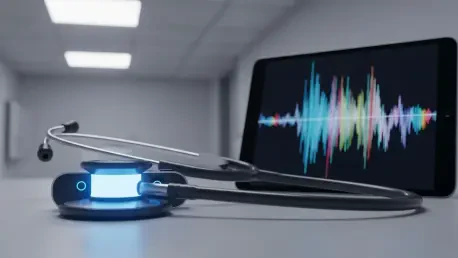
The incredible leap in sensitivity comes down to the power of deep learning algorithms analyzing pure, digital sound. A human ear, even a highly trained one, has limitations. In a busy clinic, it can be hard to distinguish a faint, abnormal murmur from background noise or a patient’s breathing. The AI, however, processes a phonocardiogram—a digital recording of the heart’s sounds—and compares it against a vast library of both healthy and diseased heart sounds. It can pick up subtle acoustic signatures of turbulence that are simply beyond the threshold of human hearing. The AI isn’t just hearing; it’s performing a complex pattern analysis on the sound itself. For integration, the first steps are about workflow design. We need to seamlessly incorporate the digital recording into the routine physical exam for at-risk patients, perhaps those over 50 with risk factors like hypertension or diabetes. It also requires clear protocols for what to do with a positive AI flag, ensuring it triggers a defined next step without disrupting the clinic’s flow.
This AI tool doubled detection rates but also had lower specificity than clinicians, resulting in more false positives. How can a health system balance the benefit of earlier detection against the costs and patient anxiety from increased referrals for echocardiograms? Please share your thoughts on managing this trade-off.
This is the critical implementation question and where the art of medicine meets the science of technology. The specificity of 86.9% for the AI versus 95.6% for clinicians is a significant gap, and we can’t ignore the consequences. You’re right to point out the potential for a wave of anxious patients and strained imaging departments. The key is to treat the AI’s finding not as a diagnosis, but as an enhanced risk stratification tool. A health system could implement a two-tiered response. An AI-flagged murmur might first trigger a second opinion from a more senior clinician or a telecardiology consult before an immediate, and expensive, echocardiogram referral. We also need to develop clear communication scripts for providers to explain the result to patients, emphasizing that this is a preliminary screening tool and that a follow-up test is a routine precaution, not a cause for panic. It’s about building a smarter, more nuanced clinical pathway around the technology.
The technology is positioned as a screening adjunct, not a replacement for clinical assessment. Could you describe a hypothetical patient visit where this tool is used? Please walk us through how a primary care provider’s role and decision-making process might change when assisted by this technology.
Absolutely. Imagine a 68-year-old patient with managed hypertension is in for a routine annual check-up. They feel fine, no complaints. The primary care provider (PCP) performs the standard auscultation and hears nothing concerning. However, due to the patient’s age and risk profile, the protocol now includes an AI-assisted screening. A study coordinator or medical assistant takes a four-point recording with the digital stethoscope. A few moments later, the AI algorithm flags a potential murmur consistent with valvular disease. This is where the PCP’s role evolves. Instead of ending that part of the exam, the flag prompts a deeper conversation: “We have a new tool that picked up a subtle sound in your heart. It’s often nothing, but it’s worth looking into.” The provider’s decision-making is now augmented. They have a concrete piece of data that justifies further investigation, which they might have otherwise skipped. The tool doesn’t make the decision, but it provides a critical data point that changes the conversation from a routine check-up to proactive, early-stage disease investigation.
Given that more than half of patients with significant valvular heart disease are asymptomatic, detection remains a major challenge. From a clinical standpoint, how does an AI-augmented stethoscope change the dynamic of a routine check-up for an at-risk, 65-year-old patient who feels perfectly fine?
It fundamentally shifts the dynamic from reactive to proactive care. For that asymptomatic 65-year-old, a routine check-up can create a false sense of security. They feel good, the doctor hears nothing unusual with a traditional stethoscope, and everyone assumes all is well. Meanwhile, a serious condition like aortic stenosis could be silently progressing. The AI-augmented stethoscope pierces through that silence. Suddenly, the PCP has a powerful reason to look deeper, to catch a disease that might not have become apparent for another five or ten years, when symptoms finally appear and the treatment options are more limited. It changes the visit from a simple “how are you feeling?” to a true screening event. It empowers the clinician to say, “You feel fine, and that’s great, but this technology lets us listen more closely than ever before to make sure we keep it that way.”
What is your forecast for the future of AI-assisted diagnostics in primary care over the next five years?
Over the next five years, I believe we’ll see a rapid and transformative integration of AI tools like this into the fabric of primary care. It won’t just be about stethoscopes. We’ll see AI-powered analysis of ECGs, retinal scans for detecting diabetic retinopathy or cardiovascular risk, and even analysis of a patient’s voice for signs of cognitive or respiratory decline. The key will be seamless integration into existing electronic health records and clinical workflows. These tools won’t replace the physician but will become a “super-sense,” augmenting their ability to detect disease far earlier and more accurately. The challenge will be managing the data, ensuring equity in access to these technologies, and re-training our healthcare workforce to partner effectively with these powerful new digital colleagues. It’s an incredibly exciting time that promises a more preventative and personalized era of medicine.