
The human mind performs a constant, silent miracle of selection, effortlessly plucking a single voice from a cacophony of conversation or spotting a friend’s face in a bustling crowd, all without so much as a flicker of the eyes. This profound ability, known as covert attention, allows us to mentally navigate our environment, a cognitive superpower so ingrained in our daily experience that its underlying complexity has long remained one of neuroscience’s most compelling mysteries. Now, a groundbreaking fusion of artificial intelligence and biological research is pulling back the curtain on this intricate mental process, revealing not only how it works but also the previously unknown types of brain cells that make it possible.
This research does more than just fill a gap in our knowledge; it signals a paradigm shift in how we understand the very architecture of cognition. By using advanced AI models as a virtual microscope for the brain, scientists from UC Santa Barbara have uncovered fundamental principles that challenge decades-old theories. Their findings suggest that attention is not a specialized, pre-programmed feature of advanced brains but an elegant solution that emerges naturally when any complex system, biological or artificial, is tasked with making sense of a visually cluttered world. This discovery reshapes our understanding of the brain and provides a new blueprint for creating more sophisticated artificial intelligence.
How You Can Look Without Looking the Invisible Mechanics of Your Minds Eye
The experience of covert attention is universal. It is the mental act of focusing on a peripheral object while keeping one’s gaze fixed straight ahead—a critical skill for driving, sports, and simple social awareness. For years, scientists relied on the “spotlight” metaphor to describe this phenomenon, envisioning a beam of mental energy that could be moved around the visual field to enhance processing at a specific location. While intuitive, this metaphor offers little explanation of the actual neural circuitry involved. It fails to answer the fundamental questions: What physical changes occur in the brain to create this spotlight, and what mechanisms control its movement and intensity?
This gap between our subjective experience and our objective understanding has long puzzled neuroscientists. The brain’s immense complexity, with its billions of interconnected neurons, makes it nearly impossible to observe the precise, coordinated activity that gives rise to a single cognitive act. The challenge has been to find a way to map this invisible machinery in action, to see not just that the brain can pay attention, but how it accomplishes this feat. The answer, it turns out, was not found by looking deeper into biological brains alone, but by building and dissecting an artificial one.
The Old Model Is Broken Why Science Is Rethinking Attention
The traditional scientific model of attention was born from studies on primates, leading to the long-held belief that it was a sophisticated, top-down process exclusive to highly evolved brains. This framework posited the existence of a specialized “attention module,” a dedicated network of neurons located in brain regions like the parietal lobes, which consciously directed the cognitive spotlight. Attention was seen as an executive function, a product of deliberate control that was hard-wired into the neural architecture of only the most advanced species.
However, this primate-centric model began to crumble as evidence mounted from across the animal kingdom. Researchers observed sophisticated attention-like behaviors in organisms with far simpler nervous systems. Archer fish, for instance, can be cued to anticipate prey in specific locations; mice can be trained to direct their focus to visual signals; and even bees demonstrate an ability to selectively attend to certain flowers. This accumulating evidence presented a major contradiction: if attention required a specialized, advanced brain module, how could these creatures perform such tasks? This inconsistency prompted a radical new hypothesis that attention might not be a pre-built component at all.
This new line of thinking proposed that covert attention is an emergent property—a complex behavior that arises spontaneously from the interaction of simpler parts within a system. Instead of being an explicitly programmed function, attention could be the optimal strategy that any neural network naturally learns when it is trained to perform a visual task with maximum accuracy. This hypothesis reframed attention not as a feature of the brain, but as a universal solution to a common problem: how to efficiently process a world filled with more sensory information than can be handled at once.
Peeking Under the Hood Using AI to Map the Brains Hidden Strategies
To test this emergent attention hypothesis, researchers turned to Convolutional Neural Networks (CNNs), a type of AI inspired by the brain’s visual cortex. These artificial networks, while far simpler than a biological brain, offer a key advantage: complete transparency. Scientists can precisely measure and analyze the activity of every single artificial neuron, or “unit,” within the network. For this study, researchers trained multiple CNNs, containing a total of 1.8 million units, on a classic visual detection task. Crucially, the AI was given no prior instructions about attention; it was simply rewarded for accurately identifying targets. This setup allowed the researchers to use the AI as a digital microscope to observe whether attentional strategies would develop on their own.
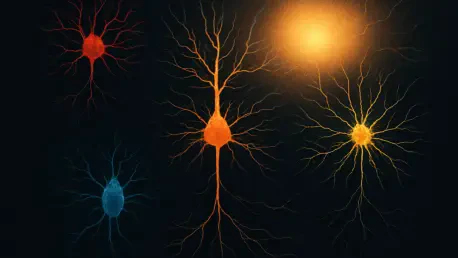
By analyzing the internal workings of the trained CNNs, the team uncovered a hidden world of emergent neural machinery. The networks had spontaneously organized their units into distinct functional groups to solve the task more efficiently, effectively reverse-engineering the mechanisms of attention. The AI not only replicated the response properties of neuron types already known to exist in the brains of primates and mice but also predicted the existence of several novel types whose roles in cognition were entirely unknown.
Among the most groundbreaking discoveries were two new classes of neurons. The first, Cue-Inhibitory Neurons, challenged the conventional focus on excitatory signals. These units actively suppressed their activity in response to a visual cue, suggesting that dampening irrelevant information is just as crucial as amplifying relevant signals. The second, and most surprising, finding was the Location-Opponent Neuron. This sophisticated cell type creates a “push-pull” dynamic; it is strongly excited when both a cue and a target appear in one specific location but is simultaneously inhibited by stimuli in all other locations within its receptive field. This mechanism acts to drastically sharpen focus on the cued location while aggressively filtering out distractions from the surrounding environment.
From Silicon to Synapse Validating the AIs Predictions in a Living Brain
A prediction from an AI model, no matter how compelling, remains a hypothesis until it is confirmed in biological reality. The critical next step for the research team was to bridge the gap between their silicon model and the synapses of a living brain. They sought to determine whether the novel neuron types discovered in the CNNs were mere artifacts of the artificial system or genuine components of biological brains that had simply gone undetected.
To validate their findings, the scientists analyzed existing neural recording data collected from mice performing a similar cued attention task. The results were a stunning confirmation of the AI’s predictive power. Within the superior colliculus, a midbrain structure involved in visual processing and eye movements, they found biological neurons that exhibited the exact “push-pull” response properties of the location-opponent neurons predicted by the model. This provided direct evidence that this sophisticated mechanism for filtering distractions is not just a computational theory but a real strategy employed by the mammalian brain.
Furthermore, the analysis of the mouse brain data also revealed evidence for other novel cell types, including the cue-inhibitory neurons. This validation solidified the role of optimized AI models as more than just tools for data analysis; they are powerful hypothesis-generating engines capable of predicting undiscovered biological phenomena. Interestingly, one specific neuron type found in the AI was absent in the mouse data, a finding that highlights an important truth: while AI can reveal fundamental computational principles, biological brains operate under additional evolutionary and metabolic constraints that shape their final design.
A New Blueprint for the Mind the Core Takeaways and Future Frontiers
The convergence of artificial intelligence and neuroscience in this study has provided a fundamentally new blueprint for understanding the mind. The findings have shifted the conceptualization of attention away from a localized, purpose-built module and toward a more distributed and emergent process. This work establishes that the core mechanics of covert attention can arise naturally from the simple imperative to perform a visual task well, a principle that may apply to many other cognitive functions.
The research has yielded profound takeaways for both fields. For neuroscience, it has unveiled new, verifiable types of neurons and provided a powerful new methodology for uncovering the brain’s hidden computational strategies. For artificial intelligence, understanding how effective mechanisms like location-opponent processing emerge could guide the development of more efficient and robust AI systems that learn with brain-like flexibility. This synergy, where AI predicts biological mechanisms and biology validates computational principles, is rapidly becoming a cornerstone of modern cognitive science.
Ultimately, this investigation did more than just explain how we can look without looking. It demonstrated a powerful new way of conducting science, where artificial minds are used to decode biological ones. The discovery of these emergent neuron types, first in silicon and then in synapses, represented a pivotal moment in our quest to understand cognition. It opened a new frontier where the secrets of the brain could be unlocked not just by observing it, but by successfully rebuilding its core functions from the ground up.