
The medical community has long treated the thymus as a relic of childhood development, a small gland in the chest that supposedly retires once we hit puberty. However, recent groundbreaking research is turning this dogma on its head, revealing that the thymus remains a critical engine for adult longevity and a powerful predictor of how we fight diseases like cancer. Joining us to unpack these findings is Ivan Kairatov, a biopharma expert with extensive experience in research and development and a deep understanding of how technological innovation is reshaping our approach to immune health. In this discussion, we explore the transition of the thymus from a “forgotten organ” to a cornerstone of personalized medicine, examining its role in T cell diversity, its impact on immunotherapy success, and how artificial intelligence is finally allowing us to see its true value.
Our conversation covers several critical themes, starting with the biological shift in how we perceive immune decline and the mechanisms that link thymic health to overall mortality. We delve into the technological leap provided by AI-driven CT scan analysis and how metrics like size and composition translate into a “thymic health score.” Furthermore, we address the alarming physiological links between thymic degradation and systemic issues such as cardiovascular disease and chronic inflammation. Finally, we discuss practical lifestyle interventions and the future of monitoring this organ as a standard part of preventative care and oncology.
The thymus was long thought to be inactive after puberty. What specific biological mechanisms explain why its health remains vital for adult longevity, and how does this change our understanding of immune decline? Please elaborate with relevant metrics or clinical observations to illustrate this shift.
For a long time, we viewed the thymus through a very narrow lens, essentially seeing it as a temporary training camp for the immune system that closes its doors after adolescence. We now understand that even as the organ shrinks and undergoes fat infiltration—a process often dismissed as irrelevant—it continues to function as a vital school for T cells, which are the frontline soldiers of our immune response. This ongoing “priming” is essential because it maintains T cell diversity, allowing the body to recognize and attack new pathogens or mutated cells that it hasn’t encountered before. The clinical weight of this cannot be overstated; recent data shows that adults with a high “thymic health score” have an incredible 50% lower risk of death compared to those with low scores. This suggests that immune decline isn’t just an inevitable part of getting older, but a specific biological failure of an organ we’ve been ignoring, effectively making the thymus a missing piece in the puzzle of why some people age so much more gracefully than others.
AI can now analyze routine CT scans to assess thymic size and composition. What specific metrics define a high “thymic health score,” and how could this tool be integrated into standard preventative care? Please describe the step-by-step process for evaluating these imaging results in a clinical setting.
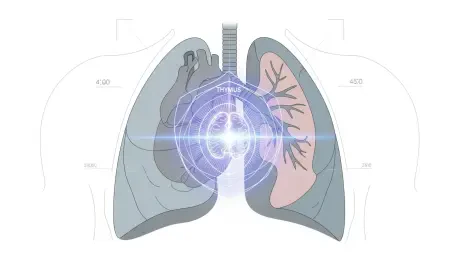
The integration of artificial intelligence into imaging is a total game-changer because it allows us to look at the thymus in a way the human eye simply cannot during a routine check. To generate a thymic health score, AI algorithms analyze three key physical attributes: the overall size of the organ, its specific shape, and its internal composition—specifically looking at how much functional tissue remains versus how much has been replaced by fat. In a clinical setting, this would ideally happen as a secondary analysis of a standard chest CT scan that a patient might be getting for entirely different reasons, such as a lung screening. Once the scan is uploaded, the software automatically segments the thymic region and applies these metrics to produce a score that tells a physician exactly how much “immune reserve” a patient has left. By making this a standard part of preventative care, we could identify high-risk individuals years before they develop chronic illnesses, allowing for a proactive rather than reactive approach to healthcare.
Poor thymic health is linked to a significantly higher risk of cardiovascular death and lung cancer. What is the physiological connection between T cell diversity and these specific diseases, and how does chronic inflammation drive this risk? Please provide examples or data showing how this manifests in patients.
The connection between the thymus and these seemingly unrelated diseases lies in the concept of immune surveillance and systemic inflammation. When thymic health declines, T cell diversity drops, meaning the immune system loses its “database” of threats and begins to misfire or simply miss early warning signs of disease. For instance, individuals with poor thymic scores face a 63% higher risk of cardiovascular death and a 36% higher risk of developing lung cancer. This often manifests in patients as a state of chronic inflammation, where the immune system is stuck in a low-level, ineffective “alarm mode” that damages blood vessels and allows mutated lung cells to proliferate unchecked. It is a sobering realization that a small gland in the chest acts as a master regulator for the health of our hearts and lungs, proving that systemic resilience is deeply tied to the quality of our T cell education.
Patients with stronger thymic health often see a 44% lower risk of death during immunotherapy. How does thymic function dictate the success of these immune-based treatments, and what precautions should be taken regarding unintended radiation exposure? Please share insights or anecdotes regarding how this affects treatment outcomes.
Immunotherapy is one of the most exciting frontiers in oncology, but its success is entirely dependent on the patient’s existing “immune machinery.” If a patient has a robust thymus, they have a 44% lower risk of death during treatment because their body can actually produce and deploy the T cells that the therapy is trying to activate. Conversely, we’ve seen cases where patients with a “depleted” thymus simply don’t respond, as there are no soldiers left to recruit for the fight against the tumor. This brings up a very serious concern regarding unintended radiation exposure during cancer treatment; if we accidentally radiate the thymus while targeting a lung tumor, we might be destroying the very organ the patient needs to survive the next phase of treatment. There is a growing sense of urgency among researchers to investigate how we can shield the thymus, ensuring that in our effort to kill the cancer, we don’t inadvertently silence the patient’s most powerful internal ally.
Lifestyle factors such as smoking and high body weight are associated with poorer immune resilience. What practical interventions can individuals adopt to protect their thymus as they age, and how can these changes be monitored over time? Please offer a detailed strategy for maintaining long-term immune health.
While we are still learning exactly how much we can “reverse” thymic aging, the data clearly shows that lifestyle factors like smoking and high body mass index are toxic to this organ. A strategy for maintaining immune health must focus on reducing systemic inflammation, which is the primary driver of thymic degradation. This means adopting a lifestyle that prioritizes metabolic health—specifically through weight management and the elimination of tobacco—which helps preserve the functional tissue within the gland. Monitoring this progress could eventually involve periodic AI-enhanced imaging to see if these lifestyle changes are slowing the rate of fat infiltration in the thymus. It’s about viewing the thymus not as a static, dying organ, but as a dynamic asset that responds to how we treat our bodies, much like our heart or muscle mass.
What is your forecast for the role of thymic health monitoring in the future of personalized medicine?
My forecast is that within the next decade, thymic health will become as fundamental a metric as blood pressure or cholesterol levels in the realm of personalized medicine. We will likely see a shift where every routine chest scan is automatically processed for an immune score, providing a “biological age” for the immune system that helps doctors tailor everything from vaccine schedules to the intensity of chemotherapy. By moving away from the assumption that the thymus is an inactive relic, we will unlock a new era of precision health where we don’t just treat diseases as they appear, but actively maintain the internal “factory” that prevents them in the first place. The thymus will no longer be the forgotten organ; it will be the primary target for ensuring that as we live longer, our immune systems remain strong enough to actually enjoy those extra years.