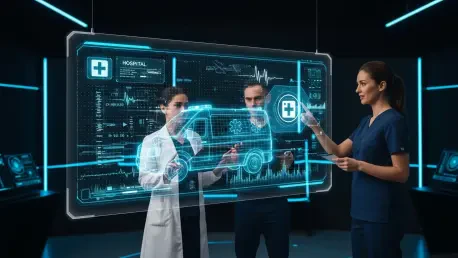

In the critical moments following a catastrophic injury, the difference between life and death is often measured not in minutes, but in milliliters of blood lost before a patient ever reaches the emergency room. For decades, first responders have navigated this uncertainty with limited tools, unable to see the internal devastation that dictates a patient’s true needs. Now, a groundbreaking application of artificial intelligence is poised to change that reality, offering a predictive lens that can alert hospital teams to the need for a life-saving blood transfusion while the ambulance is still en route. This development marks a pivotal shift from reactive treatment to proactive preparation, promising to rewrite the protocols for managing severe trauma and save countless lives in the process.
The Critical Gap in Emergency Care Why Predicting Blood Loss Is a Life or Death Challenge
Uncontrolled bleeding, or hemorrhage, remains a leading cause of preventable death following traumatic injury. When a patient suffers severe blood loss, the body enters a state of hemorrhagic shock, a deadly cascade where organs are starved of oxygen. The challenge for emergency medical services is that the most critical information—the volume of blood lost and the ongoing rate of internal bleeding—is invisible at the scene. Paramedics must make rapid assessments based on external signs that may not accurately reflect the severity of the internal crisis, creating a high-stakes guessing game against a rapidly ticking clock.
The tools historically available to pre-hospital teams are often insufficient for accurately gauging the need for a massive transfusion. Vital signs like blood pressure and heart rate can be unreliable indicators in the initial stages of trauma, as the body’s compensatory mechanisms can mask the true extent of blood loss until a patient is on the brink of collapse. This diagnostic ambiguity means that even patients who appear stable at the scene may be harboring life-threatening internal injuries, leaving hospital teams unaware and unprepared for the immediate and aggressive intervention required upon their arrival.
This information gap has profound consequences. When a hospital is not forewarned about a patient requiring a massive transfusion, critical time is lost preparing blood products, activating surgical staff, and clearing an operating room. These delays, even if only minutes long, can be devastating. Research has consistently shown that a delayed transfusion in a hemorrhaging patient is directly linked to higher mortality rates, increased risk of organ failure, and longer hospital stays for survivors. The inability to predict these needs early represents a fundamental vulnerability in the chain of survival for trauma care.
A New Paradigm Using AI to See the Future of Trauma Care
Addressing this challenge required a fundamental shift in approach, moving from observation to prediction through the power of artificial intelligence. The core innovation lies in the system’s ability to synthesize and interpret data that is already being collected by emergency responders at the scene of an incident. By leveraging information that is readily available—without the need for new, complex diagnostic equipment—the AI model provides an accessible and scalable solution that can be integrated into existing emergency medical protocols, effectively turning standard data collection into a predictive diagnostic tool.
The machine-learning model functions by analyzing a combination of pre-hospital data points to identify subtle patterns that are often invisible to the human eye. It processes a patient’s vital signs, the specific type and location of their injuries, and their relevant medication history, such as the use of anticoagulants. The algorithm weighs these factors simultaneously to calculate the statistical probability that the patient will require a transfusion. This holistic analysis provides a far more nuanced and accurate risk assessment than relying on any single vital sign or observation alone.
Once the AI model generates its prediction at the scene, the system is designed to transmit an automated, pre-arrival alert directly to the receiving hospital’s trauma center. This early warning acts as a digital heads-up, transforming the emergency response workflow. Instead of reacting to a critically ill patient arriving at their doors, the hospital team can begin preparing proactively. This seamless flow of information from the field to the hospital is the key to closing the critical time gap and ensuring that life-saving resources are ready and waiting the moment the patient arrives.
The Evidence A Robust System Validated Across Continents
The foundation of this AI system was built upon an exceptionally large and diverse dataset, a critical factor for ensuring its accuracy and reliability. Researchers developed the machine-learning algorithms by training them on a U.S. trauma registry containing the anonymized records of over 364,000 patients. This massive scale allowed the model to learn the complex and often non-linear relationships between pre-hospital indicators and the ultimate need for blood products, forming a robust predictive engine.
To prove the model’s effectiveness beyond a single population or healthcare system, it was then subjected to a rigorous multinational validation process. The AI’s predictions were tested against a separate cohort of 54,210 trauma patients from medical centers in Germany, Austria, Switzerland, Ireland, and Canada. The algorithm maintained its high accuracy across these varied international settings, a powerful demonstration of its generalizability and its potential for global adoption in trauma care.
In direct comparisons, the pre-hospital AI model significantly outperformed traditional risk-scoring methods that are typically used after a patient is already in the hospital. It proved more accurate in identifying patients who would require a massive transfusion, need emergency surgery to control bleeding, or ultimately succumb to their injuries. “These findings show that AI-driven decision support could enable earlier and more precise identification of patients at highest risk of hemorrhagic shock, using data already available to emergency services,” stated Professor Patricia Maguire of University College Dublin, a key contributor to the research.
From Prediction to Preparation The Real World Impact on Trauma Teams
The true value of this predictive technology lies in its ability to empower hospital trauma teams with the gift of foresight. An early warning from the field that an incoming patient has a high probability of needing a massive transfusion can trigger a cascade of preparatory actions. The blood bank can be notified to ready units of packed red blood cells, plasma, and platelets, while surgical and anesthesia staff can be put on standby. This advance notice effectively eliminates the lag time that typically occurs between patient arrival and the mobilization of critical resources.
This pre-arrival preparation has the potential to optimize the “golden hour,” the crucial period immediately following a traumatic injury where prompt medical intervention has the highest likelihood of preventing death. By streamlining the initial resuscitation phase, the AI system helps ensure that life-saving blood is administered faster and that the patient is moved to the operating room more quickly if needed. “This work shows how AI can use prehospital data to anticipate transfusion needs before arrival, enabling trauma teams to prepare earlier and respond faster when minutes matter most,” Professor Maguire added, highlighting the practical impact on clinical workflows.
While the validation results were a resounding success, the AI model has not yet been deployed for clinical use. The next phase of development will focus on prospective studies designed to evaluate how the technology performs in real-time emergency situations. Researchers must assess how paramedics and physicians interact with the AI-generated alerts and determine the most effective ways to integrate this decision-support tool into the complex and fast-paced environment of trauma care. Ultimately, full-scale clinical trials will be necessary to confirm that this predictive capability translates into measurable improvements in patient survival rates and a reduction in complications from severe hemorrhage. This research laid the critical groundwork, and the path toward clinical implementation is now the focus of efforts from 2026 to 2028 and beyond.