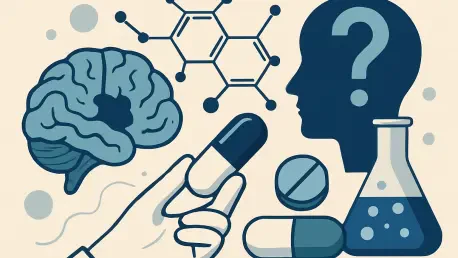

In a world where the global population is aging at an unprecedented rate, with projections estimating that nearly a quarter of humanity will be over 65 within the next two decades, the urgency to address age-related diseases like Alzheimer’s has never been more critical, posing immense challenges for healthcare systems. Aging remains the foremost risk factor for neurodegenerative disorders that lack effective treatments, making this demographic shift a looming crisis for which innovative solutions are desperately needed. Amidst this pressing issue, a revolutionary approach leveraging artificial intelligence (AI) is emerging as a beacon of hope. By harnessing vast datasets and cutting-edge computational models, researchers are redefining how therapies for complex conditions are discovered. This breakthrough not only promises to accelerate drug development but also offers a glimpse into innovative solutions that could transform the landscape of medical research for aging and Alzheimer’s disease.
Revolutionizing Drug Development with AI
Harnessing Computational Power for Complex Challenges
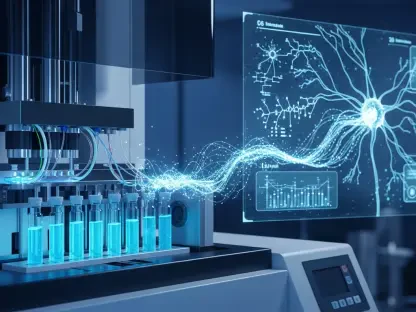
The intersection of AI and drug discovery marks a pivotal shift in tackling the intertwined issues of aging and Alzheimer’s disease, where traditional methods have often fallen short due to the multifaceted nature of these conditions. Conventional drug development struggles to address the intricate hallmarks of aging, such as chronic inflammation and mitochondrial dysfunction, which are deeply connected to neurodegenerative pathologies. In response, a novel AI-driven framework known as the Pathway and Transcriptome-Driven Drug Efficacy Predictor (PTD-DEP) has been developed to systematically analyze genomic, transcriptomic, and pharmacological data. This model sifts through enormous datasets to identify small-molecule candidates that target shared pathological pathways. By integrating machine learning and deep learning techniques, this approach offers a precision that was previously unattainable, paving the way for therapies that could simultaneously mitigate the effects of aging and Alzheimer’s at a molecular level.
Bridging Data to Clinical Relevance
Beyond merely identifying potential compounds, the AI-to-clinic paradigm stands out for its ability to translate computational predictions into tangible therapeutic outcomes, ensuring that discoveries are not confined to theoretical models. This systematic method accelerates the identification of effective treatments by combining sophisticated analytics with rigorous experimental validations in preclinical settings. A striking example lies in how network-based analytics uncover connections between disparate biological processes, revealing hidden opportunities for intervention. The reproducibility of this approach is a game-changer, as it establishes a reliable pipeline from data analysis to clinical application. Such advancements signify a departure from the trial-and-error nature of past drug discovery efforts, offering a streamlined path to address unmet medical needs. This comprehensive strategy not only saves time and resources but also instills confidence in the potential for AI to solve some of the most daunting challenges in modern medicine.
Promising Therapeutic Candidates and Future Implications
Spotlight on Melatonin as a Dual-Action Therapy
Among the most compelling findings from recent AI-driven research is the identification of melatonin, a hormone commonly associated with sleep regulation, as a candidate with remarkable potential to combat both aging and Alzheimer’s disease. Through advanced computational tools, including deep learning and proteolysis targeting chimera technology, researchers have discovered that melatonin interacts with key molecular complexes, such as the p300/specificity protein 1 transcriptional complex in super-enhancer regions. This interaction activates critical regulators of circadian rhythm, establishing a molecular bridge between aging processes and Alzheimer’s pathology. Validations in both in vivo and in vitro preclinical models have further confirmed melatonin’s capacity to address aging hallmarks and neurodegenerative markers concurrently. This discovery underscores the power of repurposing known compounds through AI insights, potentially fast-tracking their journey to clinical use.
Shaping the Future of Geroscience
Looking ahead, the implications of AI-guided drug discovery extend far beyond a single compound, as they contribute significantly to the broader field of geroscience by illuminating novel connections between aging and disease. The focus on multi-target therapies like melatonin highlights how AI can uncover solutions that address the complexity of age-related disorders in a holistic manner. This approach not only offers hope for preventing and treating Alzheimer’s but also sets a precedent for tackling other conditions linked to aging. As computational models continue to evolve, their integration with experimental research promises to refine therapeutic strategies further. The trend of leveraging AI to meet urgent medical needs reflects a transformative shift in healthcare, suggesting that scalable, data-driven solutions could become the norm. This pioneering effort, grounded in validated methodologies, lays the foundation for actionable steps that researchers and clinicians pursue to address a global aging crisis with innovative treatments.