
We are joined today by Ivan Kairatov, a biopharma expert at the forefront of medical technology and innovation. We will be exploring a groundbreaking AI-powered tool that promises to transform the early detection of heart valve disease, a condition often called a “silent epidemic.” Our conversation will delve into how this technology shifts the paradigm from late-stage treatment to proactive screening, the subtle acoustic patterns the AI can detect beyond human hearing, and how it can be seamlessly integrated into busy clinical workflows. We will also discuss the critical value of diagnostic consistency and look ahead to the future of AI in cardiology.
Given that severe valve disease is often a “silent epidemic” where outcomes can be worse than many cancers by the time symptoms appear, how does this AI tool shift the approach from reactive treatment to proactive screening? Please walk me through the ideal patient journey with this technology.
This technology completely flips the script on how we approach valvular heart disease. Right now, we’re stuck in a reactive mode. Patients often come to us only after they develop noticeable symptoms like shortness of breath or fatigue. By that point, the disease is advanced, and the prognosis can be devastating—the risk of death can be as high as 80% within two years if it’s left untreated. The ideal journey with this AI tool starts much, much earlier, during a routine primary care visit. A nurse or GP can take a few seconds to record heart sounds with a digital stethoscope. The AI provides an instant analysis, flagging patients who need a closer look. This allows us to catch the disease in its silent, early stages, referring them for a definitive echocardiogram long before irreversible damage to the heart occurs. It’s a fundamental shift from waiting for a crisis to actively preventing one.
Your research trained the algorithm directly on echocardiogram results, not just heart murmurs. What specific acoustic patterns can the AI detect that the human ear might miss? Could you share an example of a diagnosis this system could make that traditional auscultation might overlook?
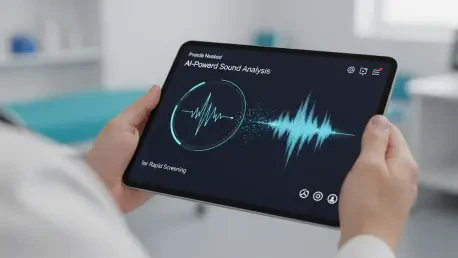
That’s the core of the innovation. By training the AI on the gold-standard echocardiogram data, we taught it to recognize the true acoustic signature of the disease itself, not just the classic “whooshing” sound of a murmur that doctors are trained to hear. The human ear is fantastic, but it’s limited, especially in a noisy clinic. The AI can pick up on incredibly subtle variations in the timing, intensity, and frequency of heart sounds that signify, for instance, a slight backward leak of blood in mitral regurgitation or the faint turbulence of early aortic stenosis. A great example would be a patient with significant disease but a very faint or atypical murmur. A busy clinician, listening for a classic sound, might easily miss it. Our AI, however, isn’t listening for a “murmur”; it’s listening for the precise acoustic fingerprint that correlates with the echocardiogram, allowing it to correctly identify 94% of severe mitral regurgitation cases that might have otherwise been overlooked.
This technology is positioned as a rapid screening tool for primary care that requires minimal training. How do you envision it integrating into a busy clinic’s workflow without adding significant burden? Describe the step-by-step process from a patient’s check-in to the AI’s initial assessment.
We designed this with the realities of a busy clinic in mind. The process is incredibly streamlined. When a patient, particularly someone over 65, comes in for a routine check-up, a medical assistant or nurse could perform the screening as part of the standard vitals check—right alongside taking their blood pressure and temperature. It just takes a few seconds to place the digital stethoscope on the chest and capture a recording. The device then instantly sends the sound data to the AI, which provides a simple, clear result: “no significant disease detected” or “further investigation recommended.” This result appears on a screen, giving the doctor an immediate, reliable data point to act upon during the consultation. It doesn’t add a time-consuming procedure; it enhances an existing one with a powerful, life-saving insight.
The study showed the AI was not only more accurate but also more consistent than clinicians, who varied in their judgments. Beyond sheer accuracy, what is the clinical value of that reliability, and how does it help manage the balance between catching disease and avoiding false alarms?
The consistency is just as valuable as the accuracy. In our study, we saw that when 14 different GPs listened to the same recordings, their interpretations varied widely. Some were more prone to flagging any potential issue, while others were more conservative, leading to a huge difference in who gets referred. This inconsistency creates a lottery based on which doctor you happen to see. The AI eliminates that. It applies the exact same criteria every single time, providing a standardized, objective baseline. This reliability is crucial for managing healthcare resources. By designing the system to minimize false positives, we ensure that we’re not flooding already-strained echocardiography departments with unnecessary referrals. It gives us the confidence to focus our most intensive resources on the patients who, according to a highly reliable screening, truly need them the most.
Detecting moderate forms of valve disease is a noted challenge. What are the key technical hurdles to improving the algorithm’s sensitivity for these less severe cases? Can you outline the most important milestones you hope to achieve in the upcoming real-world clinical trials?
Detecting moderate disease is definitely the next frontier. The primary technical hurdle is that the acoustic signals are much fainter and more complex than in severe cases. The changes in blood flow are less dramatic, so the resulting sounds blend more easily with the normal noise of the body. To overcome this, we need even larger and more diverse datasets to train the algorithm to pick up on these subtler patterns. Our biggest milestone for the upcoming real-world trials is to validate the tool’s performance in a chaotic, everyday GP setting, not just a controlled research environment. We need to prove it works effectively across a diverse patient population with various body types, co-existing conditions, and ambient noise levels. Successfully demonstrating its utility and ease of use in that setting will be the final, crucial step before we can advocate for its widespread adoption.
What is your forecast for the role of AI-enhanced diagnostic tools in cardiology over the next decade?
Over the next decade, I believe AI-enhanced tools like this will become the standard of care in primary and preventative cardiology. They won’t replace the expertise of clinicians, but will augment their senses, acting as an incredibly powerful co-pilot. We’ll see these algorithms integrated not just into stethoscopes, but into a whole suite of portable, accessible devices that can screen for a range of cardiovascular conditions at the point of care, or even at home. This will democratize diagnostics, moving it from specialized hospital departments into local clinics and communities. The result will be a healthcare system that is far more proactive, efficient, and ultimately capable of catching heart disease before it becomes a life-threatening emergency, giving countless people many more years of healthy life.