
For millions of people living with drug-resistant epilepsy, the hope for a cure often comes with a terrifying prospect: undergoing invasive brain surgery just to find the precise origin of their debilitating seizures. This high-stakes diagnostic journey requires surgeons to place electrodes directly onto the brain, a procedure fraught with risk, followed by weeks of waiting in a hospital bed for a seizure to strike. This challenging reality highlights a critical unmet need in modern neurology—a safer, faster, and more precise way to map the brain’s electrical storms.
Now, a groundbreaking development from Carnegie Mellon University promises to rewrite this daunting clinical narrative. Researchers have developed a powerful machine learning framework capable of pinpointing the source of seizures with remarkable accuracy using only noninvasive scalp recordings. This innovation, known as Spatial-Temporal-Spectral Imaging (STSI), not only offers a potential alternative to risky surgery but also unifies the analysis of all known epileptic brain signals, a feat that could transform presurgical planning and accelerate neuroscience research for years to come.
The High Stakes Search for a Seizures Starting Point
The challenge of localization is immense for patients whose seizures cannot be controlled by medication. Surgically removing the small piece of brain tissue where the seizures originate—the epileptogenic zone—offers the best chance for a cure. The success of this procedure, however, is entirely contingent on identifying that zone with millimeter-level precision. An incorrect localization can lead to an unsuccessful surgery, leaving the patient to continue enduring seizures while having undergone a significant brain operation.
This diagnostic uncertainty places an immense burden on patients and their families. The search for a cure becomes a waiting game, one that involves difficult decisions about invasive procedures and their associated risks, including infection, bleeding, and potential neurological deficits. The emotional and financial toll of this process underscores the urgent need for a more humane and efficient diagnostic tool.
The Gold Standards Heavy Price
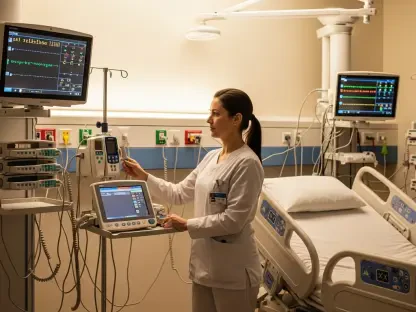
The current clinical gold standard for localizing the seizure source is intracranial electroencephalography (iEEG). This involves a major surgical operation where a portion of the skull is temporarily removed to place a grid of electrodes directly on the brain’s surface. Following the surgery, patients must remain in a specialized hospital unit, often for days or weeks, while being continuously monitored.
During this extended hospital stay, clinicians wait for the patient to have a spontaneous seizure, which is the only way to capture the definitive data needed for localization. This period is not only physically and emotionally taxing for the patient but is also incredibly costly for the healthcare system. The entire process represents a central dilemma in epilepsy care: the pursuit of precision is locked in a trade-off with patient safety, comfort, and cost.
A Noninvasive Revolution
In response to these significant limitations, a team led by Professor Bin He at Carnegie Mellon University developed the STSI framework. It represents a unified, machine learning-based approach that stands as the first technology capable of analyzing all major types of epileptic brain signals—from fleeting spikes to sustained oscillations—within a single, cohesive computational model.
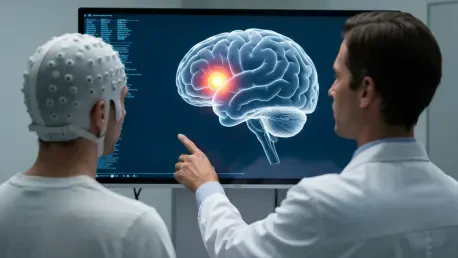
The power of STSI lies in its ability to simultaneously analyze brain activity across three critical dimensions: where it is happening (spatial), when it occurs (temporal), and at what frequency it oscillates (spectral). By integrating these dimensions, the algorithm can create a detailed, dynamic map of brain activity from data collected via a simple, safe, and easy-to-acquire scalp EEG, completely eliminating the need for invasive surgery for localization.
Putting the AI to the Test
The STSI technology was not just a theoretical concept; it was subjected to a rigorous, multi-year validation study in collaboration with the Mayo Clinic. Researchers conducted a large-scale analysis of 2,081 distinct EEG events from 42 patients with drug-resistant epilepsy, creating one of the most comprehensive datasets for comparing noninvasive source imaging techniques.
The study’s results delivered a crucial breakthrough. After comparing all known biomarkers, the team identified pathological High-Frequency Oscillations (HFOs)—which are HFOs that occur in direct conjunction with epileptic spikes—as the most reliable interictal biomarker. Professor Bin He noted the unprecedented nature of the achievement, stating that having a single computational framework handle all these different biomarkers had never been done before.
A New Benchmark for Precision and Speed
The data revealed that imaging these pathological HFOs could pinpoint the seizure source to within an average of nine millimeters of the true origin, a level of precision that rivals the seven-millimeter accuracy achieved by imaging an actual seizure event. This remarkable accuracy is achieved using data that can be collected in less than an hour, a dramatic improvement over the weeks of invasive monitoring currently required.
This research also resolved a long-standing debate in the field, demonstrating that general HFOs (those not tied to spikes) are poor localizers, which explains years of inconsistent clinical results. With these promising findings, the team plans to secure funding for larger trials, moving STSI toward widespread clinical adoption. Beyond epilepsy, its ability to analyze any EEG or MEG signal positions STSI as a powerful tool for broader neuroscience research, from studying memory and pain to better understanding psychiatric disorders.
The development and successful validation of the STSI framework marked a significant conceptual shift in electrophysiological source imaging. It established a noninvasive, rapid, and highly accurate method that promises to fundamentally reshape presurgical planning for epilepsy. By identifying pathological HFOs as a superior biomarker, the research not only provided a practical tool but also brought critical clarity to the field. This work offered a tangible pathway toward a future where patients could be spared the immense physical, emotional, and financial burdens of invasive monitoring, representing a major step forward in both neurological medicine and patient-centered care.