
The intricate symphony of the human brain has long been played through a filter of heavy static, but a revolutionary AI conductor is finally allowing scientists to hear the music clearly for the first time. For decades, researchers have relied on functional magnetic resonance imaging (fMRI) to observe the brain in action, a technique with immense promise for unlocking the secrets of cognition and disease. However, the value of these scans has always been limited by a fundamental problem: the true signals of neuronal activity are often buried under a cacophony of physiological “noise.” A groundbreaking artificial intelligence method developed by researchers at Boston College, named DeepCor, is now changing that paradigm, offering an unprecedented level of clarity that could accelerate discoveries about the brain and its disorders.
What if We Could Turn Down the Static in Brain Scans
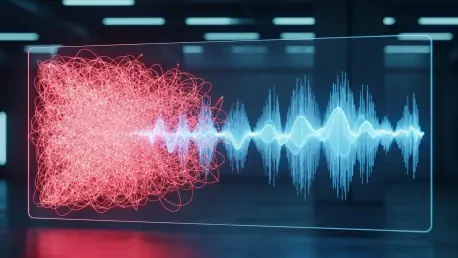
Every fMRI scan captures a complex dataset where valuable information is intermingled with unwanted distortions. These artifacts arise from the subject’s own body—the subtle movements from a heartbeat, the rhythm of breathing, or an unintentional shift in position. This interference acts like static on a radio, obscuring the faint but crucial signals that represent genuine brain responses. Filtering out this noise without accidentally removing important data has been one of the most significant and persistent challenges in neuroscience.
The inability to perfectly separate signal from noise means that subtle brain activity, which could be key to understanding complex disorders like autism or schizophrenia, might be missed entirely. Researchers have spent years developing computational methods to clean this data, but progress has been incremental. The need for a more powerful and precise tool has been paramount, one that can intelligently distinguish the meaningful whispers of the brain from the loud, distracting shouts of bodily functions.
The Challenge of Listening to the Brain
Functional magnetic resonance imaging stands as one of the most powerful noninvasive tools for studying the human brain, allowing scientists to map active regions by detecting changes in blood flow. When a particular brain area becomes more active, it requires more oxygen, and fMRI technology is designed to pick up on these metabolic shifts. This process provides a dynamic map of brain function, crucial for everything from basic cognitive science to clinical diagnostics.
However, the raw data produced by an fMRI scanner is far from pure. The very physiological processes that keep a person alive create significant image distortions. A person’s pulse sends pressure waves through the brain, and each breath causes the body to move slightly, both of which are captured by the sensitive scanner. These factors introduce patterns into the data that can easily be mistaken for neuronal activity, leading to inaccurate conclusions and masking the subtle patterns researchers are trying to find.
DeepCor The AI Solution for Tuning into True Neuronal Activity
To solve this long-standing issue, a team at Boston College developed DeepCor, a method that leverages the power of generative AI. Unlike previous techniques that apply more generalized filters, DeepCor is trained to learn the specific signatures of noise. The AI is taught to differentiate between the signal patterns that originate from brain regions containing neurons and those that come from areas without them, such as the fluid-filled ventricles.
The underlying logic is elegantly simple. Since physiological noise from sources like heartbeat and respiration tends to affect the entire brain uniformly, it will appear in both neuronal and non-neuronal regions. In contrast, true brain activity is localized to neuron-rich areas. DeepCor identifies the patterns common to both types of regions, correctly flags them as noise, and subtracts them from the dataset. What remains is a dramatically cleaner signal, amplifying the true neuronal activity that researchers need to study.
Measuring the Breakthrough a Staggering Leap in Data Purity
The performance of DeepCor has proven to be nothing short of revolutionary. In direct comparisons detailed in a recent Nature Methods publication, the AI model demonstrated a massive leap in efficacy. When cleaning noise from fMRI data focused on face-response activity, DeepCor outperformed the widely used conventional method, CompCor, by an impressive 215 percent. On realistic synthetic data created to mimic real-world fMRI properties, the improvement was even more striking, reaching 339 percent.
These figures surpassed even the most optimistic projections of the research team. According to Stefano Anzellotti, the study’s senior author, the team had hoped for a modest improvement, perhaps in the range of 10 to 50 percent. The results, which were more than triple the performance of the previous state-of-the-art approach, signaled a major breakthrough rather than a simple incremental advance. This staggering increase in data purity moves the entire field of neuroscience forward.
Charting a New Course for Neuroscience with Cleaner Data
The implications of such a significant enhancement in fMRI clarity are vast. With cleaner, more reliable data, neuroscientists can investigate the brain with a new level of precision. This could enable the detection of previously invisible neural markers for psychiatric and neurological conditions, leading to earlier diagnoses and more effective treatments. The ability to confidently track subtle brain signals opens new avenues for understanding learning, memory, and emotion.
Recognizing the potential impact of their work, the creators of DeepCor are focused on making the method widely and easily accessible to the global research community. Their plans include applying the AI to denoise large, publicly available fMRI datasets, a move that will allow scientists everywhere to re-analyze existing data and uncover new insights. By democratizing this powerful tool, the team is helping to chart a new course for brain research, ensuring the entire field can benefit from this leap in technological capability.
The development of DeepCor marked a pivotal moment in the quest to understand the human brain. It provided a solution that moved beyond incremental improvements and fundamentally altered the quality of data available to scientists. This breakthrough effectively cleared away decades of distortion, allowing the faint but vital signals of brain activity to be heard with unprecedented fidelity. With this newfound clarity, the field of neuroscience was equipped to ask more nuanced questions and pursue answers that had long remained hidden within the noise.