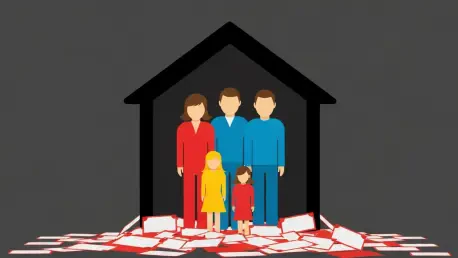

The American healthcare system presents a deeply troubling paradox where having health insurance offers no guarantee of financial security, a reality starkly illustrated by the story of Sarah Monroe. A 43-year-old from the Cleveland area, Monroe and her family enjoyed a comfortable, middle-class life with a six-figure income and what they believed was solid health coverage. Their stability was shattered when a high-risk pregnancy coincided with a serious heart diagnosis, plunging them into a financial crisis. Despite being insured, Monroe was quickly overwhelmed by medical bills, accumulating over $13,000 in debt within a single year. This catastrophic fallout forced her family from their home into a small apartment, wiped out their savings, and ruined their credit. Her experience is a microcosm of a nationwide epidemic, where a 2022 survey revealed that about 100 million people in the U.S. have healthcare debt, the majority of whom, like Monroe, are insured. This crisis exposes the systemic flaws of a healthcare model that continues to find political champions.
The Theory and Failure of Consumer-Driven Healthcare
The concept of high-deductible health plans (HDHPs) paired with tax-free Health Savings Accounts (HSAs) gained significant traction about two decades ago, emerging partly as a reaction against the restrictive nature of Health Maintenance Organizations (HMOs). The underlying theory, long advocated by conservative economists, was that requiring patients to have more “skin in the game” would transform them into discerning consumers. Proponents argued that if individuals were directly responsible for a larger portion of their medical costs, they would be motivated to shop for higher-quality, lower-cost care. This consumer-driven approach was heralded as a market-based solution that would naturally control spiraling healthcare costs and empower patients. This philosophy is now being revived in proposals that suggest giving Americans cash to deposit into health accounts paired with these high-deductible plans, framing it as a way to send money “directly back to the people” and empower them to lower costs.
However, two decades of real-world application have systematically dismantled this theory, revealing it as a profound policy failure. The intended outcome of cost control never materialized; instead, the financial burden was simply transferred from insurers to patients. While deductibles became nearly universal and their costs skyrocketed—the average for a single worker rising from approximately $300 in 2006 to almost $1,700 today—the underlying prices for medical services continued their relentless climb, far outpacing general inflation. For instance, the average price of a knee replacement surged by 74% from 2003 to 2016. This evidence demonstrates that making patients pay more out-of-pocket did little to curb the ever-increasing cost of care. As Shawn Gremminger of the National Alliance of Healthcare Purchaser Coalitions concluded, the expectation that patients would drive down prices “largely has not been the case.”
The Impracticality of Shopping for Medical Care
The central premise that patients can and will “shop” for healthcare like they do for other goods and services collapses under the weight of real-world medical crises. When Sarah Monroe was faced with a life-threatening heart condition while carrying twins, her primary concern was ensuring the best possible medical outcome for herself and her unborn children, not comparing the prices of cardiologists or delivery rooms. She logically chose the largest, most integrated health system in her region to minimize medical risk, a decision driven by an urgent need for expertise and safety, not by cost-efficiency. This scenario highlights a fundamental flaw in the consumer-driven model: in moments of fear and vulnerability, patient decisions are dictated by medical necessity and trust in providers, rendering the concept of price shopping not only impractical but also dangerously misguided. The idea of calmly comparing costs is a luxury that few facing a serious health threat can afford to entertain.
This anecdotal evidence is strongly supported by comprehensive data that exposes the myth of the empowered healthcare consumer. The Health Care Cost Institute estimated that a mere 7% of total healthcare spending for Americans with job-based insurance is for services that could realistically be shopped for. Most medical needs are for emergencies or complex, long-term treatments where price comparisons are not feasible or advisable. Oncologist Dr. Fumiko Chino of MD Anderson Cancer Center reinforces this point, stating the absurdity of expecting a patient who has just received a potentially fatal cancer diagnosis to effectively compare prices for complex procedures like surgeries, radiation, or chemotherapy within the urgent timeframe required for treatment. The healthcare market is not a transparent, consumer-friendly environment; it is a complex and often opaque system where critical decisions must be made under duress, making the “shopping” analogy a dangerously flawed foundation for national health policy.
A System That Creates Debt and Worsens Health
The financial tools created to support the high-deductible system have proven to be woefully inadequate safety nets. Health Savings Accounts were designed to help patients save for their out-of-pocket expenses, but as Sarah Monroe’s story vividly illustrates, these accounts often fail to accumulate sufficient funds to cover a major medical event. A sudden, catastrophic illness or a complicated childbirth can easily generate bills that far exceed whatever savings a family has managed to put aside in an HSA. This renders the account insufficient precisely when it is needed most, leaving families financially exposed and vulnerable to insurmountable debt. The promise of the HSA as a protective buffer has, for millions, turned into an illusion, offering little more than a false sense of security against the crushing weight of a healthcare crisis. The accounts work for minor, predictable expenses but fall apart in the face of true medical emergencies, the very events for which insurance is supposed to exist.
Ultimately, the most alarming legacy of the high-deductible model was not just financial ruin but the documented harm it caused to public health. The significant financial barriers these plans created led many patients to delay or even forgo necessary medical care, a decision that had lethal consequences. Research conducted by Dr. Chino found that cancer patients with high-deductible plans were more likely to die than similar patients who did not face such high upfront costs. This stark finding suggested that the “skin in the game” theory was not just a failed economic experiment but a dangerous policy that directly contributed to negative health outcomes. The evidence from the past two decades showed that a system built on shifting costs to patients failed to control prices, burdened families with debt, and in the worst cases, cost American lives. As Sarah Monroe poignantly stated, looking back on her ordeal, “We owe it to ourselves to do it a different way. We can’t treat people like this.”