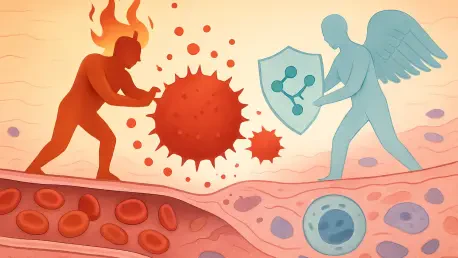

The same biological process that heroically defends the body against injury and infection can become a relentless saboteur when it fails to disengage, driving many of modern medicine’s most formidable chronic diseases. For decades, the focus of anti-inflammatory treatment has been on suppressing this response, but a landmark study has shifted the paradigm by identifying the body’s own natural “off-switch.” This discovery illuminates a sophisticated internal mechanism for resolving inflammation, offering a precise new target for treating a host of debilitating conditions without the broad side effects of current therapies.
The Persistent Problem of Chronic Inflammation
Inflammation is a fundamental, protective response. When the body encounters a threat, such as a pathogen or tissue damage, the immune system dispatches cells to contain the danger, clear debris, and initiate healing. This acute phase, characterized by pain, heat, redness, and swelling, is a temporary and highly effective defense mechanism. In a healthy system, this response concludes once the threat is neutralized, allowing the body to return to a state of balance.
The problem arises when this resolution process fails. The immune system’s alarm bells continue to ring long after the initial danger has passed, leading to a state of chronic inflammation. This persistent, low-grade activation keeps immune cells on high alert, where they can begin to damage healthy tissues. This underlying dysfunction is a common driver of conditions ranging from rheumatoid arthritis and heart disease to diabetes, where the body’s own defense system contributes directly to the progression of the disease.
A Breakthrough in How Our Bodies Resolve Inflammation
In a significant advance, researchers at University College London (UCL) have uncovered a specific molecular pathway that naturally brings inflammation to a close. The investigation moved away from simply blocking the inflammatory process and instead focused on understanding and enhancing the body’s inherent ability to heal itself. This approach led to the identification of a group of tiny, fat-derived molecules called epoxy-oxylipins as central players in this resolution phase.
These epoxy-oxylipins function as powerful natural brakes on the immune system. Their primary role is to halt the excessive production of a specific type of immune cell known as an intermediate monocyte. These cells are strongly implicated in fueling the cycle of chronic inflammation and are notorious for promoting tissue damage. The study established a direct correlation: higher levels of epoxy-oxylipins lead to a more rapid and effective shutdown of the inflammatory response, preventing the cascade that leads to chronic disease.
Mapping the Resolution Pathway in Human Volunteers
To validate these findings in a clinically relevant context, the researchers designed an innovative study using healthy human volunteers. They induced a localized and temporary inflammatory reaction by injecting a small, harmless amount of UV-killed E. coli bacteria into the forearms of participants. This method safely mimicked the body’s natural response to an infection, allowing the team to observe the entire inflammatory cycle from onset to resolution within a controlled environment.
The study explored two distinct therapeutic timelines. In one group, volunteers received a drug that boosts epoxy-oxylipin levels two hours before the inflammation was induced—a prophylactic approach to test if cellular damage could be prevented. In a second group, the drug was administered four hours after the inflammation had already begun, simulating a more typical clinical scenario where treatment begins after symptoms appear. In both cases, the results were unmistakable: elevating epoxy-oxylipin levels significantly accelerated the resolution of pain and dramatically reduced the number of harmful intermediate monocytes, both at the inflammation site and in the bloodstream.
A New Era for Anti-Inflammatory Therapeutics
The consensus among the research team is that this discovery heralds a new chapter in the treatment of inflammatory diseases. By focusing on restoring the body’s natural checks and balances, this strategy offers a more targeted and potentially safer alternative to traditional anti-inflammatory drugs, which often suppress the immune system broadly and can leave patients vulnerable to infection. This approach does not block the beneficial aspects of the initial immune response but rather enhances the body’s ability to turn it off when it is no longer needed.
“This pathway is a key part of our body’s own healing mechanism, and by understanding it, we can design safer treatments for a huge number of diseases driven by chronic inflammation,” stated Professor Derek Gilroy, the study’s corresponding author. He emphasized that mapping this process in humans provides a clear blueprint for developing drugs that work in harmony with the body. Dr. Olivia Bracken, the first author, highlighted the direct implications for conditions like rheumatoid arthritis, suggesting that these new therapies could be used to manage disease flare-ups and potentially prevent the joint damage caused by persistent inflammation.
Translating a Landmark Discovery into Clinical Medicine
The clarity of the study’s findings has created a direct path from the laboratory to potential real-world medical applications. The drug used in the trial works by inhibiting an enzyme called soluble epoxide hydrolase (sEH), which naturally breaks down the beneficial epoxy-oxylipins. By blocking this enzyme, the drug effectively increases the concentration and prolongs the activity of these healing molecules. The success of this sEH inhibitor in a human model provides strong proof of concept for a new class of therapeutics.
With this foundational human data now established, the critical next step was to move sEH inhibitors into formal clinical trials. The research provided a solid rationale for testing these agents in patients with chronic inflammatory conditions, such as rheumatoid arthritis. The goal of these trials, which are advancing, will be to determine if this therapeutic strategy can not only manage symptoms but also slow or even halt the underlying progression of the disease by restoring the body’s natural ability to resolve inflammation and protect its own tissues.