
For millions grappling with the profound and persistent darkness of major depression, the journey to find an effective treatment can be a long and disheartening road, but a landmark clinical trial has now provided powerful evidence that an implanted medical device offers substantial and lasting relief for those with the most severe, treatment-resistant forms of the illness. The extensive findings from the RECOVER clinical trial, supervised by investigators at the Washington University School of Medicine in St. Louis, demonstrate that vagus nerve stimulation (VNS) not only alleviates debilitating symptoms but also sustains these improvements over a two-year period, offering a new horizon of hope for a patient population that had previously exhausted nearly every available therapeutic avenue. This research marks a pivotal moment in the search for durable solutions for individuals whose lives have been severely constrained by an unyielding mental health condition, pointing toward a future where technology can restore function and quality of life.
Understanding the Challenge and a Novel Approach
The Crisis of Treatment-Resistant Depression
Major depression affects a significant portion of the adult population in the United States, yet for as many as one-third of these individuals, standard therapies like antidepressant medications and psychotherapy fail to provide adequate relief. This condition, known as treatment-resistant depression (TRD), represents one of the most pressing challenges in modern psychiatry. The RECOVER trial zeroed in on the most extreme end of this spectrum, recruiting participants for whom even advanced interventions such as electroconvulsive therapy (ECT) and transcranial magnetic stimulation (TMS) had proven ineffective. The study’s lead author, Dr. Charles Conway, a professor of psychiatry at Washington University, characterized the participants as “the sickest treatment-resistant depressed patient sample ever studied in a clinical trial.” On average, each patient had endured a 29-year history of depression and had unsuccessfully tried an average of 13 different treatments, a testament to the intractable nature of their illness and the urgent need for a truly novel therapeutic strategy.
The devastating impact of this severe form of depression extends far beyond emotional distress, profoundly affecting every aspect of a person’s life. The chronic and disabling nature of the illness left three-quarters of the trial participants unable to work, illustrating the immense societal and personal cost of the condition. For this population, the concept of a “cure” often seems out of reach; as Dr. Conway noted, even a partial response can be “life-altering,” restoring a degree of functionality and hope that had been lost for decades. The clinical trial was therefore designed not just to measure a reduction in symptoms but to assess meaningful improvements in quality of life and daily function. The immense challenge posed by this patient group underscores why the development of innovative, long-term solutions is not merely a scientific pursuit but a critical necessity for individuals who have been left behind by conventional psychiatric care, highlighting the immense unmet need for interventions that can break the cycle of treatment failure.
The VNS Therapy System and the RECOVER Trial
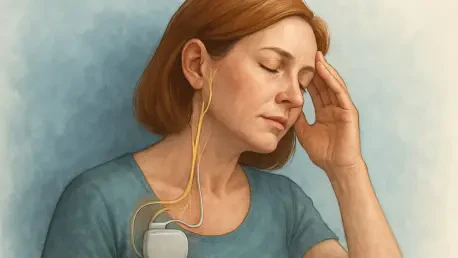
At the core of this investigation is the Vagus Nerve Stimulation (VNS) Therapy System, a sophisticated medical technology designed to modulate brain activity. The system involves the surgical implantation of a small, pulse-generator device, similar in size and function to a cardiac pacemaker, under the skin in the upper chest area. This device is connected to a thin, flexible wire that is carefully threaded to and wrapped around the left vagus nerve in the neck. Once activated, the device is programmed by a clinician to deliver carefully calibrated, intermittent electrical pulses to the nerve. As a major neural pathway, the vagus nerve connects the brain to many of the body’s internal organs and plays a key role in regulating a wide range of physiological processes, including mood. The goal of VNS therapy is to leverage this connection to influence activity in brain regions that are known to be dysregulated in individuals with major depression, thereby helping to restore a more balanced emotional state over time.
The RECOVER trial itself was a large, multicenter study meticulously designed to evaluate the efficacy and safety of this technology. Sponsored and funded by the device manufacturer, LivaNova USA, Inc., the trial enrolled nearly 500 patients across 84 clinical sites throughout the United States. To ensure the highest level of scientific rigor, the study incorporated a one-year, blinded control phase. During this initial period, all participants had a VNS device implanted, but for the first 12 months, the devices were activated in only half of the patients. The other half served as a control group, receiving the implant but with the device remaining inactive. This double-blind design allowed researchers to make a direct and unbiased comparison of outcomes between the active treatment group and the control group. The trial’s ultimate objective extends beyond scientific inquiry; it aims to generate the robust clinical data necessary to support a coverage determination from the U.S. Centers for Medicare and Medicaid Services (CMS), which could make the therapy accessible to many more patients.
Long-Term Data Reveals Sustained Success
Durability and Delayed Benefits
While early reports from the trial’s first year showed promising improvements in quality of life for the active VNS group, newly published findings focusing on long-term effects have provided even more compelling evidence of the therapy’s power. This new analysis, which appeared in the International Journal of Neuropsychopharmacology, tracked 214 patients who received active VNS from the trial’s outset, examining their progress from the 12-month mark to the 24-month mark. The results demonstrated a remarkable and sustained benefit over this extended period. At the one-year follow-up, approximately 69% of patients had achieved what was defined as a “meaningful response,” indicating at least a 30% reduction in depressive symptoms in key metrics. Critically, among these responders, more than 80% either maintained or further improved their clinical benefits at the two-year mark. The data was even more impressive for those who had a “substantial response” (a 50% or greater symptom reduction) at one year, with 92% of this group continuing to experience a benefit at 24 months.
Another of the trial’s most significant discoveries was the emergence of late responders, revealing that the therapeutic benefits of VNS may take more than a year to fully manifest in some individuals. Nearly one-third of the participants who had shown no meaningful response after the first year of active stimulation went on to report significant and clinically relevant benefits by the end of the second year. This finding suggests a delayed mechanism of action for some patients, a crucial insight that challenges conventional expectations for treatment timelines in psychiatry. It highlights the importance of long-term adherence to the therapy, even in the absence of immediate or rapid results. For patients and clinicians, this knowledge is transformative, as it provides a strong rationale for continuing treatment beyond the one-year mark and offers hope to those who might otherwise feel discouraged by a slow initial response. This delayed effect underscores the unique way VNS therapy may work to gradually remodel neural circuits over an extended period.
A Remarkable Path to Lasting Wellness
Perhaps the most compelling outcome from the two-year data was the rate of remission achieved among this severely ill patient population. After 24 months of continuous VNS therapy, more than 20% of the treated participants were considered to be in remission, a state where their depressive symptoms had improved to such a degree that they could function normally in their daily lives. Dr. Conway expressed his astonishment at this figure, stating, “We were shocked that one in five patients was effectively without depressive symptoms at the end of two years.” He characterized these results as “highly atypical” for studies involving patients with such a profound and long-standing history of treatment failure, where the long-term sustainability of any therapeutic benefit is rarely observed. This outcome moves beyond symptom reduction and points toward the possibility of profound, life-altering recovery for a significant portion of individuals who had lost all hope.
The two-year data from the RECOVER trial provided strong and compelling evidence that vagus nerve stimulation was a highly effective, durable, and long-lasting treatment option for a significant portion of patients with the most severe and intractable forms of depression. The therapy not only reduced symptoms but also demonstrably improved quality of life and daily functioning over an extended period. The findings that benefits were sustained for at least two years, that some patients experienced a delayed but significant response, and that a notable percentage achieved full remission, collectively positioned VNS as a transformative intervention. These results were expected to play a crucial role in future decisions regarding insurance coverage, potentially making this life-changing therapy accessible to many more patients in dire need of a new path forward.