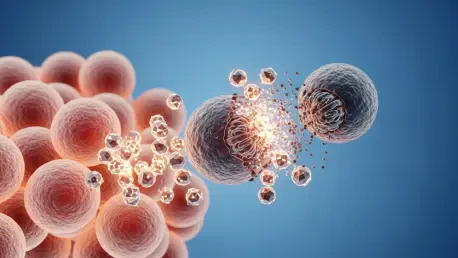

The long-standing struggle against small cell neuroendocrine cancers has finally reached a pivotal turning point through the strategic exploitation of genetic dependencies. For over fifty years, patients diagnosed with these aggressive malignancies in the lungs, prostate, or ovaries faced a grim prognosis, as the rapid mutation and metastatic nature of these cells rendered traditional chemotherapy largely ineffective. However, the emergence of synthetic lethality offers a more sophisticated weapon. By identifying a specific biological “fail-safe” that exists only in tumor cells, researchers have developed a method to induce self-destruction in cancer while leaving the surrounding healthy tissue untouched. This approach moves the oncology field away from the blunt-force trauma of systemic toxins toward a surgical, gene-level intervention.
Introduction to Synthetic Lethality in Oncology
At its core, synthetic lethality is a biological phenomenon where the loss of one of two genes is manageable for a cell, but the simultaneous loss of both is fatal. This principle is particularly revolutionary for treating cancers driven by the absence of tumor suppressors. In many aggressive tumors, the Retinoblastoma (RB) gene—a vital internal brake on cell division—is completely missing. Because one cannot “fix” a missing gene with traditional drugs, synthetic lethality seeks a second gene that the cancer has become addicted to in the absence of RB. Identifying this partner transforms a genetic deficit into a unique, exploitable vulnerability.
This strategy represents a departure from the “one-size-fits-all” model of 20th-century medicine. Rather than attacking all rapidly dividing cells, synthetic lethality relies on the specific genetic signature of a patient’s tumor. It effectively turns the cancer’s own evolutionary shortcuts against itself. As precision medicine matures, this framework is becoming the primary solution for recalcitrant cancers that have historically evaded every other form of targeted therapy.
Mechanics of Targeted Genetic Vulnerability
The RB-Loss and E2F3 Dependency Axis
Recent breakthroughs at UCLA have pinpointed the E2F3 protein as the critical “Achilles’ heel” for RB-deficient cancer cells. In a healthy cell, the RB gene regulates the E2F family to ensure orderly growth; however, when RB is lost, the cell becomes hyper-dependent on E2F3 to drive its unchecked proliferation. The discovery revealed that while healthy cells can survive fluctuations in E2F3 levels, small cell neuroendocrine cancers (SCNCs) lose their fundamental ability to divide and form tumors if this protein is inhibited. This creates a specific therapeutic window, allowing for a treatment that is lethal to the tumor but benign to the patient’s wider physiology.
High-Fidelity Modeling: CRISPR and Organoids
Validating these genetic dependencies required a move away from simplistic, two-dimensional cell cultures. Researchers utilized three-dimensional organoids—miniature, lab-grown versions of human tumors—to simulate the complex environment of a living body. By applying genome-wide CRISPR screens to these models, scientists analyzed nearly 1,400 different genetic dependencies. This high-fidelity approach allowed the team to confirm that E2F3 was not just a random association but a universal requirement for SCNC survival across different organ types. Such sophisticated modeling bridges the gap between theoretical genetics and actual clinical predictability, reducing the risk of failure in subsequent human trials.
Innovations in Metabolic Pathway Targeting
Since direct pharmacological inhibitors for proteins like E2F3 are notoriously difficult to design, the focus has shifted toward metabolic inhibition. Researchers found that they could indirectly suppress E2F3 by targeting the pyrimidine synthesis pathway, which provides the essential building blocks for DNA replication. By inhibiting the DHODH enzyme, they successfully starved the cancer cells of the resources needed to maintain high E2F3 levels. This indirect approach represents a shift in how we think about gene expression, suggesting that we can control “undruggable” proteins by manipulating the metabolic engine that powers them.
Real-World Applications and Drug Repurposing
The most immediate impact of this research lies in the potential to repurpose existing, FDA-approved medications. Drugs like leflunomide and teriflunomide, originally designed for autoimmune conditions like rheumatoid arthritis, have shown a surprising ability to inhibit the DHODH enzyme and, by extension, stall SCNC progression. Utilizing these established compounds significantly accelerates the clinical timeline, as their safety profiles and metabolic behaviors in humans are already well-documented. This strategy bypasses the decade-long development cycles usually associated with new oncology drugs, providing a faster route to the bedside for patients with limited time.
Technical Hurdles and Implementation Challenges
Despite the promise, the technology faces significant delivery and resistance hurdles. While metabolic inhibitors work well in controlled environments, ensuring consistent concentrations of these drugs within a dense, metastatic tumor remains a logistical challenge. Furthermore, the inherent plasticity of neuroendocrine cancers means that tumors may eventually develop secondary mutations to bypass the E2F3 dependency. Regulatory bodies also remain cautious about the off-label application of autoimmune drugs for oncology, necessitating rigorous, large-scale clinical trials to prove that the success seen in organoid models translates effectively to diverse human populations.
Future Outlook for Synthetic Lethality Treatments
The trajectory of oncology is moving toward a unified treatment model where diverse cancers are grouped by their molecular vulnerabilities rather than their organ of origin. In the coming years, we can expect the integration of artificial intelligence to map even more complex “lethal pairs,” identifying secondary and tertiary genetic backups that tumors use to survive. This could lead to multi-drug synthetic lethality cocktails that shut down every possible escape route for a cancer cell. As our library of genetic dependencies grows, the stagnant survival statistics of the last half-century will likely begin to shift, turning once-terminal diagnoses into manageable conditions.
Summary of Clinical Progress and Potential
The transition from broad-spectrum cytotoxicity to the precision of synthetic lethality marked a fundamental change in how the medical community approached aggressive malignancies. By moving beyond the hunt for new toxins and instead focusing on the inherent genetic flaws of the tumor, researchers provided a roadmap for treating the untreatable. The discovery of the RB-E2F3 axis proved that even the most resilient cancers have a breaking point that can be reached using tools already present in our pharmaceutical arsenal. This framework did not just offer a new drug; it offered a new philosophy of treatment that prioritized the biological reality of the patient’s disease over the generalities of historical oncology. Looking forward, the focus will remain on refining delivery mechanisms and expanding the catalog of lethal genetic pairs to ensure that no tumor is left without a targetable weakness.